December, our last month of 2023, and the beginning of winter. The winter solstice comes on Dec. 22, when the Sun will be at its lowest position in the sky. It will be directly overhead in the southern hemisphere, at the Tropic of Capricorn, and will only be about 20 degrees above our southern horizon. Our day length on the 22nd will be about eight hours and 38 minutes, with sunrise at 7:45 a.m. and sunset at about 4:23 p.m. Days will then slowly get longer. By Dec. 31 we will have picked up about 5 minutes of daylight.
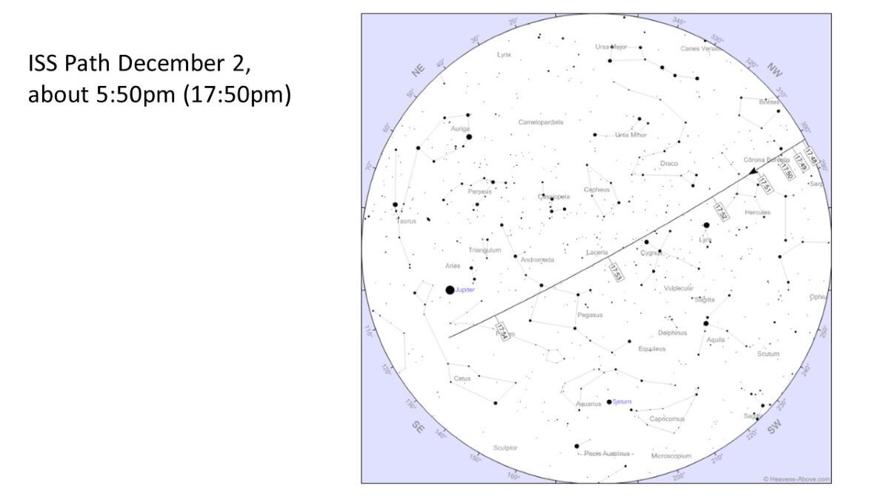
If you have not viewed the International Space Station flying overhead, early December presents a few opportunities. On Dec. 1, 2, 3 and 5 it will pass over us, quite high in our sky. On Dec. 1, at about 5 p.m., the ISS will be in the northern sky, passing between the Big Dipper and Little Dipper. On Dec. 2, it will pass almost directly overhead at about 5:50 p.m. It will be very bright, looking somewhat like a jet plane zooming across the sky, moving from northwest to southeast. On Dec. 3, another bright pass will occur, again with the ISS moving from northwest to southeast, just after 5 p.m.
These are the best sightings, but there will be others as well in early December. Check out the attached screen shot from Heavens-Above for the Dec. 2 pass (note that times are in 24-hour format). You can visit Heavens-Above (Heavens-above.com) for more times in early December. NASA also has a very nice website called “Spot the Space Station” at https://spotthestation.nasa.gov/. You can download their app onto your mobile phone as well.
Saturn and Jupiter are still visible in the night sky, although Saturn is getting pretty low in the west. By the end of the month, Saturn will set shortly after 9 p.m. On Dec. 17, the waxing crescent Moon will be just to the left of Saturn, which should make for a great view. Jupiter still shines high in the southern evening sky. The Moon will be near Jupiter on Dec 21 and 22.
Our December Moon will be new on the 12th, with full Moon following on Dec. 26, right after Christmas. In addition to the mentioned pairing with Jupiter, the Moon will be close to the bright star cluster Pleiades on the evening of Dec. 23. On Christmas Eve, it will form a nice triangle with the Pleiades and the bright star Aldebaran, in the constellation Taurus. If you are an early riser, look for the thin crescent Moon just above the bright star Spica in the southeastern morning sky. Bright Venus will be just below those two.
Venus is again the “morning star” this month, dominating the early morning sky. Our neighbor is slowly moving away from us, and will be slightly lower in the sky each day as the month progresses. Venus will remain in the morning sky for the next few months, then will move “behind” the Sun as we see it late next spring, reappearing in the evening sky next summer.
It is unfortunate that our December skies are usually cloudy (and cold), because one of the best meteor showers occurs this month, the Geminids. The shower peaks on Dec. 13 and 14. This year should be very good, as the Moon will not be up, and skies will be dark. Bundle up and give it a shot if skies are clear!




Commented