
Welcome to November! When I think of November, I am reminded of the Thomas Hood poem of the same name. It goes (in part),
No sun — no moon!
No morn — no noon —
No dawn — no dusk — no proper time of day.
No warmth, no cheerfulness, no healthful ease,
No comfortable feel in any member —
No shade, no shine, no butterflies, no bees,
No fruits, no flowers, no leaves, no birds! —
November!
It comes across as pretty negative. Then again, remember he wrote this in London in 1844, with London fog and smog. Yes, our November skies can be pretty cloudy, but hopefully not this bad!
When skies do clear this month, we will be treated to excellent views of Saturn, the Leonid meteor shower, and a nice conjunction between Jupiter and Mars. Dark skies come early too. Give November a chance when you can!
Magnificent Saturn was closest to Earth last month, on Nov. 4. While the ringed planet is pulling farther away from Earth, it is actually in a better position for evening viewing, as it will be higher in the sky during evening hours. Saturn will be pretty much due south during November, underneath the “great square” of Pegasus. It will be hard to miss, much brighter than nearby stars in the southern sky.
November’s new Moon comes on the 9th, with full Moon following on the 24th. On the 20th, the waxing gibbous Moon will lie right above Saturn. On the 16th and 17th, the crescent Moon will lie in the constellations Capricornus and Aquarius, a good time to locate these dim constellations.
On the 23rd, the almost full Moon will past next to the bright star cluster Pleiades, although the bright moonlight will make it harder to make out the cluster’s stars (a pair of binoculars will help). If you are an early riser, the crescent Moon will lie just to the right of the planet Mars on the morning of Nov. 2.
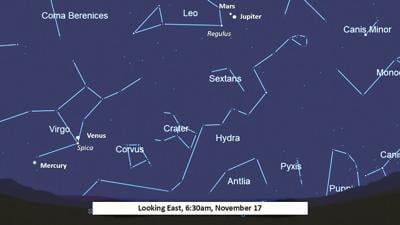
Our other bright planets, Venus, Jupiter, Mars, and Mercury, are in the morning sky. Look for Venus as the “morning star,” low in the east before sunrise. Venus will lie very close to the bright star Spica, in the constellation Virgo. Spica is the 15th brightest star in our night sky, and the comparison will give you a good idea of just how bright Venus shines.
In mid-month, look below and to the left from Venus, and you will find Mercury. Mercury should appear slightly brighter than Spica. Look a bit higher in that mid-November morning sky, and you will find Jupiter and Mars close to each other, in the constellation Leo. On the morning of the 16th, they will be the closest, with Mars located just above Jupiter. They will be about 1 degree apart (the full Moon is about ½ degree in diameter) and should present a great view in binoculars. Just to their left will be Regulus, the 21st brightest star in the night sky.
The famous Leonid meteor shower peaks on the night of Nov. 17. The first-quarter Moon will brighten the evening sky, and will set at around 11 p.m. Early morning hours will be the best time to view the Leonids, with the Moon out of the sky.
•••
Brave the chills and enjoy November’s night skies!


Commented