THE GORGE — On Aug. 28, Washington’s Department of Fish and Wildlife (WDFW) hosted the first of several public meetings to obtain community input on its State Wildlife Action Plan (SWAP), a comprehensive strategy to conserve fish, wildlife and habitat that’s updated every 10 years.
The United States Fish and Wildlife Service established the State Wildlife Grant Program back in 2000, and in order to receive these grants, each state has to develop a SWAP. The first plans came about in 2005, then in 2015. Washington’s and Oregon’s next SWAP is due on Oct. 1, 2025.
“Despite the name, these plans are not just for wildlife,” said Wendy Connally, WDFW’s SWAP coordinator. “Fish, wildlife, plants, habitats, ecosystems and landscapes are conservation targets for these plans.”
Each plan has multiple required elements. They must identify the Species of Greatest Conservation Need (SGCN), the habitats and systems they depend on, key threats to their survival and conservation actions. SWAPs must also monitor the identified species and the effectiveness of conservation actions; coordinate with relevant federal, state, local and tribal agencies; and provide space for robust public participation in the development process.
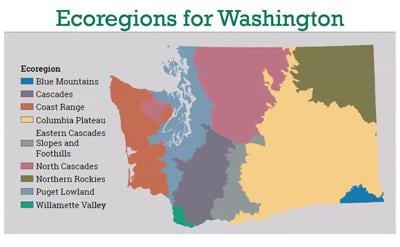
Connally explained several changes to Washington’s upcoming SWAP that would take a more holistic approach to conservation. While previous SWAPs have fixated on SGCN, the new plan will look at entire ecosystems and multi-species groups, like pollinators and migratory birds, as conservation targets. Organized by Washington’s nine ecoregions, the plan will offer an interconnected view of Washington’s environment, and also include things like education, outreach and enforcement, unlike the previous version.
“Washington State has a broad and deep pool of people who are interested in biodiversity and conservation at home and in wild places, so we want the plan to welcome and inspire all of those who want to roll up their sleeves and do meaningful and effective conservation work with us,” said Connally.
Oregon’s Department of Fish and Wildlife (ODFW) has also begun revising its SWAP, called the Oregon Conservation Strategy (OCS), but has not yet accepted public input. This summer, though, the agency collected staff feedback and aims to have draft chapters completed by fall 2024 and a complete draft finished by spring 2025.
“At this point, we will initiate an extensive review and outreach process. We anticipate offering multiple opportunities for input, including hosting public webinars and workshops,” said Carolyn Eckrich, the OCS revision coordinator for ODFW. Regarding changes, the new OCS will include an updated list of strategy species, key conservation issues and recommended conservation actions.
For those in Washington who want to participate, visit WDFW’s website (wdfw.wa.gov/species-habitats/at-risk/swap) for information on public meetings. On Sept. 20, there will also be a survey for people to comment and ask questions about Washington’s SWAP, available through the same website.



Commented