
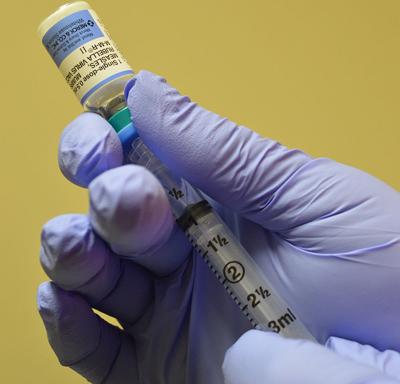
The state of Oregon has the highest percentage in the U.S. of people seeking non-medical exemptions for childhood vaccinations and new data shows that some schools in Hood River County are above that already high state average.
A report released last week by The Oregonian of compiled data from the Oregon Health Authority shows Oregon’s rate of non-medical childhood vaccine exemptions — sometimes referred to as personal or philosophical belief exemptions — was 7.1 percent as of the 2013-14 school year. The Oregonian’s study only included both public and private schools and child care facilities that enrolled 50 or more students, which still amounted to more than 1,700 institutions.
At Hood River Middle School, the non-medical exemption rate is just under the state average at 6.5 percent. But at May Street Elementary, the opt-out rate is 8.6 percent. At Horizon Christian School, it’s 12.9 percent. And at Bright Beginnings, a preschool and kindergarten childcare facility located on State Street in Hood River, the non-medical exemption rate is 23.1 percent, which would put it as the 54th-highest non-medical exemption rate in the state.
Oregon is one of 18 states that allow philosophic exemptions, according to the Centers for Disease Control, with more still allowing for religious exemptions, which Oregon also allows. The OHA requires parents seeking a non-medical exemption submit a “Vaccine Education Certificate” to their child’s school, which is obtained by either receiving education from a healthcare provider or by completing a module on the OHA’s website and then printing out the certificate at home. However, currently there is a bill in the state legislature that could remove those philosophical exemptions in an attempt to increase vaccine rates.
According to Ellen Larsen, director of the Hood River County Health Department, the county’s current non-medical opt-out rate is at 5 percent. The number is important due to a key concept in disease control known as “herd immunity.” Herd immunity is the idea that when enough people in a population are vaccinated against a disease, it prevents the disease from spreading as quickly, and helps ensure that a potential outbreak is contained.
Herd immunity is especially important for those who can’t get vaccines for medical reasons, including pregnant women, children under the age of 1, people who have allergic reactions to vaccines, and those who have compromised immune systems, explained Larsen. Without others getting vaccinations, those who can’t get vaccines due to medical reasons run the risk of getting sick — or worse.
Larsen said the percentage of immunizations must be 95 percent for successful herd immunity to be achieved. With an opt-out rate of 5 percent, the county is right on the cusp, with some schools — such as Horizon, May Street, and Hood River Middle School — falling below the threshold needed for herd immunity.
Ken Block, superintendent for Horizon Christian School, was asked if he knew why the rate for Horizon Christian School was higher compared to other grade schools in the county.
“No — anything I would say is a pure guess,” he said. “I would be stretching it to guess.”
Block said he had not seen the OHA numbers and was caught off-guard by the 13-percent rate of non-medical exemptions at Horizon.
“That seems really high to me,” he said. “I’m surprised.”
At Hood River County School District, the opt-out numbers were also alarming to Superintendent Dan Goldman, who like Block, had not seen the report.
“Yeah, I’m concerned about it,” he said. “Wherever we have higher risk for major illness or safety issues, we take that very seriously.”
Goldman, who said that his daughter had attended Bright Beginnings, hypothesized that May Street’s district-high opt-out rate of 8.6 percent was at least partly due to the high opt-out numbers at Bright Beginnings, noting that “a big percentage of those kids continue on to May Street.”
A call was placed to Bright Beginnings Thursday morning to answer questions about their opt-out rate, but was not returned as of press time.
Goldman was not certain as to why the schools had the opt-out rates that they did, but offered that “it looks like we have not done an effective job of promoting the effectiveness of vaccines.” He did note, however, that in areas outside of Hood River, the non-medical exemption rates were up to two to three times lower. Parkdale Elementary (4.2 percent), Wyeast Middle (2.7 percent), and Mid Valley Elementary (under 2 percent) all had rates that fell within the herd immunity targets. However, Hood River Valley High School (4 percent) and Westside Elementary (under 2 percent) also fell below the 5 percent number.
Goldman hypothesized the decision to not vaccinate was a “first world problem,” and that “it would seem the higher income bracket is making their own healthcare choices.” He suggested that the higher poverty levels in the upper and mid valley may actually be contributing to greater vaccination rates.
“The families often receive Medicaid and OHP (Oregon Health Plan) and there’s a lot of outreach into those communities from social services agencies and you generally get a lot of touch there,” he explained.
Larsen was asked if the county health department actively conducted vaccination campaigns in the community.
“We are always here to provide information, but we don’t go out and conduct campaigns,” she replied.
According to the data from the OHA as presented by The Oregonian, there are some cases that demonstrate the relationship between economics and vaccination rates. At May Street and Hood River Middle, the percentage of “economically disadvantaged” students is listed at 47 percent. At the Hood River Valley High and at Wyeast Middle, the percentage is 56 and 71, respectively. Westside was at 49 percent, and no percentages were listed for Bright Beginnings or Horizon Christian.
Despite the increase in non-medical exemptions in the state — rising from a low of 2.1 percent during the 2001-02 school year — Larsen said the county’s numbers have actually decreased, noting that the number of warning letters the health department has sent to parents who had not turned in vaccination information this year was 138, as compared to last year’s number, which Trish Elliott, the county’s public health nurse supervisor, said was 200. The deadline for parents to supply information on their child’s vaccine status is Feb. 18.
Despite the decreases, Larsen said she would still like to see the vaccination rate closer to 97 or 98 percent. When asked why she thought people weren’t vaccinating, Larsen said that “there are just people who have fears for their children.” She also suggested some of those fears may be attributed to “a very erroneous, negligent study that has been totally discredited” linking vaccines to autism.
Block also felt that concerns over vaccines could be on the minds of Horizon parents, although he did not indicate that the number was concerning to him.
“We’ll evaluate that and consider whether we would encourage our families to get inoculated,” he said. “I’m a little bit conflicted — I don’t know, because I think some people think it’s a risk to get vaccinations.”
Goldman also planned to look into the numbers, and adamantly encouraged parents to have their children vaccinated. “I would say that we would urge all families to get their children vaccinated and that we support the best research to date which indicates that are there are no discernible side effects and that the benefits far outweigh the risks,” he said.


Commented