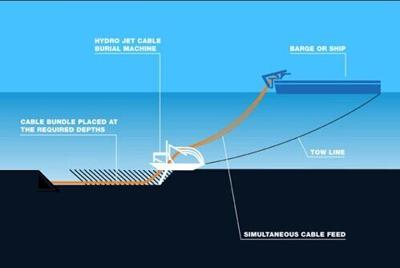
A barge or ship and towed submarine system will be used to lay a power under sediment at the bottom of the Columbia River between The Dalles and Vancouver.
A barge or ship and towed submarine system will be used to lay a power under sediment at the bottom of the Columbia River between The Dalles and Vancouver.
Initial plans for the Cascade Renewable Transmission Project were discussed at the most recent Hood River County Board of Commissioners meeting on Feb. 21. The project was introduced by representatives from PowerBridge, LLC, the acting project developer. Chris Hocker, vice president of planning, Susan Brown, project coordinator, and Carol Loughlin, a senior consultant at Lakeridge Resources, teamed up to present a relatively detailed overview of the project, explaining their goals, strategy, and preliminary siting routes for the energy transmission line.
The Cascade Renewable Transmission Project entails installing an underground and underwater 1100 megawatt HVDC transmission line from The Dalles to the greater Portland area, which involves roughly 100 miles of transmission cable. Delivering cost-effective renewable energy from east of the Cascade Mountains to the west of the Cascades via this “proven noninvasive technique” will help Oregon and Washington approach new renewable energy mandates set for 2030, though it will only resolve about 20% of the energy deficit. PowerBridge explains this method will “bridge the Cascade Mountains while minimizing environmental and visual impact.”
The company has teamed up with the Community Renewable Energy Association (CREA) to apply for U.S. Department of Energy funding worth several hundred million dollars. This funding would help cover a significant percentage of the total cost to benefit ratepayers. The transmission line can carry 1100 megawatts of power, which is the maximum capacity for the size of transmission line being used: Two cables less than six inches in diameter bundled together with a fiberoptic cable. It is proposed to run from a substation near the BPA Big Eddy bus station in The Dalles, under the Columbia River, to Hayden Island and run approximately 5 miles underground to an AC/DC conversion and storage station in the Port of Portland Rivergate Industrial District.
Each substation is a standard five acre parcel with compact setup that meets seismic regulations.
The underwater installation process will take place primarily in the middle of the Columbia River, as far from waterfront areas as possible. Using a CRT submarine, barge, and support tug, installation will occur in the winter months to avoid fish spawning seasons. The barge uses a crane to dispense cable down into the river while the submarine uses a blade to dig an 18-inch trench in the riverbed sediment, simultaneously laying the cable and letting the sediment settle back on top. The barge moves very slowly, laying approximately 1.5 miles of cable per 24 hours of work, and the cable will eventually settle 10-12 feet under the riverbed sediment helping to protect it from anchor strikes and other potential collisions.
The line will take a detour of roughly 7 miles underground through Washington in order to avoid the Bonneville Dam’s complex geology and sensitive fishing areas. Further research by state siters and the Army Corps of Engineers, among others agencies, is still required to conduct cultural and environmental studies on how the energy line will effect local residents and their current energy use.
There are roughly 150 projects in the world like this one, four of which are in the United States. Two of those projects were completed and are currently maintained by PowerBridge. According to their website, the Neptune Regional Transmission System was completed in 2007 and the Hudson Transmission Project was completed in 2013: “Both are underwater cable projects that were completed on budget and ahead of schedule.”
The Neptune Project is a 660 megawatt HVDC cable that covers a 65-mile stretch between the First Energy Stadium in Sayreville, N.J., and a substation in Levittown, Long Island. The Hudson Project, a 660 megawatt electric transmission link, delivers additional electric power to New York City residents and provides the city “with access to renewable resources … and includes very significant upgrades and reinforcements to the transmission system in New Jersey.”
Some concerns about the project were raised by the county commissioners, such as repairability and possible harm from electromagnetic fields. Hocker reassured the board that previous studies on this type of cable show EMFs to be minimal. He explained that not only does the cable itself not emit EMFs, but aquatic life such as Chinook salmon are not particularly sensitive to EMF radiation the way some species, like rays and sharks, are. Additionally, Hocker stated that the deep layer of riverbed sediment acts as a barrier for most potential damages. In the case that the cable does need mending or renovating, PowerBridge has the experience necessary to make repairs. The cable is lain in sections so it is already spliced, making the repair process even more simplified. According to a study published in 2021 by Frontiers, a peer-reviewed research journal, “External aggression remains the primary cause of faults [in HDVC underwater cable lines], such as fishing and anchors. Most faults continue to occur at a shallow depth (300 m) … Insulation breakdown is the leading reason for the short fault.” The study also explains other possible causes of insulation breakdown in underwater transmission lines, including “extensive voids, water treeing, mechanical stress, partial discharge, overheating, and electrochemical erosion.” Marine conditions can also complicate cable installation or failures.
Due to public policy decarbonization requirements, both Oregon and Washington have a significant energy deficit to adjust by 2030. Plans to retire fossil power plants and a push for electric energy and better infrastructure, like EVs and charging stations, are already making a dent in the use of gas versus electric per household in the county. Portland General Electric and Puget Sound Electric have quoted more than 3300 MW per company to be replaced with renewable energy in their portfolios by 2030, and cost-efficient renewable energy is scarce on the west side of the Cascades.
This line will allow future energy updates to be more manageable, as it will provide some power usage while other renewable energy replacements are installed. Though it might not be a favorable option to many, the alternatives for achieving renewable energy requirements are often less desirable and more complicated. Waiting until the deadline to address these state mandates will be too late, and options such as building above ground introduces issues of visual impact, fire risk, multifaceted environmental effects (involving trees, birds, and more), and maneuvering through mountainous terrain just to name a few liabilities.
Jurisdiction in Hood River County and along the Columbia River is still to be established, and dates have yet to be set for the beginning of this project.



Commented