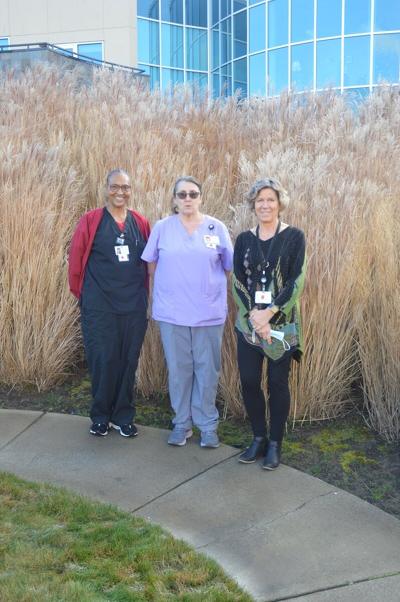
Pictured from right, Cheri Viltz, Janice Wilson and Melodi Johnson stand outside of MCMC’s Celilo Cancer Center, having briefly removed their masks for a photo.
Pictured from right, Cheri Viltz, Janice Wilson and Melodi Johnson stand outside of MCMC’s Celilo Cancer Center, having briefly removed their masks for a photo.
Alana Lackner photo
As of August 2021, Mid-Columbia Medical Center has three employees that have worked at the hospital for 40 years.
Melodi Johnson, oncology nurse navigator, started at MCMC on June 1, 1981, after moving to the Gorge from Spokane, where she had worked at Deaconess Hospital as a student and then graduate nurse. Following her graduation from Washington State University in January of 1981, she began searching for a job near Hood River. She applied to MCMC and the rest is history.
Though she’s been at MCMC for 40 years, Johnson said the job has never gotten old or become boring.
“I’ve worked in a lot of different areas while I’ve been here, so it hasn’t felt like the same job,” Johnson said. “And of course, with all the changes and transitions, it isn’t like the same place either.”
Johnson said it’s been incredible to watch the hospital expand and grow throughout her employment and that when she looks back, it’s incredible to see the progress that’s been made.
Because Johnson works at the Celilo Cancer Center, she’s been subject to even more changes. In fact, she said she remembers when the building was initially built.
Working at Celilo has been a huge part of Johnson’s life and has been something she’s been proud to be a part of, she said. One of her favorite things about the center has been the emphasis on the Planetree model, which focuses on a patient as an entire individual, focusing on not just their physical needs but their emotional, intellectual and spiritual needs as well. Though the Planetree model has been less prominent in recent years, Johnson said the staff is working to reintegrate it.
“I’ve always been really proud to work at Celilo because of what we offer that was so different than my counterparts in Portland,” Johnson said. “They were so surprised. We have massage therapists here. And we believed in integrative medicine, and we’d let the patient decide some things. And we’re trying to pull back to that.”
Like Johnson, Cheri Viltz also started her MCMC career in June of 1981, though for her it was toward the end of the month. Having gotten a bachelor’s degree in x-ray at the Oregon Institute of Technology, Viltz began working doing exactly that.
However, it wasn’t long before she was cross-trained in nuclear medicine. Then, she said, when the hospital got a CT scanner, she was trained in that too. At this point, Viltz said she can operate most everything within diagnostic imaging, with the exception of MRI.
“I have done and have certifications in most everything (in diagnostics) except for MRI because they didn’t want me to do that because I was too busy. They said, ‘No, don’t do more. You don’t want to do more.’”
Similarly to Johnson, Viltz has seen a ton of changes to her part of the hospital, especially as far as technology goes. Diagnostic imaging now has access to more machines than before, and some of the technology has changed and evolved through the year. Of course, the changes don’t stop at just technological ones. Even their hours have changed a lot, she said.
“We were actually the department that closed at four o’clock, and anything after four o’clock was on call, which is crazy,” Viltz said.
Viltz said they’re now open 24/7, having added a swing shift and a graveyard shift over the years. She also said the number of patients they see has gone up exponentially as well.
“We did mammography when I first got here, but we did like three patients a day. Now we’re doing 20 a day,” Viltz said. “It’s amazing.”
Janice Wilson also started at MCMC in 1981, in August. She was a teenager at the time, she said, doing housekeeping. Later, she was moved to linen services and then, as recently as just a few years ago, supply chain.
Early on in her career at the hospital, Wilson said she was a single parent trying to take care of and provide for her children. One of the things she really appreciated at the time was how supportive MCMC was when it came to her schedule.
“It worked good for me,” Wilson said. “The hospital was really flexible with me being a single parent and working here.”
Being in linens, Wilson often finds herself getting her daily steps in, as she’s often all around the various facilities making sure everything is taken care of. She is incredibly familiar with all the different buildings, but has also had the unique opportunity to watch everything change with a bit of a bird’s eye view.
Unlike Johnson and Viltz, Wilson doesn’t work in one specific physical area, which has allowed her to see the bigger picture of change in the hospital.
One thing that Wilson pointed out as a big shift for MCMC was the addition of various new departments and sections.
“We originally were a big bed hospital, big bed,” Wilson said. “Then went to downsizing it to where they added in the different departments: Our rehab, our GI, our same-day. Lots of additional departments to make the hospital better serve the community and all the patients’ needs and stuff.”
Additionally, the hospital itself has fewer beds than it once did, Wilson said.
“A lot of the rooms now that are offices and this or that were patient rooms,” she said. “You hear 30 count and you think ‘Whoa, it’s busy,’ but no, busy would have been 100 count.”
All three employees have experienced a lot of different crises in their four decades at MCMC. Even before the COVID-19 pandemic, the hospital has weathered its fair share of emergencies.
For example, in 1984, members of the Rajneeshee cult poisoned the salad bars at 10 local restaurants with Salmonella bacteria. Around 750 people fell sick as a result, and 45 were hospitalized, though no one died.
The salmonella poisoning meant even more patients than usual and there were even beds lining the hallway, Wilson said. Johnson worked in the OB at the time, and said they saw the effects even there.
“We had people who had such bad diarrhea that it would push them into labor,” she said.
The community really felt the effects afterward as well. Viltz said it took years for any of them to be comfortable wearing red again, as it had been the color of the Rajneeshee.
“It was my favorite color too,” she said.
Now, in the COVID-19 pandemic, a lot of things are different. This is definitely the biggest emergency they’ve seen, but having been at the hospital for as long as they have and been through all the things they’ve been through, they find themselves better equipped.
One thing Johnson said she’s noticed is that she sees other team members looking up to her and asking her questions, when she remembers being that person not that long ago.
“When we started, we always looked up to those people who had done their jobs for a while, or you always wanted to learn something new from them, like, ‘Oh my gosh, I can’t believe they know how to do this, this and this,” Johnson said. “And I’ve realized I’m that person now.”
Viltz seconded that feeling. “It’s kind of weird to be on this end of the spectrum because I was the one that was asking all the questions previously,” she said.
All three women agreed that though they don’t feel like they’ve been there for 40 years, they’re all glad they have been and they’re proud of where they work.
“It’s great to be a part of the team here,” Johnson said. “I really am so grateful for that.”



Commented