
THE DALLES — The Dalles City Council convened for its regular meeting on June 9, with a packed agenda that ranged from the annual tourism report to passing the fiscal year 2025–26 budget, street vacations, and updating the city’s fee schedule.
Chamber reports on tourism spending
The Dalles Area Chamber of Commerce CEO Lisa Farquharson delivered an annual report for their tourism contract, which was just renewed last month following a competitive bidding process.
Farquharson emphasized that the chamber has shifted its strategy to prioritize increased visitor spending, explaining, “If we can have a more impactful visitor, we have a smaller footprint, but a better ROI on our investment.”
To that end, she highlighted three core campaigns:
- New television partnership. A partnership with KATU yielded 272,000 impressions from “nine different businesses in The Dalles, helping them to tell their story and doing that story brand,” achieved with a $12,500 investment—well below the $20,000–$25,000 initial outlay required in the prior year.
- Targeted regions. By using various formats, including animated GIF ads, around targeted geofences in Portland, Seattle, Tri-Cities and beyond, the chamber received 30,000 impressions in approximately one month. “With an investment of $5,000 we were able to return to our community an investment of $7.2 million from our tourism visitors,” Farquharson said.
- Tracking visitors and spending. Through Datafy’s analytics, the Chamber logged 292,753 verified visitors from July through April, an increase of 18,240 over the same period last year, which corresponded to an additional $4,722,000 in estimated spending—bringing total visitor spending to $75,848,027 for the period, according to a formula provided by Travel Oregon.
Farquharson closed with a nod to grass-roots outreach, noting that the Chamber still welcomed “2,800 walk-in visitors” to its downtown lobby, distributed “over 8,000 brochures and maps,” and fielded domestic walk-ins primarily from Oregon, Washington, California, Idaho and Arizona—and, internationally, from Canada, the U.K. and Fiji.
She pointed to ongoing programs such as the charm trail’s wooden token wall, rider welcome bags for Ride The Gorge, and familiarization tours for travel writers and influencers. Farquharson shared that her favorite influencer campaign was paid for by Travel Oregon and partnered with wheelchair user and advocate Cory Lee, who assessed nine businesses in The Dalles for their accessibility.
In a discussion of contract oversight, Councilor Runyon proposed quarterly reports, saying, “I, for one, would like to see a quarterly report of a shorter duration of what has happened for that period of time,” to which City Manager Matthew Klebes replied that the contract only required an annual report typically around this time of year, with the option to request quarterly reports.
Finally, on the hiring of a new tourism director, Farquharson announced the job listing went live on WorkSource the same day as the meeting.
Public comment: surveillance concerns and ICE
During the audience participation portion of the meeting, several speakers brought forward topics touching on national, hot-button issues.
Business owner Tim Schechtel shared concerns about license-plate-reading systems marketed by Flock Safety, an Atlanta-based company specializing in surveillance cameras that can integrate with police systems and predictive policing programs like Palantir. A lawsuit set to try this October against the city of Norfolk, Virginia alleges that Flock Safety’s cameras constitute a search without a warrant, violating the fourth amendment.
Schechtel noted Skamania County installed a similar system “without public comment,” and urged The Dalles to “exercise caution … have that public discussion before any decision is made.”
Klebes responded that the police department had indeed met with Flock representatives but “there was no intent to move forward with such a program”—an assurance greeted with applause.
Another commenter, Chip Wood, spoke about his alarm over the ICE raids, expressing fear that agricultural workers in the Columbia Gorge could face “wide sweeps” without due process.
“I can imagine a whole crop of cherries rotten on the trees,” he said.
Wood’s plea, “If we have peaceful protesters trying to protest ICE’s presence here will our local officials have our backs?” went unanswered before the council moved on.
City passes annual budget
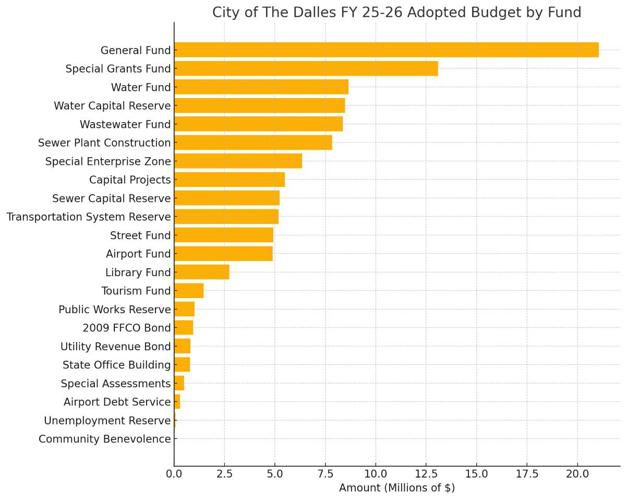
Next, the council heard testimony on the $111,484,869 budget for financial year 2025–26.
The most structural changes are the debut of two dedicated funds, the Tourism Promotion Fund and Special Enterprise Reserve Fund, and two new departments.
“We established a new Tourism Promotion Fund after the council passed some changes to our transient lodging tax,” Klebes said at the budget meeting May 4, noting that 55% of lodging-tax receipts will stay in that fund while the balance shifts to the general fund.
Departmentally, the city now has a standalone IT department and a centralized facilities services unit, moving technology and maintenance costs out of individual programs and into shared services.

Using re-channeled Transient Lodging Tax dollars, the council budget now earmarks $649,988 for nonprofit contracts, including $465,000 in tourism promotion with The Dalles Area Chamber of Commerce, $25,000 for The Dalles Main Street. $10,000 is going to the Columbia Gorge Discovery Center, allocating $6,000 for its digital archives project.
Northern Wasco County Parks & Rec are no longer receiving $335,000 directly from the Transient Lodging Tax, but instead are getting $145,000 from the General Fund, a new Intergovernmental Funding Agreement with Wasco County contributing $40,000 toward water expenses. $19,000 is going toward new fencing at Kramer Field.
The roughly $13 million in the Special Grants Fund this year is going to the 1st Street river front connection ($6.8 million) and the Federal Street Plaza project ($4.9 million) among other projects.
A newly minted Special Enterprise Zone Fund will hold enterprise-zone and Strategic Investment Program (SIP) dollars tied to Google’s data-center expansion with the plan to spend 6.3 million on various contractual services this year.
Nearly $5.5 million is stockpiled for the Capital Projects Fund, which this year includes building maintenance work at City Hall, the police station and the library. The library HVAC replacement is budgeted at $423,050, with elevator and roof work programmed next.
For the full, detailed annual budget, visit the city of The Dalles website here.
During the June 9 meeting, community member Amy Kroll of West 12th Street asked, “Why is the police budget the top receiver of the funds?”
Klebes noted that a significant portion funded the new CAD/RMS dispatch and records system shared with Wasco County and Mid-Columbia Fire and Rescue, and that public safety budgets routinely represent the largest general-fund allocation. The Dalles Police Department receives $7.2 million in the newly-passed budget.
Kroll responded, “Where we spend our money reflects our values.”
Without any further public comment, the city passed the budget, maintaining last year’s tax rate at $3.0155 per $1,000 of assessed value.
Easement allocates space for Federal Street Plaza
The council then considered vacating portions of Federal Street between East 1st and East 2nd Streets to create the long-planned Federal Street Plaza, a high-priority project for the city.
Community Development Director Joshua Chandler explained that, under ORS 271.110 and TDMC 11.16, no abutting property owners had objected and the Columbia Gateway Urban Renewal Agency, the private owner of this property, and the city itself would dedicate their portions of the vacated right-of-way to allocate public ownership for the plaza.
Chandler noted that existing public and franchise utility lines would be preserved through recorded easements.
Similarly, the council voted to vacate a dead-end segment of right-of-way near Columbia Road and Steelhead Way, entirely enclosed by Google’s data-center campus, to allow an on-site turnaround and gate for truck traffic.
Chandler noted 92% of affected owners supported the vacation, which would consolidate the campus footprint and stop trucks from clogging public streets.


Commented