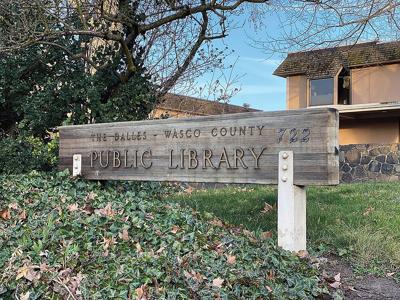
THE DALLES — Tensions spiked at a Wasco County Board of Commissioners meeting on May 1 when City Manager Matthew Klebes clashed with the Wasco County Library Board over who’s going to foot the bill for certain costs and improvements at The Dalles Library.
“It’s easy when there are clear boundaries between one entity and another,” opined Commissioner Phil Brady, “but in this case, the city owns the building, the library district does the work there, and the employees are city employees. To put boundaries on something that has so many convolutions is going to be a challenging task.”
Underscoring this complex dynamic, Library Board President Tina Coleman brought the newest proposed intergovernmental agreement (IGA) before the commissioners with concerns about dividing the costs for capital improvements. The board also wanted more clarity around the city’s annual administrative fees and more say in the library’s hours.
“We’re a little bit concerned that 50% is covered by the library district funds even though the building is a city building,” Coleman said.
In past iterations of this IGA, any repairs or improvements more than $10,000 were labeled as capital expenses and paid for by the city. Anything under $10,000 was viewed as maintenance and paid for by Library Services.
“I don’t think a 50/50 agreement makes sense,” Brady said. “The city has a lot of public trust and a lot of goodwill — and the library has more. People love our libraries, and there are some very adamant ones. I want to make sure that this is an agreement that I think could pass the court of public opinion, as well as the legal counsel.”
Klebes emphasized that he wants to approach these negotiations like a partnership and split costs down the middle. He said most instances where one entity owns a building and another operates services would be considered a landlord/tenant relationship, but he doesn’t want that dynamic for this agreement.
“There are some significant needs at the library,” he said, “First and foremost the H-Vac system is very high on the list.”
For an approximately $500,000 H-Vac system replacement, both the city and Library Services have put aside $10,000 a year for the last three years.
Klebes said the cost sharing makes sense, given changes in the city’s facility services department, which includes a new position and additional development within the facility services program to serve both the library and other public works.
He explained, “The facilities department also provides services to The Dalles library as well. Everything from mowing the lawn to landscaping, to changing out light bulbs, unclogging toilets, the whole spectrum of things.”
To Klebes, these services are an example of how the city is involved in both the library’s maintenance spending and capital spending, but for the library board, the line items in the city’s administrative fee have been difficult to predict.
Library Board Vice Chair Mary Beechler added the administrative fee “has no boundaries on it.”
The commissioners probed Klebes for how administrative services are billed, getting granular with the time the city council spends on library contracts and city employee’s time.
Klebes listed his own time working with the library board on the IGA as a line item, as well as any time the library has come before The Dalles City Council.
Coleman said, “The library came before the city council one time with one agenda item and our bill for that was $3,500, or something very close to that.”
Commission Chair Steve Kramer asked the city and library board to go back into meetings to add more specificity in the IGA, but Klebes pressed the commissioners to explain how the current division of cost and expenses could be more clearly stated.
Brady encouraged Klebes to view the negotiations from the perspective of the library and put more limits on the city’s methodology for their charges.
“I don’t think the community will think badly of the city if the city is overly generous to the library,” Brady said.
Klebes defended his position, saying the city has already achieved a level of generosity toward the library by agreeing not to charge legal services unless they are used.
Hege interrupted, asking Coleman to weigh in.
“We have a verbal, informal agreement that we won’t be charged for legal services this year if we don’t use them, we’ll only be charged for what we use. But that is not an agreement written into our IGA,” she replied. “What happens next year?”
Coleman said this is the crux of the library board’s concern: That what the Library Services District will and will not be charged and how much isn’t specifically mentioned in their agreement, resulting in unpredictable charges from the city.
“We could make it very clear why every department provides services and those costs, and we’ll just keep it straight that way, and not have those kinds of verbal agreements in the spirit of partnership,” Klebes said. He suggested that the city could take a “very strict” approach and charge for every potential service down the board using the averages developed by his methodology.
“In my mind, that sounded like a threat,” Coleman said.
Commissioner Kramer quickly adjourned the session.



Commented