
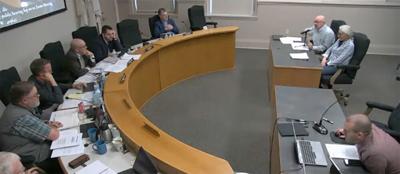
THE DALLES — In a marathon-like, nearly-four-hour meeting on May 12, The Dalles City Council considered an appeal from the Neighborhood Association for Responsible Development, addressing concerns related to the proposed subdivision on Smith Ridge.
After extensive discussion involving residents, the developer, and city staff, the council ultimately denied the appeal and upheld the subdivision’s original approval.
The proposed subdivision, spearheaded by developer Jason Alford, involves constructing a two-phase, single-family residential development atop the steep slopes of Smith Ridge. The neighborhood association and local residents expressed significant apprehensions regarding safety risks, particularly focusing on potential landslide hazards and inadequate road access during extreme weather and wildfires.
Ted Valkov, representing the Neighborhood Association for Responsible Development, made an impassioned appeal that the council not approve the current plan, but take the process more slowly, asking the developer to reconfigure several design elements. Valkov argued for a different design, and added geological studies would make the development safer.
Community Development Director Josh Chandler explained that because this project had already used up its timeline extensions, Oregon law requires that the council provide a final determination on May 12, or schedule a special hearing within the week after to make the legal deadline.
Concerns of a slippery slope
Residents attending the meeting provided firsthand accounts of erosion and instability in the area, emphasizing concerns over planned extensive earthworks required to construct a loop road and multiple home sites overlooking the nearby hospital. Many feared these construction activities could exacerbate already precarious conditions.
“Smith Ridge itself looks like a hill, but in fact, it’s classified as a head scarp. It means that’s actually the exposed face of a fault from the previous landslide,” Valkov said, citing a 2023 DOGAMI report from the Oregon Department of Geology and Mineralogy.
The residents also raised concerns about traffic safety due to the subdivision’s reliance on a steep, single-access road. Multiple community members shared personal experiences about winter conditions as well as potential risks in the event of a wildfire, asserting that increasing residential density would amplify these hazards.
“One of my neighbor’s little granddaughter drives her little pink ladybug Volkswagen just around the corner. You don’t see her,” Valkov said. “The worst is in the winter. You simply cannot drive there. I have a four wheel drive car with studded tires; it’s pretty heavy, and I’m scared out of my wits when I have to drive down the hill,” said Valkov. He went on to describe a situation where he nearly hit his neighbor on an icy day.
The neighborhood association proposed an alternative design featuring short cul-de-sacs extending directly from East 21st Street, arguing this would significantly reduce the scale of required earthworks and lessen the landslide risk.
Too steep for new housing?
City Council members engaged city staff extensively during the session to determine the validity and severity of the residents’ concerns. Chandler addressed questions on the city’s approach to geological issues, explaining that geological stability is typically managed individually during lot-by-lot construction.
“The site is not located in any of the city’s mapped geologic hazard zones, per the 2010 geologic hazard studies survey under city code,” he said. “A geo study is only required of a development if it is located in one of those five zones. Although there are some slopes here that exceed 25%, steep slopes are regulated. They are not prohibited from being developed on.”
Public Works Director Dale McCabe provided insights into traffic and infrastructure concerns raised by residents. He confirmed that the traffic studies commissioned for the subdivision met all regulatory standards and guidelines. He noted that the site plan allowed for a 15% grade road: an exception to the city’s required 12% maximum grade because E. 21st is at 16% grade.
“We have quite a few streets around town that exceed that 12% threshold,” he said.
Developer Jason Alford also addressed council members directly, emphasizing his project’s compliance with existing regulations.
“We feel that we meet all of the city requirements with the conditions that have been imposed upon us,” Alford said. “When you think about [it], all these soils are relatively uniform throughout this area. You have a major hospital built on this material. You have the oncology center built on this material. You have city infrastructure, [a] water reservoir and pipeline built within this area, nothing’s moved. There’s no hazards. It’s not falling apart, it’s not collapsing. It’s not falling down.”
What about the housing crisis?
During the public comment period, resident Mary Hanlon of Hanlon Development came to the microphone with a point on many would-be-homeowners’ minds.
“I would just like to say that The Dalles has an extremely severe housing crisis, and every housing project that I’ve been made aware of is fought. People fight it.”
Hanlon said that The Dalles currently has a 1.5% vacancy rate and 15% housing growth, but has experienced 35% population growth between 2020 and 2023. Hanlon also serves on the Port of the Dalles Commission as secretary/treasurer.
“The Dalles is growing faster than 68% of similarly sized cities, and it is not keeping up with housing,” she said. “From 2016, the average housing price was $180,000, and in 2024, the peak was $530,000. During that period, only eight housing units were added to The Dalles housing supply.”
During his rebuttal period, Valkov addressed Hanlon’s concern by noting the proposed Smith Ridge development involves dwellings slated for the $500,000-$600,000 range.
“This development is really not going to do anything about the housing shortage in town. In fact, it’s going to make it worse, because the people who need homes in The Dalles are teachers, firefighters and so forth,” Valkov said. “These homes [are] not homes for working people. In fact, they displace homes for working people.”
Alford responded to this point during his rebuttal, arguing that supplying higher-end homes can potentially free up the more affordable dwellings for potential homeowners looking in a lower price bracket.
“If you look at the houses that exist within the development, they’re built to take advantage of the views and to fit the sites that they are on. None of them are the same,” Alford said. “They’re all unique to the piece of property. While that might tend to indicate a higher price point, maybe those people that are buying those lots are currently living in an existing $300,000 house within the city, but there’s no 500 or $600,000 house available. When these lots become available, they move up, and then those empty homes can now be back-filled.”
Councilors opt to deny appeal
Council members weighed both the residents’ concerns and the assurances offered by city staff and the developer.
Before the vote, Councilors Dan Richardson and Ben Wring carefully questioned Chris Grant of Mid-Columbia Fire and Rescue, McCabe, and Chandler about the specific data points brought by the neighborhood association.
After discussion, the city council voted unanimously to deny the appeal. This decision supported the initial approval, allowing the developer to proceed with the original subdivision design.
“I feel pretty strongly that the neighbors there raised some valid concerns about potential impacts of the subdivision uphill, and I would share some of those if I lived there,” Richardson said. “It’s also pretty clear that we don’t really have legal ground or authority to deny the subdivision that’s gone through our current codes and process.”
The council emphasized their commitment to transparency and ensuring that all future construction activities are rigorously monitored to address community concerns actively.
Councilor Wring also concurred that the landslide images Valkov provided from hillside developments in California hit home for him, but he supported the Planning Commission’s decision.
“There are pathways to ensuring that this project and others will continue to go forward in a safe manner. I’m pretty confident in our city staff’s ability to assess and evaluate along the way,” he said.
Mayor Richard Mays thanked Valkov for presenting the neighbor’s concerns in a thoughtful and procedural way, allowing the discussion to remain respectful.


Commented