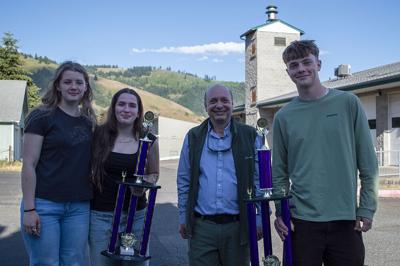
Columbia High’s Sylvia Pimley, Kiki Barkhimer, Coach Omar Sankari and Graham Beck pose for a portrait outside White Salmon’s Fire Hall with their second Washington State Knowledge Bowl trophy in as many years on June 3. Not pictured is team member Anders Daly.
Columbia High’s Sylvia Pimley, Kiki Barkhimer, Coach Omar Sankari and Graham Beck pose for a portrait outside White Salmon’s Fire Hall with their second Washington State Knowledge Bowl trophy in as many years on June 3. Not pictured is team member Anders Daly.
WHITE SALMON — City council welcomed some state champions and passed an ordinance requiring that most new residential construction have the capacity to charge electric vehicles during their meeting on June 3.
For the second year in a row, Columbia High School’s Knowledge Bowl team took home the state trophy from Wenatchee. The Bruins have placed first in regionals four times in the past 20 years, according to Coach Omar Sankari, but that top crown remained elusive until recently. Seniors Sylvia Pimley and Graham Beck, alongside juniors Kiki Barkhimer and Anders Daly, made up this year’s squad.
“I’ll miss these guys, I’ll miss doing knowledge bowl — I’ll miss doing a lot of this,” said Sankari, who’s retiring this year. “We don’t know any other teams that have done it three times, so we’ll see.”
Council then launched into the EV-ready ordinance, a policy recommended by White Salmon’s Greenhouse Gas Emissions Reduction Plan and subsequently workshopped by the CityLab board, which Councilors Patty Fink and David Lindley serve on. Apart from mobile homes, dwellings smaller than 800 square feet and affordable housing, as defined by state law, all new residential buildings must have an electrical panel, cable and 7.2-kilowatt circuit to support Level 2 charging.
Excluding service fees, the materials cost anywhere from $50-200, and installation during initial construction is much less expensive than retrofitting. Charging access and speed remain one of the biggest influences on EV sales, and Fink noted that transportation-related emissions is the city’s second largest source of greenhouse gases, reflecting national trends.
Their colleagues took some convincing. Councilor Ben Giant wasn’t keen on the idea of mandating an additional cost, and Councilor Morella Mora pointed out that lower-income people can seldom afford EVs, making the benefits relatively one-dimensional. Councilor Doug Rainbolt questioned why they couldn’t also provide assistance for those who want to upgrade post construction.
Mitigating climate change is a net benefit, and EVs are getting cheaper, Fink responded. Lindley also highlighted an important exception: if the charger makes a more significant electrical upgrade necessary, like a new transformer, then it’s not required. Both framed the ordinance, which passed unanimously, as a positive, policy-driven change.
“This is the first step. It’s the easiest step,” Fink said. “CityLab is working on a variety of different issues to help folks be aware of what might be available to them in terms of both state, federal — or even local at some point — opportunities to retrofit their house, put solar panels on it, to do whatever.”
Somewhat related, residents can learn about the EV bike lending program the city is testing during a community meeting at White Salmon’s library on June 18 (see related story on A5). Mayor Marla Keethler also reminded folks to adopt a conservation mindset as a dry summer begins, and thanked the public works crew for quickly clearing debris and addressing failed pipes caused by the thunderstorm two weeks ago.



Commented