
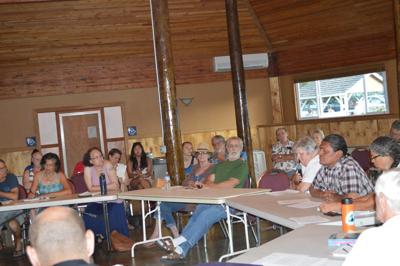
A joint City of Cascade Locks and Port of Cascade Locks roundtable discussion Thursday night charged the public with sketching out the benefits and dangers of a proposed water bottling plant in Cascade Locks.
Two large sheets of paper heralded “pros” and “cons,” in bold red marker, and a third read, “Nestlé Questions.”
Most of the night’s discussion took the form of concerns and “cons.” Among them were environmental and economic impact, potential impact on tribal water rights at Oxbow Springs, and a purported conflict of interest in local leadership.
The style of forum at the Cascade Locks Marine Park Pavilion was unique, with City and Port representatives sitting opposite to the public at a circular arrangement of tables. Front and center were paper sheets for public testimony — which proved abundant.
Members of “Unchee Wana Fishing People Against Nestlé,” a local advocacy group, argued the proposed plant, and cross water rights transfer, violated historic treaties governing native water rights to Oxbow Springs.
“No matter how you cut it, it’s a violation of the Treat of 1855,” said Klairice Westley.
Westley read a letter written by members of the Confederated Tribes of Warm Springs in May which “urges the state to re-consider their (public interest) process” due to the “critical importance for ODFW’s proposed water transfer, particularly in the context of climate change ... and more frequent droughts and dry years.”
The letter expressed concerns of bypassing a public interest review in the cross water rights transfer between Oregon Department of Fish and Wildlife and Cascade Locks, which would pave the way for Nestlé’s bottling operation. The City would then sell spring water to the corporation for its bottling plant.
Port President Jess Groves said the City and Port plan to meet with the chairmen of the Warm Springs and Umatilla Tribes to discuss the Nestlé deal and impacts to tribal rights.
Later in the evening, several members of the public questioned Groves on the roots of his support for Nestlé — during a testimonial, Katelyn Stuart, of Cascade Locks, claimed Groves had once been paid by the corporation, a potential conflict of interest.
Groves confirmed he used to work for Nestlé.
“I used to be. I did get a stipend from Nestlé at one time … for being a Nestle rep for a couple years,” said Groves.
When asked how much he made, he responded, “That’s private information … I was working privately. You should probably look at the ORS and see if I did something wrong,” said Groves, referring to Oregon State Law 777, which governs Oregon’s ports.
Groves has served on the Port Commission since 2009.
Despite the pleasant air conditioning in the pavilion, tensions flared hot throughout the night. Two deputies with the Hood River County Sheriff’s Office were present as a precaution “in case a fight broke out,” they explained.
“I’m seriously insulted that you brought protection — seriously, two officers?” said Stuart.
Port and City officials didn’t respond to the complaint, but the deputies left the meeting about two hours into the night during a short recess.
Caroline Park of Thunder Island Brewing Company listed the first pro on the board as “jobs,” but then peppered City and Port leaders with cons. Among them were “no guarantee of jobs to local citizens" and harm to existing businesses in town.
Several pros for Nestlé came from Bernard Seeger, who was appointed that night to the Joint Workforce Group for Economic Development.
Seeger, former City Manager of Cascade Locks, argued the new plant would cut down on West Coast truck traffic (since the nearest Nestlé bottling plant is in Northern California), would provide factory jobs as well as spin-off jobs for trucking and utilities, and would benefit fish in the Oxbow hatchery with a consistent supply of groundwater.
Near the end of the meeting, pros for Nestlé accounted for half a page and cons filled two entire sheets.
Holly Howell and Paul Koch of the Port added the second “cons” sheet about halfway through the session to make room for public concerns.


Commented
Sorry, there are no recent results for popular commented articles.