
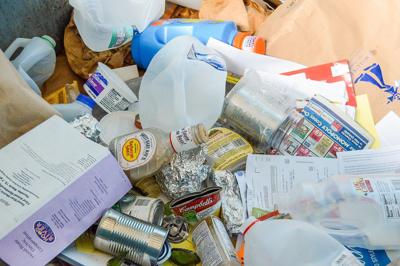
What’s changed on the recycling front in Hood River County?
In a word, nothing.
It’s been over a year since China announced it would no longer allow imports of post-consumer plastics and unsorted paper in response to poor quality materials shipped from the United States and Europe, pollution issues and its desire to develop its own recovery system.
As a result, material recovery facilities — MRFs — in Portland and Vancouver, to whom Hood River County sends its recyclables, have slowed down sorting conveyors in an effort to weed out more contaminates, causing a backlog of materials and a reduced demand from the MRFs for materials.
Last March, Jim Winterbottom, district manager of The Dalles Disposal/Hood River Garbage, was hopeful that new markets would open up and urged Hood River County residents to continue comingled recycling — and to make sure all recyclables put out curbside were free of trash and food debris.
While new markets have yet to open up, Winterbottom continues to urge residents to continue to recycle as usual, even though comingled materials are still being landfilled.
“Keep doing what you’re doing,” he said. “Don’t get frustrated and start throwing everything away because when the program changes back, we don’t want to miss a beat.
“That’s why we haven’t changed the way we’re doing things right now. We want to be transparent and let everyone know what’s going on,” he said.
The reason is simple: When he gets word that a market opens, Hood River Garbage will be able to pick up where it left off instead of having to re-educate the public on recycling policy.
“We’re still unable to find markets for our material,” said Winterbottom. “We thought there would be some other Asian markets opening up, such as Vietnam or Cambodia. The trouble is, it’s hard to audit the material that goes to those countries, so we’re not sure what they’re doing with it (if it’s being recycled) — there’s no audit trail to speak of, so we’re still waiting for some domestic markets to open.”
Oregon Department of Environmental Quality has continued its monthly meeting with stakeholders statewide, he said. Some jurisdictions have eliminated their curbside recycling programs, some have initiated a depot system, and some have added a “pay as you throw” charge — none of which has happened in Hood River County.
A stakeholders meeting was held by the DEQ in Hood River in December, and a number of representatives from Hood River City Council and local businesses attended, as well as one concerned citizen from Hood River; Winterbottom said representatives from Cascade Locks are also needed because Hood River Garbage covers three jurisdictions: Cascade Locks, the City of Hood River and Hood River County.
“We hope by mid-year, we’ll have direction and a clear vision of what the program will look like in Hood River,” Winterbottom said.
For now, the best way to keep recyclables out of the landfill is to take them directly to the transfer station. Container glass, such as jars and beer and wine bottles, are being recycled at the station and curbside (although they must be separated from comingled materials); cardboard boxes are being sent to a processor, and tin can be recycled as scrap. Yard waste is directed to Dirt Hugger, located in Dallesport.
A good rule of thumb: “If you’re questioning it, it probably shouldn’t be in a recycling bin,” he said.
Comingled materials, he clarified, make up about 25 percent of what is processed at the facility. The remaining 75 percent — cardboard, e-waste, glass, concrete and tires, for example — are still being recycled.
While the future of recycling is still up in the air in Hood River County, Winterbottom sees it going back to basics, such as tin, paper and plastic numbers one and two (opaque milk jugs and clear water bottles with a neck).
“Yogurt containers, clamshells, a lot of that never was to be included, but now, if this is what we adopt, it will definitely have to be policed more to make sure none of that material is getting into the mix,” he explained.
To help, Hood River Garbage is working on a smartphone app called “Recollect” that will give users definitive answers on what can be recycled (like newspaper) and what cannot (think rubber boots). The app would serve all of Hood River County, Winterbottom said.
“We want to recycle — it’s taken us too long to get to these great diversion rates to let it slide backwards,” he said.
The overall message: Patience.
“We want to make sure the message that we send is the message we can go with for the next 10 years,” he said. And until a clear direction is found, that message will wait.


Commented