
Social media is often the first place people go to looking for information on local events or emergencies.
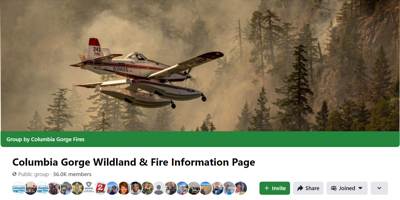
Perhaps the best known is local Facebook page, Columbia Gorge Wildland and Fire Information, which has sought to provide timely and accurate information on fires since its formation in 2015.
The volunteers who run the page take their work seriously, and have even pulled all-nighters to keep the public up to date, said Dawn Rasmussen, one of the 11 page administrators, or admins.
It has nearly 36,000 followers now and mainly covers fires on both sides of the Columbia River from Corbett and Washougal on the west to Alderdale and Arlington to the east. It also frequently covers south central Washington and north central Oregon, Rasmussen said.
“We use information gathered from scanner radio traffic, Wildcad [wildland fire dispatch] fire reports, weather, wind, GPS, and air traffic, as well as contributions from followers out in the field to get fire notification posts up quickly and efficiently,” Rasmussen said.
“We also make sure that we verify everything,” she said. “Where this page really shines is in the immediate moments after fire is reported until task forces are put into place to manage the fire.”
“It used to be that different fire agencies would start a specific fire page for that incident, but people didn’t know what the fire was called. So, this page came about to become sort of a clearinghouse, go-to site so when a fire gets started, people know to come to our page to get the right information before the agencies take over” and start a page for the fire.
The page makes one thread per fire, “so it’s clear and uncluttered on our page, and all updates occur on that same thread so it’s just constantly updated versus having multiple posts about the same thing,” she said.
“The other part is that we can only update it when officials information comes out, which can be excruciatingly slow. We get frustrated many times when there’s a big incident happening and yet there’s no updates anywhere from first responders or the police or even crews when they go to [tactical] channels. So we have to glean as much information as we can.”
Rasmussen said being an admin for the page “is a lot of work and sometimes it takes a lot of hours. It sounds kind of corny, but it feels like one of the most patriotic things you can do, because we can’t go fight the fire.”
Indeed, the page was recognized two years ago by The Dalles Area Chamber of Commerce when the page founders, Mark Lamb and Darlisa Black, were awarded first responders of the year.
As for those all-nighters, Rasmussen said, “It’s what needs to be done.” Fires do usually settle down at night, but not always, and sometimes evacuation levels can change in the middle of the night.
“The nice thing is that we tag team and when one person has to go, someone takes over the monitoring,” she said. “Most folks don’t know what goes into this page.
“Plus, all of us have day jobs so that is a little difficult, but we make it happen,” she said.
Another popular wildfire monitoring app is called Watch Duty. Rasmussen said, “We are different than Watch Duty because we are based locally and have local connections that can inform us. Watch Duty is helpful, but it also only pulls from a lot of online reporting sources so it’s not quite as informed as we are.”
She added, “We are also always looking for people who are good on computers and want to volunteer to help us. We do have a vetting process and training, and a scanner radio is provided. We really need ears near Cascade Locks.”
Page admins closely monitor the page, and do not allow speculation on what caused a fire. “That’s not the place for this comment. We are here to inform about transpiring events to help inform the community,” she said.
“One of the best parts of this group is that everybody has their specialties,” Rasmussen said. “I am really fast at getting posts assembled and then other people are really good at pulling information from other sites and feeding it into me so I can include it in the post.”
Others are good at gathering photos. And they all take turns monitoring who asks to join the group so they can keep out trolls or spammers, she said.
•••
This story originally appeared in “Fire in the Gorge: Emergency Preparedness,” a special publication of Columbia Gorge News with presenting sponsor Washington Department of Natural Resources.


Commented