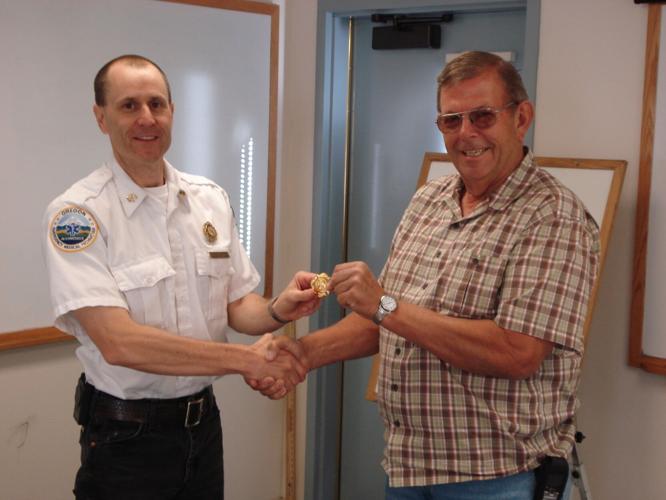
MCFR Chief Bob Palmer, left, and Tom Ashmore, who served 14 years on the MCFR board. “He was very responsible, very community oriented,” Ashmore says of the chief, who retired Dec. 1.
MCFR Chief Bob Palmer, left, and Tom Ashmore, who served 14 years on the MCFR board. “He was very responsible, very community oriented,” Ashmore says of the chief, who retired Dec. 1.
THE DALLES — As a little kid, Bob Palmer scared his mom one day when he just disappeared. Eventually, she found him a few houses away — gawking at a fire truck that had responded to a call.
Palmer grew up around the fire service, with his father being first a volunteer and then a paid firefighter.
So, it’s hardly a surprise that Palmer followed in his footsteps. Palmer recently capped a 44-year career in the fire service, retiring as chief of Mid-Columbia Fire & Rescue (MCFR) on Dec. 1.
He joined The Dalles Fire Department in 1980 as a firefighter and Emergency Medical Technician (EMT). He imagined he’d do more firefighting than EMT work, but quickly realized EMT was a “huge, huge, huge part of the fire service,” he said.
In 1992, Palmer became chief of the fire department. It merged with Wasco Rural Fire Protection District in 1995 to become MCFR, and he was named assistant chief, while the Wasco Rural chief, Joe Richardson, helmed the new agency. Palmer became chief in 2007 when Richardson retired.
Over his decades of work, Palmer’s seen continual evolution in the responsibilities of firefighters.
First, they learned more about hazardous materials response, since firefighters were getting hurt or killed on those types of calls.
Then, EMTs learned more and more medical skills, gaining new certifications. Locally, the fire service went from only providing basic life support to now doing advanced life support.
Then, with the Oklahoma City bombing in 1995 and 9/11 in 2001, came training in how to respond to weapons of mass destruction and terrorism.
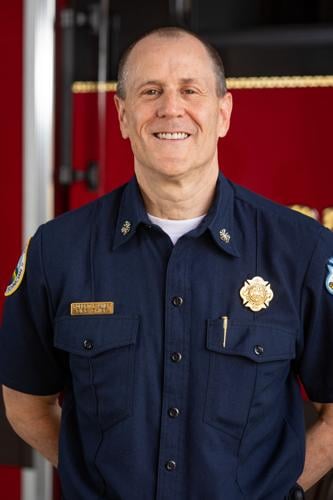
Bob Palmer retired from Mid-Columbia Fire and Rescue Dec. 1, capping a 44-year career.
Contributed photo
Then they had to learn how to respond to active shooters. Schools started having not just fire drills, but lockdown drills.
With the COVID-19 pandemic, focus turned to planning ways to maintain continuity of operations, and how the fire service protects itself.
Last, but certainly not least, weather events and disaster preparedness are now added to the mix. Wasco County has seen so many wildfires that Palmer and his command staff became very experienced in the Oregon state mobilization process. As the Wasco County Fire Defense Board chief, the positive partnerships Palmer and his staff developed with the Oregon State Fire Marshal, Oregon State Forestry, United States Forest Service, regional and local emergency services were envied by agencies throughout the state. Palmer was earnestly referred to as “the conflagration king” by some, due to the many conflagration responses that have taken place within Wasco County.
Palmer became known at the state level for using good judgment regarding when to seek a conflagration designation, which brings more state resources to a fire. The local region also became known for effective wildfire response.
“When we call for a conflagration, it’s certainly needed to keep fires small, and not taken lightly,” Palmer said.
Fires over the past 5-7 years have picked up in severity and intensity, Palmer said, due to weather, topography and increased fire fuel.
It’s not just the job that’s changed. Once-huge volunteer corps of about 40 people at both the city and the former Wasco Rural are gone. “Volunteerism has changed tremendously,” Palmer said. “It’s not that people don’t want to help, it’s the time commitment involved. As a paid person it’s challenging to keep up with it, let alone a volunteer.”
Now, MCFR has just three volunteers, two of them chaplains and one in fire prevention.
MCFR uses a state-grant-funded apprenticeship program that has six slots. Over two years, apprentices undergo training to achieve their Firefighter II certification and Emergency Medical Technician license. MCFR has hired a majority of the apprentices from this program.
Tom Ashmore served on the MCFR board for 14 years, and said Palmer took his responsibility to protect the community seriously. “He was very responsible, very community oriented. He felt very responsible for the performance of his troops, his people under him,” Ashmore said.
“He’s smart,” Ashmore said. “He studied a lot. He took a lot of classes. He was well educated.”
Palmer reflected on a few funny stories from his time in the fire service.
Once he and a partner responded to a call and heard a man shouting for help from inside his home, saying he couldn’t open the door. His partner broke the door open, and they saw a man somehow entwined in a bicycle frame.
“He was truly pretzeled up in this bicycle and it took probably 15-20 minutes to untwine him,” Palmer said. Fortunately, he wasn’t hurt.
On another call, Palmer’s partner was first to the door, but then told Palmer to go first. “He backed away and there’s this Great Dane dog standing there, probably about the same height as me, looking at me, and I went to my partner, ‘No, you go.’”
A woman came to the door and assured them the giant dog was gentle. “That was comical for both of us.”
He learned an important lesson on another call involving an intoxicated woman. She was talking and talking to Palmer’s partner, and finally an impatient Palmer asked her if she wanted to go to the hospital or not.
“And she said to me, ‘You know, I like him, but I don’t like you.’ And I looked at [my partner] and said, 'Okay.’ At that point, I decided it would be best to just back away, watch and learn.”
“I’ve met a lot of people that basically, all they need to do is they just want to be listened to and understood. Some of them, they’re just flat out lonely. Whether you know it or not they’re having their worst day and you’re there to help them through their ordeal.”
He wouldn’t call himself an adrenaline junkie, but “there is certainly an adrenaline rush you get when you go out on calls and there is an air of self-satisfaction that you get after you respond to the call and you basically help somebody out.”
And if you get to stop a fire, that’s also a rush. “Maybe you beat Mother Nature. Fire is a pretty powerful thing.”
As for his future plans, A) he’s tired of the question, and B) yes, he’s probably going to do something in retirement, but he’s not ready to say what just yet.
“I’m not gonna just sit around and not do anything,” he said. “That’s my way: Stay active.”



Commented