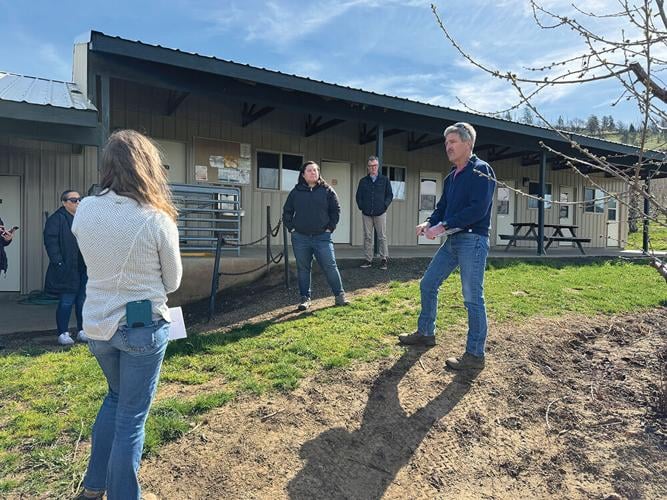
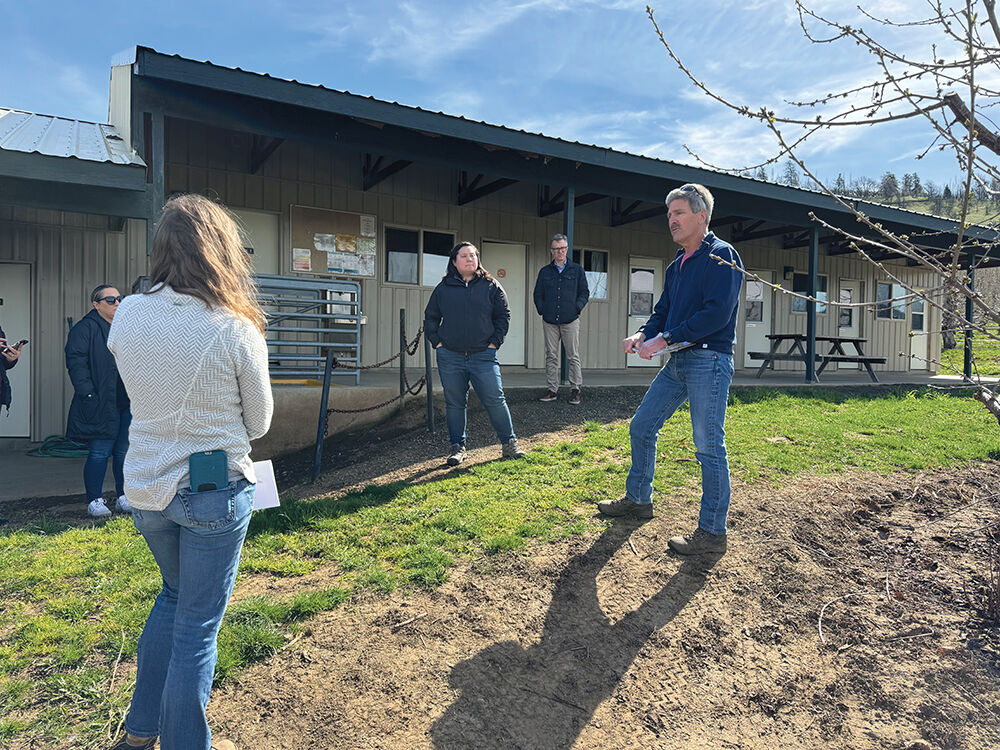
Dave Meyer shows his cherry farm worker housing at High Rolls Ranch in The Dalles mid-2024 to members of the Agricultural Labor Housing Rulemaking Advisory Committee during a tour of three Wasco County farm labor camps. Attending the tour were members of the advisory committee, farm worker advocates, Oregon OSHA staff and members of Gov. Tina Kotek’s staff.
THE GORGE — Oregon’s Health and Safety Division (Oregon OSHA) released a comprehensive new set of health and safety guidelines for farm worker housing, announcing the end of a contentious six-year process to overhaul these rules, some of which have not been updated since 1989.
These rules apply to all agricultural labor housing (ALH) in Oregon, where approximately 15,000 seasonal workers live on farms reliant upon seasonal labor during short harvest windows.
The backlash has come quickly after the Jan. 8 announcement, with farmworker advocates saying the rules fall short of these workers’ needs, while grower advocates argue they can’t afford to make these changes.
A release from the Oregon Farm Bureau said the expenses created by the new set of rules “ensures the end of many family-based farms that grow famous Oregon crops such as pears, apples, peaches, and cherries.”
Martha Sonato, a legislative and policy advocate with the Oregon Law Center who grew up in the Gorge, said farmworker advocates feel the protections fall short of farm workers’ needs, and were disappointed that OSHA backed down from certain previously-considered provisions.
“Good labor housing is essential for a thriving agricultural industry. It’s not just a financial issue; it’s about basic human dignity and fairness,” she said.
While OSHA created a Fiscal Impact Statement estimating the growers’ costs to comply with the new rules, pear grower and Columbia Gorge Fruit Growers Association Chair Lesley Tamura said the agency’s numbers were too low compared to the costs growers in the Gorge anticipate.
“They don’t have a grasp of the reality of what we’re facing financially,” she said. “I think if they did grasp the cost, they would not have finalized some of the rules that they did.”
The final rule changes go beyond OSHA’s federal requirements and include improved ratios of toilets for each gender: 1:10 compared to the previous 1:15, requiring kitchens, water testing, smoke monitors, locked storage and locking doors for bathrooms, among other requirements and ratio-adjustments.
“We do believe that this is going to increase protections for workers and their families, housing occupants across the board,” said Oregon OSHA’s Public Information Officer Aaron Corvin.
With these rules come a new self-certification process for ALH operators, using photos and videos to demonstrate compliance, as well as seven new inspector positions to evaluate housing conditions, work with operators on compliance and refer sites to OSHA’s enforcement program.
OSHA made some compromises after public comment
In response to five public hearings and 264 responses during the public comment period in late 2024, OSHA’s final rules include some changes to previously-considered timelines and provisions.
Initial posts on the advisory website showed OSHA had spent years considering a requirement of 100 square feet per person in sleeping areas with bunk beds, but the final rules require 50. The previous requirement was 40 square feet per person.
Another change favored by the Oregon Farm Bureau was the removal of a 500 foot setback from livestock facilities, which the bureau said would impact dairy farms.
The final rules also delay some effective dates to give employers more time to adapt. For example, water testing for arsenic, coliform bacteria, and nitrates will not be mandatory until January 2026. Similarly, new requirements for locking shower stalls and increased toilet ratios will phase in as late as January 2028.
“This approach balances worker protection with practical implementation considerations, ensuring that both small and large agricultural operations can adapt to the new standards,”
“This approach balances worker protection with practical implementation considerations, ensuring that both small and large agricultural operations can adapt to the new standards,” according to a document provided by Oregon OSHA.
.
Dave Meyer shows his cherry farm worker housing at High Rolls Ranch in The Dalles mid-2024 to members of the Agricultural Labor Housing Rulemaking Advisory Committee during a tour of three Wasco County farm labor camps. Attending the tour were members of the advisory committee, farm worker advocates, Oregon OSHA staff and members of Gov. Tina Kotek’s staff.
Contributed photo
Farmworker advocates say rules don’t go far enough
While acknowledging improvements, advocates expressed disappointment with the new rules, describing them as insufficient to address the systemic challenges faced by farmworkers and their families.
“There are improvements like ensuring changing areas near shower facilities for safety and privacy, locking stalls, and better toilet ratios, though portable toilets still count and can become unhealthy in summer,” Sonato said. “These rules fall short of what farmworkers have been asking for over many years.”
“It’s really disappointing to see some of those more effective measures changed and not implemented,” said Executive Director Ubaldo Hernández of environmental and social justice organization Comunidades in Hood River.
Key points of contention include the smaller increase in square footage requirements for community sleeping quarters and an allowance for mesh enclosures for cooking areas, which advocates argue fail to prevent pesticide drift and other contaminants.
“The proximity of housing to fields continues to be a top concern,” Sonato said. “Some housing is just feet away from fields, raising exposure risks to pesticides and contaminants.”
Hernández said OSHA should have included more preventative measures around pesticide exposure.
“They are putting the health of our community on the back burner by exposing them to harsh chemicals,” he said.
Indoor temperature standards have also drawn scrutiny from advocates, who pushed for air conditioning units to combat Oregon’s high summer temperatures.
“Even when it’s 95 degrees outside, housing only needs to be 15 degrees cooler—leaving workers in stifling conditions,” Sonato said.
Columbia Gorge News asked Sonato how advocates would respond when growers define certain provisions as comforts or conveniences instead of health and safety needs.
“There’s plenty of evidence out there, public health studies, scientific studies, that highlight the need for all of these provisions in terms of safety and health,” she replied.
Growers say upgrade costs might put them out of business
The Columbia Gorge Fruit Growers Association said that the regulations could strain small and mid-sized farms already operating on thin margins.
“We’ve had some really difficult crop years due to different circumstances between weather and labor shortages and so financially, we’re all facing a very difficult time,” Tamura said.
According to Tamura, most of the farms in the Gorge region will have to do some level of remodeling and construction to comply with OSHA’s new standards. She noted the increased square footage, added septic tanks and new kitchens as the most costly changes.
In a release, Oregon Farm Bureau President Angela Bailey said ALH operators will have to spend between $400,000 to $1.5 million to comply with these rules: a number averaged from public comments submitted to OSHA by farmers and advocacy groups.
Growers also criticized the phased implementation timeline, arguing that it does little to alleviate the upfront costs of retrofitting or rebuilding housing to meet compliance standards.
“It is a really fast implementation date, and there’s just no way that we’re going to be able to maintain our current housing capacity in that implementation timeline,” Tamura said.
Some funding exists, but not many growers receive it
While ODA will supply a new $5 million state grant program to assist housing upgrades, according to the law that set aside these funds, HB2001, this money does not apply to buildings that house H2-A workers. Tamura said this represents 60-70% of all ALH in the Gorge.
She noted that while there are low-interest loans available through USDA’s Rural Development Program, growers are reluctant to apply.
“Due to our financial situations year after year, we’re not making enough to even cover our regular expenses. We’re not in any position to be able to pay back a loan,” she said, adding that the upfront costs of Oregon Housing and Community Services’ ALH tax credit also deters applicants.
Despite CGFG’s years participating in the rulemaking process and providing quotes and estimates, growers feel that OSHA is completely out of touch with their anticipated costs.
Tamrua pointed out that OSHA’s fiscal impact statement only included estimates from Linn, Washington, Jefferson and Multnomah Counties, while two thirds of ALH are in Hood River and Wasco counties.
“Considering that we as growers in the Gorge have been the most heavily involved in this process and we have the most housing in the state in this area, it makes sense to focus the realistic financial circumstances on what we’re paying,” she said.
Columbia Gorge News asked Corvin why Wasco or Hood River counties were not used in estimating compliance costs.
Corvin said that building and renovation costs vary widely and OSHA included feedback from stakeholders, but he did not explain why counties from the Gorge were not used as the basis for estimating costs.
“We do believe that the rule changes we have adopted maintain a stable operating environment for employers, and that is our track record,” Corvin said. “That’s how Oregon OSHA operates.”
Both growers and farmworker advocates open to community-based housing
While advocates and growers acknowledge the potential of off-farm community housing, growers feel the lack of this housing leaves them with few options.
Advocates have long argued for community-based housing as a way to construct buildings layering multiple funding sources, as well as allowing for farmworkers to be more visible and to connect with the local community.
“They are able to have more control of their housing situation, and they can be close to basic necessities like the grocery store or the doctor’s office, Sonato said.
Last year Sonato worked with Representative Maxine Dexter (D–Hood River) to allocate $10 million for both on and off-farm ALH through Oregon Housing and Community Services.
While the growers support the concept of community housing, they stress its limitations in addressing immediate needs.
“The community housing that is available in this area is full,” Tamura pointed out. “They have waiting lists, which obviously shows a need for housing. But if they don’t have any additional capacity, then it’s not a solution at this time.”
Columbia Gorge News asked Tamura if CGFG had connected with organizations like Community and Shelter Assistance of Oregon, the Farm Worker Housing Development Corporation, Bienstar or other nonprofits that have had success in Oregon to create off-farm worker housing.
“I think we’d be in support of it, depending on the details,” she replied. “It’s not really something we involve ourselves in at this point.”
Tamura said growers have asked OSHA many times during the rulemaking process where workers are supposed to go if the growers cannot afford these upgrades.
“They have yet to answer the question even once,” she said.



Commented