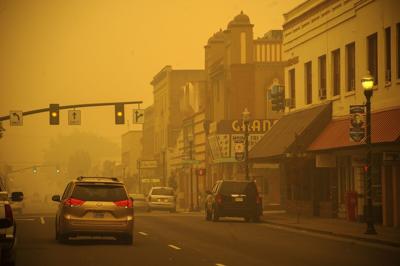
Heavy wildfire smoke in Oregon reduced visibility in downtown The Dalles in 2020 to about three blocks. Residents throughout the region were encouraged to stay indoors if possible, and wear particulate (N95) masks if they had to be outdoors. Masks were made available for residents county-wide, with distribution sites in The Dalles and outlying communities.
Heavy wildfire smoke in Oregon reduced visibility in downtown The Dalles in 2020 to about three blocks. Residents throughout the region were encouraged to stay indoors if possible, and wear particulate (N95) masks if they had to be outdoors. Masks were made available for residents county-wide, with distribution sites in The Dalles and outlying communities.
The Columbia River Gorge has some of the highest smoke levels in the world, and not just during wildfire season. But just how much smoke is in the air today? An Oregon Health Sciences University grant to install 10 new smoke monitors in Hood River and Wasco counties will soon help answer that question in real time, giving residents the information needed to evaluate potential smoke-related health risks on a day-to-day basis.
There are currently only two smoke monitors in the region, one in The Dalles and a second in Hood River, said Lauren Kraemer, with Oregon State University Extension Service in The Dalles. “We can’t make exposure decisions with only two monitors,” Kraemer told the Wasco County Board of Commissioners during their Jan. 5 regular meeting.
The worst exposure levels are in the summer. “We have continuing issues with smoke in the summers,” Kraemer noted. “Fire season has increased by 80 days over the last few years.”
She noted health impacts are dangerous for vulnerable groups, like those working out of doors during the harvest season, or working in construction.
But exposure issues aren’t limited to only summer, she added. Warming fires, orchard waste and forest slash burning, controlled burns for wildfire mitigation all contribute high levels of smoke in the Gorge in Winter, spring and fall seasons as well. “We have some of the worst smoke in the world,” Kraemer said.
The $80,000 grant from OHSU will provide 10 additional smoke monitors, allowing for better smoke-related decisions, including not just exposure risks but helping with other smoke related decisions, like whether or not it is a good day — or a bad day — to burn a debris pile.
The grant will also help OSU Extension work out ways to “communicate about smoke.” OSU Extension will be creating a website outputting information from the new monitors, and developing other communication streams. “Someday, smoke sensors will be texting emergency managers and people impacted in a region,” she said. “We will be able to network with the bigger system and make that information available.”
Kraemer said her agency has also applied for an Oregon Department of Environmental Quality grant to explore ways to mediate or reduce smoke in the Gorge, for example by chipping waste wood rather than burning it.
“We are changing the way the Gorge handles smoke,” she said.



Commented