
By Charlie Vanden Heuvel
Columbia Gorge Beekeepers Association
Native bees evolved over millions of years ago as indigenous flowering plants came into being. Each species developed a special relationship to pollinate their surrounding flora. Within the United States there are about four thousand species. Approximately five hundred species of native bees reside in Oregon.
In recent years a growing concern has arisen concerning the ‘managed honey bee’ and the native bee. Does one obliterate the other? Is one spreading disease to the other? Should we not eliminate one set to preserve the other?
Great questions for the family, group of friends, or even in our classrooms. The key issue to consider is the role of Mother Nature.
Native bees specialize alongside the surrounding flora. For instance, the Squash Bee collects pollen from Cucurbita (pumpkins and squashes).
Some have longer tongues while others shorter. For example, the honey bee proboscis (tongue) is short preventing the bee from accessing nectar deep down inside a flower. For instance, the Aquilegia formosa or Columbine with is long flower requires a different approach to nourish on the nectar and access the flowers pollen.
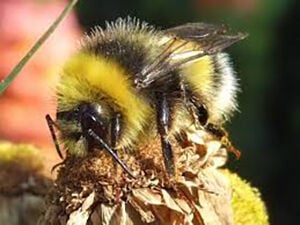
The bumble bee has developed a technique called “buzz pollination” where they vibrate their flight muscles at high frequencies to release pollen from the depths of the tubular flower.
Native bees are considered solitary, as each female builds her own nest to develop a small family only to die before the season ends, leaving behind a few new queens to hibernate the winter only to begin the cycle once again. Bumble bees are considered semi-social or seasonal social.
The majority (70%) develop nests in the ground while others (30%) create their homes in wood or hollow stems (mason bees).
Unlike honey bees who forage for up to five miles, the native bees, often visiting specific plant families, only forage a short distance.
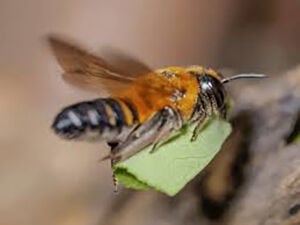
The Leafcutter bee (Megachili) cuts circular pieces of leaves to use in the construction of their nests, typically in crevices of wood or rock, in beetle holes, in pithy stems and occasionally in the ground. The family is named for the “large jaw” or mandible. Their preferred crops are alfalfa, onion, carrot and sunflower.
Green bees (Halictidae) are known for their brilliant, iridescent green, yellow-green, or coppery coloration. They are ground nesters. Sometimes they are attracted to human sweat. These bees are considered ‘generalists’ visiting squash, blueberries and sunflowers.
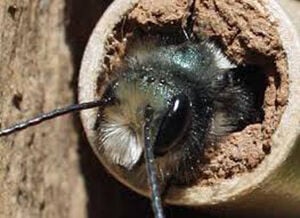
Mason bees (Megachilidate) create their homes typically in hollowed sticks separating each newly laid egg along with a drop of nectar and pollen with mud (ergo – mason). Similar to the leafcutter bee, the Mason bees have a large jaws and big heads. They prefer apple, blueberry, cane berries, cherry and strawberry plants.
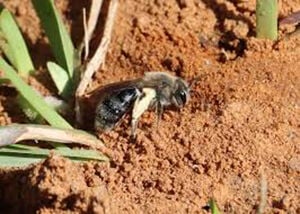
The Miner bee (Andrenidae) are happy to dig tunnels into the ground to create their abode. These are typically the first to be seen in the early spring. The preferred crops are apple, cherry, peach and pear, which is great for the Columbia Gorge area.
Carpenter bees (Apidae) enjoy gnawing tunnels into wood to create their family building site in stems, like blackberries. These bees are small mostly hairless that vary in color from dark metallic blue to green. Emerging in the spring remaining active until the fall. Their crop of choice is apple, cane berries, cherry, pear and strawberry.
Bumble bees (Bombus) enjoy a nice burrow in the dirt, for instance a garden. There are around forty-six species of bumblebees in North America. The bumblebee are a great asset to the greenhouse environment and are capable of foraging in colder or wet weather. The favorite crops are blueberries, cranberries, and red clover.
The Honeybee’s body, even their eyes, are covered in hairs designed to attracted the flowers pollen as it flies off the flower when the bee delves into it to slurp up the sweet nectar.
The honey bee is considered a generalist as it foraging on a variety of flora rather than a specific one.
The honey bee scrapes its body with its forelegs, adding a bit of nectar to moisten the pollen, creating a ball to finally rest on the aft legs at a site labeled corbicula, a flattened part of the leg, enabling the bee to navigate at speeds up to fifteen miles per hour.
Some of the Native Bees house their accumulated pollen derived from foraging on the underside of their bodies.
Yes, one can see both Native and Honeybees foraging on the same flora. Yes, there are viruses and diseases that have been found in both species. What is not known is who had the virus first. In science this is considered the baseline.
Manipulating Mother Nature entails human intervention to control or alter natural systems through technology. Mother Nature takes on a holistic viewpoint maintaining balance between all aspects of nature. Nature is integral and deterministic operating by its laws. There exist an interdependence, altruism, balance, interconnection, harmony and unity. Elements that often result in issues not foreseen. Changing anything with our limited appreciation of the myriads of issues under Nature’s control, almost always upsets the balance thus causing what we hoped to achieve to end in failure.
The Native bee is an integral part of Nature and its relationship to the surrounding environment, as is the honey bee.
Consider dispensing a few dollars toward Project Apis m in support of their funding (https://www.projectapism.org/partners/#give).
The Columbia Gorge Beekeepers Association meets on the third Wednesday of each month, http://www.gorgebeekeepers.org, at the Hood River Extension, 2990 Experiment Station at 6:00 PM. A different subject is presented by an Entomologists or experienced beekeeper. All are welcome. Visitors may attend in person or via Zoom. You may reach out to the club for login information - admin@gorgebeekeepers.org. You may also enjoy a visit to the Hood River Extension to view the three bee hives maintained by the Columbia Gorge Beekeeping Club and financially by the Hood River Master Gardeners, Klahre House and the Columbia Gorge Beekeepers Association.


Commented