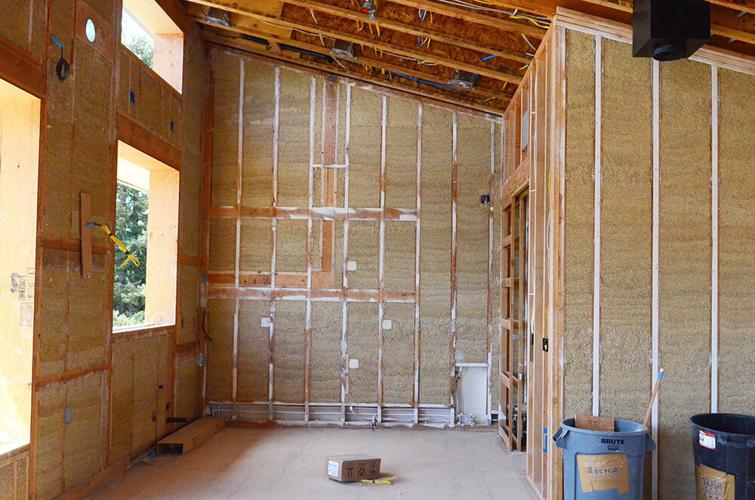
The Underwood house’s interior walls of hempcrete, by Next Genesis Design. The material replaces exterior paint, exterior siding, weather-resistant barrier, plywood sheathing, insulation, drywall and interior paint.
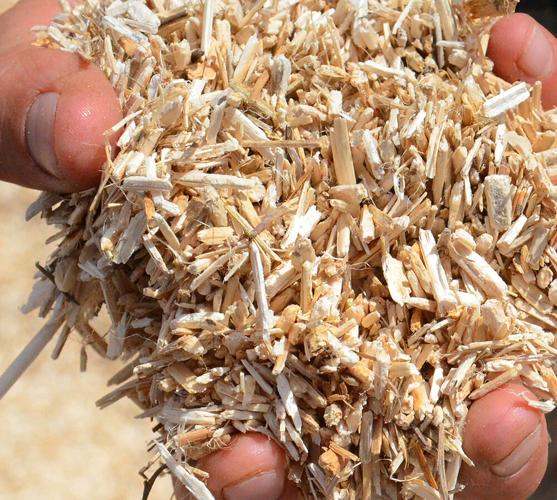
Hemp hurd, the inner core of a hemp stalk. Emma Renly photos
The Underwood house’s interior walls of hempcrete, by Next Genesis Design. The material replaces exterior paint, exterior siding, weather-resistant barrier, plywood sheathing, insulation, drywall and interior paint.
THE GORGE — At the construction site of a newly built house in Underwood, small woody bits of debris known as hemp hurd line the base of the walls. It’s one of the four ingredients used to create hempcrete, or hemplime — a natural building material that replaces a conventional seven-layer wall assembly.
The hemp is mixed with a lime binder, water and mineral additives known as pozzolans, then hand-packed inside the wooden framing structure. It’s finished with lime plaster on the exterior and clay plaster on the interior, giving the walls an earthy textured look.
The house in Underwood is the first of its kind in Skamania County, architecturally designed by John Hutton, owner and operator of Next Genesis Design.
He has built two other hempcrete houses in the Gorge — in Parkdale and Hood River — though his work spans across Oregon. He says clients have chosen the material for indoor air quality, environmental sensitivity and its resistance against mold, as the walls are vapor-open.
Additionally, he pointed out the material’s fire-resistant nature — hempcrete received a flame spread index of zero and a smoke development index of zero on the ASTM E84 Steiner Tunnel Test, meaning it neither burned or smoked under test conditions.
“You could take a blow torch to this wall for two hours and it’s not gonna burn down,” Hutton added. “I’ve done fire tests.”
But it was the material’s non-toxicity that first drew Hutton to hempcrete.
“[In a traditional wall system] there’s an unknown amount of chemicals in it, and let alone how they’re all interacting with each other,” Hutton said. “These chemicals include fungicides, benzenes, insecticides, biocides, formaldehydes, PFAS — forever chemicals.”
Hemp hurds are an agricultural byproduct from the fast-growing plant. It’s become easier and less expensive to source since hemp cultivation became legalized in the U.S. from the 2018 Farm Bill. Before then, the material was imported from Canada and Europe.
Recently, there have also been changes in the International Residential Code (IRC), a minimum set of standards the building industry follows to pass inspection. In 2024, for the first time, hempcrete construction was included. Hutton explained that this speeds up the permit process — previously, a hempcrete permit was applied for through the alternative materials and methods application, which took years.
“Legal momentum is totally on our side. It just takes time for it to gain mass adoption,” Hutton said. States independently adopt the newest IRC code over time.
In BZ Corner, Rob Paulsen of Headwaters Carpentry is building another hempcrete house, the first in Klickitat County. While Paulsen didn’t previously have experience with hempcrete, his clients requested it, so he opted to learn, even taking one of Hutton’s week-long workshops.
“I was actually skeptical about it to begin with, because it wasn’t something I was familiar with,” Paulsen said. “Now that I’ve gone through the process, I think it’s fantastic if you want to check those boxes of no VOC [volatile organic compound] and a super low toxicity natural home.”
He noted that contractor unfamiliarity with the material will keep prices higher at first, as there are unknown cost-risks that come with new material.
“As with everything, the more widely it’s adopted, the less expensive it becomes,” Paulsen added.
Labor is the highest cost factor. Paulsen said that handpacking, like at the Underwood house, requires dozens if not hundreds of work hours, but creates a dense wall with a wavy layered pattern. The technique Paulsen used was spray applying, and while it’s significantly faster, it requires more equipment purchases upfront.
To offset costs, Paulsen even recommends that homeowner builders look into DIY options. “If you take it on yourself, it could actually be a pretty cheap way to insulate and finish your house if you take a plastering class and plaster it yourself,” he said.
Despite the learning curve, Paulsen is excited about the material.
“I can’t think of anything more natural and more resilient than this system,” he added. “I would happily do one again, now that I’ve done one.”



Commented