
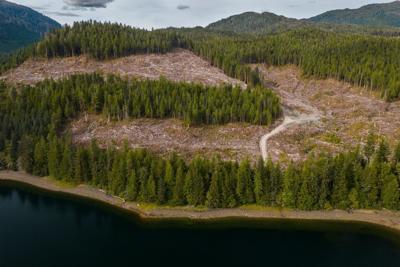
The fight for the largest intact temperate forest in the United States continues with the U.S. Department of Agriculture's Forest Service announcing on Friday, April 24, that it will open 1,655 acres of Alaska's Tongass National Forest to logging.
The proposal sparked an immediate call to action from conservationists and local businesses who say the plan will "irrevocably harm" one of Southeast Alaska's most important forest landscapes. They are urging everyone who loves the Tongass to voice their opinions until until June 7, 2026.
Tongass Timber Sale Enters Public Comment Period
On April 24, 2026, the Forest Service opened a 45-day comment period on a draft environmental impact statement of the Twin Mountain II Timber Sale.
The project would make about 1,655 acres of old-growth timber, or about 26.8 million board feet, available for harvest on Prince of Wales Island, along with road construction and maintenance in the Staney and Red Bay areas.
"The Twin Mountain II Timber Sale Project will provide valuable resources toward supporting a viable timber industry in southeast Alaska and providing jobs and opportunities for Alaskans," said Tongass National Forest Supervisor Monique Nelson, in the official statement.
"Providing a supply of timber to the American people is a central part of the Forest Service's mission and we continue to fulfill that obligation as part of our agency's multiple-use mandate," she added.
Forest Service estimates that the sale will generate up to $6.65 million in labor income for the timber industry and support an estimated 113 to 121 jobs.
The project will also include 0.9 miles of new National Forest System road, 12.4 miles of temporary road construction, and reconditioning approximately 24.5 miles of existing roads.
The Forest Service is accepting comments on the draft environmental impact statement until June 7, 2026, at 11:59:59 p.m. Alaska time. Readers can find all information on how to submit comments through this page.
Hunter McIntosh, president and executive director of The Boat Company, a nonprofit cruise company in Alaska, is quick to urge everyone who loves the Tongass to voice their opinions.
"This is a moment for everyone who cherishes their public lands to be loud, quick and strong," said McIntosh.
The company is actively protecting the Tongass National Forest and Southeast Alaska in a variety of ways, including funding lawsuits, supporting conservation efforts and promoting stewardship among cruise guests. The company has invested more than $30 million in Alaska conservation.
McIntosh also argues that the plan would do little for people who use public lands for recreation, local communities or wildlife. Instead, he said, the clearest beneficiaries would be timber companies profiting from publicly owned trees.
“The public lands we all own as taxpayers will be irrevocably harmed if this plan is enacted. The only alternative is no action," he added.
Tongass Logging Plan Is Part Of A Bigger Fight
The Twin Mountain II Timber Sale proposal comes at a time when the 2001 Roadless Area Conservation Rule is already under review.
The 'Roadless Rule' restricts road construction, road reconstruction and timber harvest on roughly 60 million acres of national forest land (about 30% of all National Forest System lands).
While the rule no longer applies to more than 9 million acres in Idaho and more than 4 million acres in Colorado, where state-specific rules are now in place, 45 million acres are still covered, including the Tongass National Forest in Alaska.
U.S. Department of Agriculture Secretary Brooke L. Rollins announced on June 23, 2025, that the department intended to rescind the rule.
A notice of intent was published in the Federal Register on Aug. 29, 2025, initiating an environmental review process for the Tongass National Forest.
The USDA initially scheduled the release of the Draft Environmental Impact Statement (DEIS) for the nationwide Roadless Rule rescission for March 2026, but that hasn't happened.
High Country News reported that, in the absence of federal public meetings, tribes, conservation groups and local nonprofits have begun holding their own "people's hearings" across the country to explain the Roadless Rule rollback, gather testimonies and build a public record of opposition.
In Southeast Alaska, the Organized Village of Kake and the Southeast Alaska Conservation Council co-hosted one such hearing on April 3, 2026.
Earthjustice, a nonprofit environmental law organization, has been involved in the Tongass roadless fight for more than two decades.
They challenged the Bush administration’s 2003 Tongass exemption, later went back to court over the Trump administration’s exemption and is now defending the 2023 reinstatement of Roadless Rule protections for the forest.
Kate Glover, senior attorney at Earthjustice explained in an interview to Forbes.com that “The old-growth Tongass is a carbon powerhouse since it stores 20% of the carbon stored across all U.S. national forests combined. It is a climate life raft for us, and we must keep those trees standing.”
She also noted that the forest is essential for local and indigenous communities since rely on the Tongass for food, cultural traditions and everyday life through subsistence hunting, fishing and gathering.
"The economy in southeast Alaska is largely based around tourism and commercial fishing. It is not a logging economy," she added in the interview.
The Fight Over The Tongass Is Playing Out On Multiple Fronts
While the USDA is reviewing the national Roadless Rule, it is also revising the Tongass National Forest Land and Resource Management Plan, which guides decisions on timber, recreation, tourism, fisheries, subsistence uses, old-growth habitat, roadless areas and conservation priorities.
The Forest Service published its latest notice on February 18, 2026, opening a scoping period that closed March 20, 2026.
The next update is expected in fall 2026, when the agency plans to release a draft revised plan and draft environmental impact statement for a 90-day comment period. A final revised plan is expected in May 2027.


Commented