The average parent loses the equivalent of 48 nights of sleep each year worrying about their child — with concerns about technology emerging as the biggest contributors.
A new survey of 2,000 parents of school-aged children finds that families are entering the school year under growing tech-driven anxiety as concerns over screen time, social media, school phone policies and child safety collide.
Results found that respondents lose seven hours of sleep per week on average, and worries about screen time habits (24%), social media's impact on self-esteem (20%) and gaming or app addiction (18%) ranking among the top concerns keeping them awake at night.
The survey, conducted by Talker Research on behalf of Cosmo, found that there’s a new and growing form of modern parenting stress: “techxiety,” the pressure parents feel balancing the benefits of digital connection with concerns about smartphones, social media, screen addiction and online exposure.
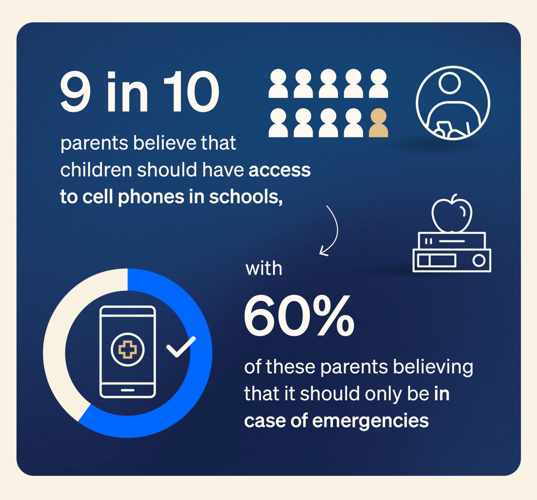
Although parents find themselves worried about how tech usage is impacting their child, nine in 10 parents report wanting their child to have access to a cell phone at school.
The Tension Between Safety, Distraction and Wellbeing
The transition to a smartphone remains a defining milestone for many families, though it also brings mixed emotions for parents.
The survey found that transitioning to a smartphone weighs on 38% of parents' minds as a "loss of innocence" rather than a "step toward independence" (62%).
For parents whose children already have smartphones, the pressure is even more pronounced.
These parents lose nearly two additional hours of sleep per week on average and are more likely than parents whose children do not have smartphones to worry about their child’s mental health (31% versus 27%), social media’s impact on self-esteem (22% versus 17%) and feeling disconnected from what is happening in their child’s life (19% versus 14%).
Despite noted reservations, nearly three-quarters of parents surveyed (73%) said their child already has their own smartphone, including 47% of parents of five-year-olds.
While parents have their concerns about screen time and technology use, 76% believe the ability to contact their child in an emergency is the more important consideration.
At the same time, most parents said preserving childhood remains a priority. Eight in 10 said they want to protect their child's childhood as much as possible, while 73% said they would like technology to help rather than hinder their child's development.
Many also see technology as a tool that can enable greater independence. Parents said they would feel more comfortable allowing their child to go to the park (42%), play in the neighborhood (41%) or ride a bike independently (37%) if they knew where they were.
“We heard parents loud and clear: staying connected with your child shouldn't require handing them the entire internet,” said Russell York, Cosmo’s Founder and CEO. “For many families, connectivity and distraction have become inseparable. Parents are looking for a way to keep in touch without introducing the constant pull of apps, social media and online content. In fact, eight in 10 parents who have already given their child a phone say they wish a simpler option had been available from the start. Families shouldn't have to choose between staying connected and protecting their child.”
(Talker Research)
By Talker
Parents Looking For School Safety Along With Simpler Options
The competing concerns at the heart of parents' techxiety become especially apparent when it comes to phones in schools.
Although phone restrictions have been implemented in schools across more than 30 states, parents whose child's school has a phone ban reported feeling anxiety about not being able to contact their child an average of three times per day.
Of the nine in 10 parents who want their child to have access to a cell phone at school, 60% say that access should be limited to emergencies.
The survey found parents recognize the mix of benefits and drawbacks of smartphones in the classroom.
Four in 10 (40%) said phones help students stay connected with parents during emergencies, while 30% said they can be disruptive to learning and 28% said they contribute to drama and conflict among students.
Still, the ability to reach a child in an emergency appears to outweigh many parents' concerns about early access to technology.
But overwhelmingly, over three-quarters (77%) of surveyed parents said that they would prefer a device that offered the ability to stay connected with their child but effectively limited distractions.
“The conversation around kids and technology has shifted,” said York. “Parents aren’t asking for more features or complicated parental controls on smartphones — they’re asking for something entirely different. They don’t want to choose between keeping their children safe and protecting their childhood. Families are telling us they want thoughtful solutions that support both independence and peace of mind.”
Research methodology:
Talker Research surveyed 2,000 parents of school-aged children with internet access. The survey was commissioned by Cosmo and administered and conducted online by Talker Research between May 22 and May 29, 2026. A link to the questionnaire can be found here.
To view the complete methodology as part of AAPOR’s Transparency Initiative, please visit the Talker Research Process and Methodology page.




Commented
Sorry, there are no recent results for popular commented articles.