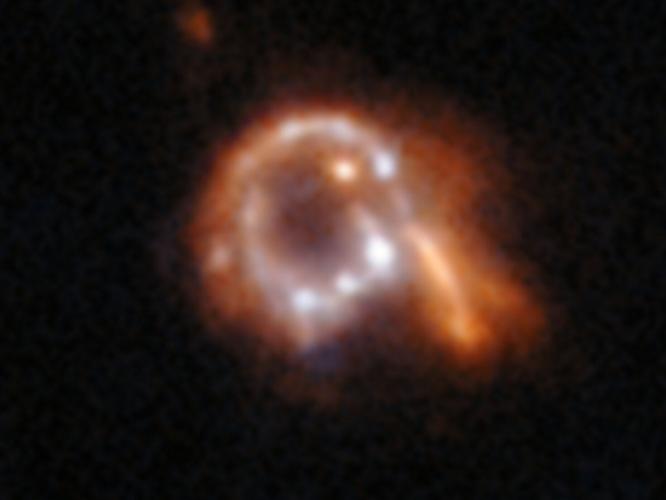
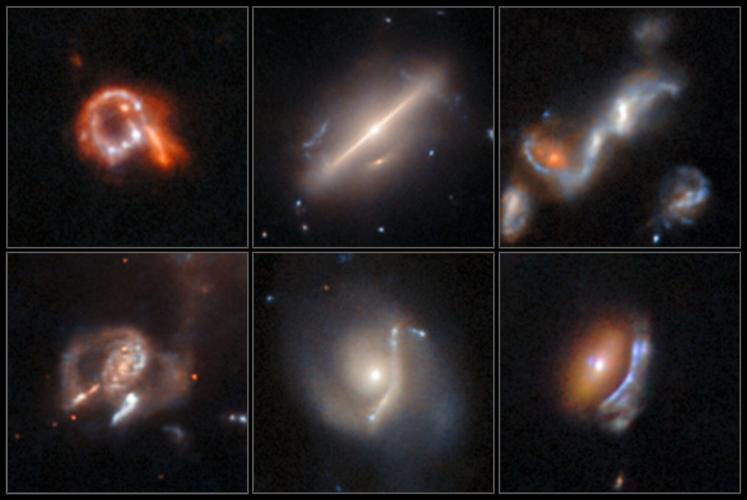
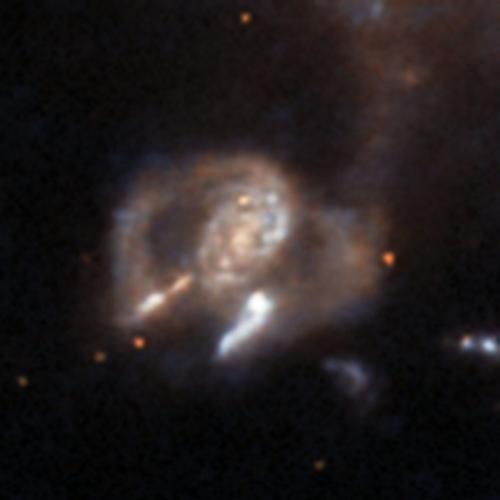
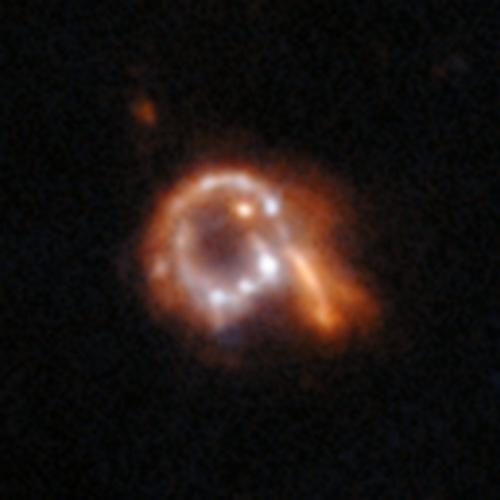
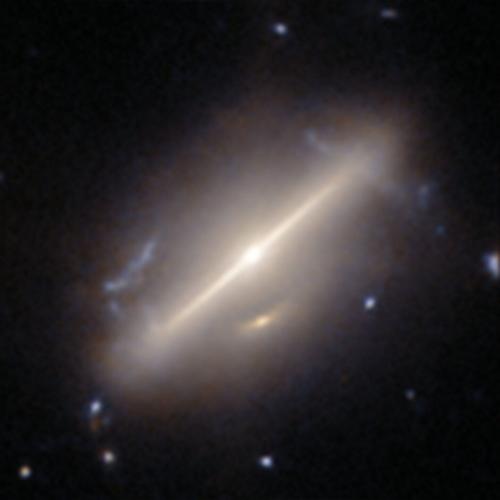
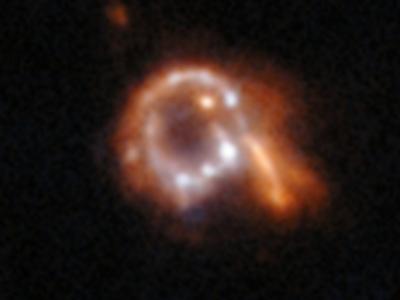
New images from NASA's Hubble Space Telescope include three lenses with arcs distorted by gravity, one galactic merger, one ring galaxy, and one galaxy that defied classification. (NASA/ESA/Hubble/David O'Ryan/Pablo Gómez/Mahdi Zamani via SWNS)
New images from NASA's Hubble Space Telescope include three lenses with arcs distorted by gravity, one galactic merger, one ring galaxy, and one galaxy that defied classification. (NASA/ESA/Hubble/David O'Ryan/Pablo Gómez/Mahdi Zamani via SWNS)
By Talker
By Dean Murray
Artificial intelligence has uncovered a series of mysterious "astrophysical anomalies", according to space scientists.
Revelations include jellyfish-like galaxies with gaseous “tentacles”, massive star-forming clumps, edge-on planet-forming disks in our own galaxy resembling hamburgers, and several dozen objects defying classification altogether.
(NASA/ESA/Hubble/David O'Ryan/Pablo Gómez/Mahdi Zamani via SWNS)
By Talker
The team analyzed nearly 100 million image cut-outs from the Hubble Legacy Archive, each measuring just a few dozen pixels (7 to 8 arcseconds) on a side.
They identified more than 1,300 objects with an odd appearance in just two and a half days — more than 800 of which had never been documented in scientific literature.
Most of the anomalies were galaxies undergoing mergers or interactions, which exhibit unusual morphologies or trailing, elongated streams of stars and gas.
(NASA/ESA/Hubble/David O'Ryan/Pablo Gómez/Mahdi Zamani via SWNS)
By Talker
Others were gravitational lenses, where the gravity of a foreground galaxy distorts space-time and bends light from a background galaxy into arcs or rings.
NASA says that identifying such a diverse array of rare objects within the vast and growing repository of Hubble and other telescope data presents "a formidable challenge".
They said: "Never in the history of astronomy has such a volume of observational data been available for analysis."
To address the challenge, researchers David O’Ryan and Pablo Gómez of ESA (European Space Agency) developed an AI tool capable of inspecting millions of astronomical images in a fraction of the time required by human experts.
(NASA/ESA/Hubble/David O'Ryan/Pablo Gómez/Mahdi Zamani via SWNS)
By Talker
Their neural network, named AnomalyMatch, was trained to detect rare and unusual objects by recognizing patterns in data — mimicking the way the human brain processes visual information.
“Archival observations from the Hubble Space Telescope now span 35 years, offering a rich dataset in which astrophysical anomalies may be hidden,” said David O’Ryan, lead author of the study published in Astronomy & Astrophysics.
“This is a powerful demonstration of how AI can enhance the scientific return of archival datasets,” Gómez said. “The discovery of so many previously undocumented anomalies in Hubble data underscores the tool’s potential for future surveys.”



Commented