
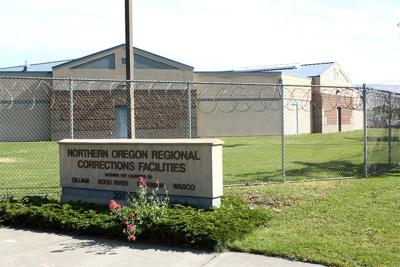
THE GORGE — Worried about a lawsuit filed in Portland, sheriffs from the four counties that run NORCOR, the regional jail in The Dalles, announced Jan. 6 that in December they had asked a federal agency to take three inmates held on criminal immigration charges elsewhere — despite believing that the Northern Oregon Regional Corrections Facilities could legally hold them under Oregon’s sanctuary laws.
NORCOR has a contract with the agency, the U.S. Marshals Service, to house people in Marshals’ custody. But the jail also “formally advised” the service that “individuals facing illegal Re-Entry charges are not to be transported to NORCOR going forward,” the announcement says.
The sheriffs said they took these steps in coordination with jail command staff “to ensure that NORCOR continues to operate within the clearest possible boundaries of state law.”
“Under Oregon sanctuary law, in NORCOR or any jail, we can legally hold these individuals,” Wasco County Sheriff Lane Magill told Uplift Local in an interview.
But in light of a Dec. 10 lawsuit alleging that jail administrators in Multnomah County are “unlawfully agreeing to detain or incarcerate individuals” under a contract with the Marshals Service, NORCOR’s Sheriffs’ Advisory Board made an executive decision, Magill said.
”To mitigate any potential loss or risk of loss through a lawsuit, let’s just get rid of this. Call the U.S. Marshals and say, hey, come get these three individuals, and don’t bring us any more with illegal reentry," he said.
Oregon’s sanctuary laws prohibit state and local officials from helping federal authorities enforce immigration laws, directly or indirectly, unless there is a warrant from a judge. While most immigration-related offenses are considered civil, or “administrative,” people who come into the U.S. without authorization or who are deported and come back without documentation, can face federal criminal charges.
NORCOR’s action is “good news for us,” Mara Bauermeister, a staff attorney with the Oregon Law Center, which filed the suit, told Uplift Local. “We were excited to hear they were taking some action to ensure they’re not violating [Oregon’s sanctuary law], and not even taking any risk.”
The nonprofit law center is representing two plaintiffs, the Portland Immigrant Rights Coalition and the Interfaith Movement for Immigrant Rights.
The suit notes that last year, Department of Homeland Security leaders expanded the typical responsibilities of federal marshals to explicitly include “investigating” and “apprehending” people for immigration violations.
It also alleges that officials with the Multnomah County jail accepted detainees under Marshals’ jurisdiction after the individuals were cleared of non-immigration charges. The suit describes this as “a new arrest … made solely for civil immigration violations” and an “immigration enforcement” action that is against Oregon law.
Nothing like this has been alleged to be happening at NORCOR. But jail officials want to avoid any such possibility. In 2017, the jail was sued over a contract to house inmates in custody of Immigration and Customs Enforcement. (ICE and the U.S. Marshals Service are separate agencies within the Department of Homeland Security, and both currently work on enforcing federal immigration laws.)
“That was a two-year battle and cost us north of a million bucks,” Magill said. NORCOR’s board also ended the jail’s contract with ICE.
But NORCOR, which has a $13.8 million budget, struggles with stable funding, and its current contract with the U.S. Marshals Service is valuable, bringing in $2.1 million for housing and $75,000 to cover the cost of taking inmates to and from federal court in Portland annually, according to the jail’s current budget.
The housing payments are $116 per inmate, per day, according to Magill, so the annual amount can vary with the number of individuals under the Marshals’ jurisdiction at NORCOR. He calculated that losing three inmates for a year would mean a loss of $127,000 for the jail, although it’s not clear how long the three who were moved would have actually stayed. Based on his experience with the lawsuit over NORCOR’s former ICE contract, Magill says that cost is worth paying.
Losing up to “$127,000 to mitigate a two-year battle that cost me almost $2 million seems like it’s pretty good math to me,” he said.
The value of the contract with the U.S. Marshals has grown as NORCOR increased transport services. Last April, for example, the daily average number of inmates housed at NORCOR through the U.S. Marshals Service doubled from 24 to 49, according to a presentation at a NORCOR board meeting May 15, and was 58 in September. That rise is “directly related to our willingness to transport,” jail commander Joyce Orendorff told the board in May.
At its Dec. 18 meeting, where Magill explained the decision to no longer accept inmates with immigration-related charges from the U.S. Marshals Service, board member and Hood River County Commissioner Ed Weathers asked about any potential impact on the contract, which he described as "vital to our sustainability.”
“I’m hoping that this doesn’t have a negative impact on our relationship and our contract with the Marshals,” he said.
Orendorff, the jail commander, said she did not think there would be a negative impact. “It was a good conversation,” she said. “It sounds like it was changing across the state.”
Magill was blunter.
“Let’s be real,” he said. “If they were to walk away, it’s bad for us. And if we were to get tied up in a lawsuit and had to force them out, they’re in bad shape too. It’s partnership.”
Weathers later told Uplift Local that NORCOR needs stable contracts, calling the ups and downs of such agreements “problematic.”
Orendorff agrees. In a November interview, she noted that the four counties NORCOR primarily serves — Wasco, Hood River, Sherman and Gilliam — don’t fully fund the jail.
“So we rely on contracts to make up the difference,” she said. “It’s been a discussion for years.”
•••
Read full notes from the NORCOR board’s Oct. 16 and May 15 meetings, by Gorge Documenters Lynda Ontiveros and Emily Harris
Editor’s note: This story has been updated to correctly spell Sheriff Magill’s last name, and to correctly identify the county he serves. It is Wasco County.


Commented