
By Susan Buce
Columbia Gorge Discovery Center
THE DALLES — The Ponderosa pine dugout canoe, for many years an impressive exhibit at Columbia Gorge Discovery Center, returned to its people on Dec. 8.
The museum partnered with the Wanapum band of Priest Rapids, Washington to return it in an “ethical repatriation,” meaning they returned the canoe to its people of origin, who built their own museum to house it.
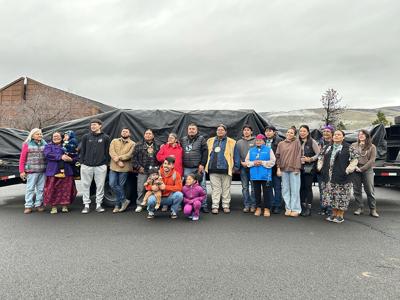
On the morning of Dec. 8, 24 people said goodbye to the canoe and prayed for its safe journey.
For years, museum staff thought this canoe was one found by photographer Benjamin Gifford after the flood of 1894. It came from the former Winquatt Museum, which once stood on Corps of Engineers land near The Dalles Dam, identified as W71-688. The only record the Winquatt museum had was for the Gifford canoe.
But in 2015, museum visitor Kathy Bateman Malley and her brother saw the canoe and told Registrar Susan Buce it was actually one her father, Joseph Bateman, salvaged from the banks of the Columbia after that same flood.
She said the canoe was in their yard for several years, then later donated to Fort Dalles Museum. Sometime after 1953 it went to Winquatt.
The canoe was displayed outdoors for many years. With the loss of their lease from the Corps, the Winquatt Museum closed in 1973 and stowed the canoe in The Dalles Dam, in the upstream gallery of the newest power house.
In 2000, the Winquatt collection was loaned to the newly built Columbia Gorge Discovery Center, canoe included.
No record of the canoe’s donation to Fort Dalles could be found, since the minutes from the Wasco County/City of The Dalles museum commission were missing from the 1950s-1960s.
The leader of the Wanapum band, Clayton Buck, came to the museum this March to discuss the canoe and request ethical repatriation. His knowledge about the details of the construction of the canoe, along with Kathy Malley’s story, confirmed his claim that this particular canoe belonged was built by Robert “Bobby” Tamawash and his two brothers. They carved three canoes which were lost in the “Hanford Floods” of 1948.
When Clayton brought Bobby to view the canoe in the late 1990s, Bobby was an elder in a wheelchair. He described to Clayton, before entering the museum, how the wood was splitting down the middle and how he’d just done a repair with a metal patch. On that visit, they made a “handshake agreement” with museum leaders to repatriate the canoe once the Wanapum had a museum with temperature, humidity and light monitoring and control.
Clayton said the bump and hole in the bottom of the canoe was built to hold a torch because their people did night fishing. The light from the torch attracted fish, which they speared. The Wanapam Heritage Center was completed in 2015.
Meetings were held, papers signed and everyone in agreement the ethical thing to do would be to return the canoe to the Wanapum people.
In digging through museum records, one document dated Sept. 10, 1997, states “Four Wanapam Indians accompanied by Dr. Paul Nickens, Senior Research Scientist at Pacific Northwest Laboratory in Richland (associated with Hanford), came to see our canoe today. They think it is one of their canoes that washed away during the 1948 flood.”
A more recent donation of photos from the estate of Lewis Nichols included a photograph taken at Fort Dalles museum, showing two canoes. The real Gifford canoe’s fate is unknown.
A question was, “How did it travel so far down river?” Oregon Climate Service, from Oregon State University, keeps a list of maximum peak water levels recorded every year since 1868. The Corps of Engineers identifies 450 cubic feet per second (CFS) as the start of minor flooding, with 600 CFS the start of major flooding.
1996 is a flood year many local people remember, with sandbags lining streets. The Baldwin Saloon’s kitchen in the basement flooded. Mill Creek overflowed its banks. On June 11, 1996, the river gage measured 83.94 feet, with a streamflow of 456,000 CFS.
The 1948 flood measured 154.56 feet on May 13, with a streamflow of 1,010,000 CFS. And that time, no dams stood between Priest Rapids and The Dalles.
Its new home is Wanapum Heritage Center, 29082 Washington 243, Mattawa, Washington 99349, www.wanapum.org.
•••
Martin Gibson contributed to this report.


Commented