
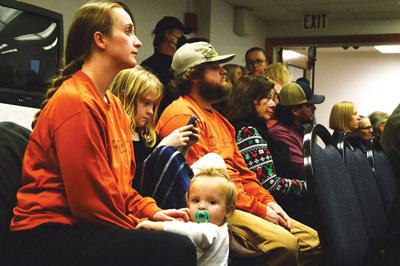
HOOD RIVER — Packer Orchards was the hot button item at Hood River County’s Planning Commission meeting on Dec. 10, where the business sought exemptions to several conditions outlined in its farm stand permit.
The hearing lasted almost three hours, drawing a large crowd to testify and listen.
The commission’s decision — which is now scheduled to be made at a Feb. 11 meeting — will be the conclusion of a long process for Packer Orchards and could set the precedent for future farm stand permitting in Hood River County. It comes on the heels of the Oregon legislature’s own contentious farm stand debates, which are now paused but may come up in the 2026 legislative session.
On one side is Tammi Packer, owner of Packer Orchards & Farm Place Farm Stand. On the other is Hood River County’s Planning Department, land-use advocacy group Thrive Hood River, and neighbors of the farm stand on Thomsen Road, debating whether the farm is operating under the rules laid out for land zoned exclusive farm use (EFU).
EFU land is a specific designation protecting farmland from other commercial use and development. In service of that, statewide regulations define how farm stands can operate on the land, including a rule that income from fee-based activities, retail sales, and prepared food can’t exceed 25% of the farm stand’s annual sales, and guidelines that the only structures allowed are those that promote the sale of farm crops and livestock — the whole purpose of the farm stand.
Thrive Hood River opposed
For the first stipulation, Packer argued that some of their event admission fee should not be included in the 25% incidental income since they provide a certain amount of farm products with admissions. Further, some of their baked goods sales should not be counted as prepared food because they are made with more than half of local products, packaged to FDA standards and not intended to be eaten at the farm stand, even if they are not sold in bulk packages. The scrutinized structures include several permanent and temporary tents and play structures intended to engage a younger generation with farm work — tractors, a corn-kernel sand box, slides, swings and climbing frames. The Packers claim the structures are within the bounds of the farm stand, but Thrive Hood River, their main opponent, disagrees.
After Hood River County Community Development Director Eric Walker conditionally approved their permit in July, the Packers appealed and met with county staff, along with Thrive Hood River, to try to come to a compromise, but were unsuccessful. The purpose of Wednesday’s hearing was to work out a legal solution, and for all parties to be heard before commissioners make their decision.
Appealing application conditions
Packer Orchards originally appealed 10 of the conditions; however, they brought only seven to the hearing, including the two most contentious: the 25% incidental income stipulation, and the removal of the play structures. Packer Orchards’ position is that they won’t be able to stay afloat if they accept all seven of these stipulations.
“That work has already been done to the extent that Packer Orchards thought they could reduce it and still be viable,” said Elaine Albrich, the attorney representing the Packers in response to a question from Commissioner Kira Guisto about moving or reducing the play structures.
Packer said they are being unfairly penalized, that Hood River County has added additional stipulations above and beyond those at the state level, and that other farm stands in Oregon are permitted to operate with the same or more playground equipment, including bouncy slides and zip lines, as is the case of Red Berry Barn in Washington County.
Public comment both for and against
The public showed up to the hearing in full force to give their opinions, with standing room only and people calling in via Zoom from California, Washington and Kansas to join the discussion.
“I’m here, apparently in a Hallmark movie. It feels like big government versus family farm,” said Dale Milam, a local teacher.
Two neighbors of the farm stand on Thomsen Road spoke about how special Packers is to them. One, Traci Dominguez, became emotional during her testimony. “They are a very important part of our community, and we need to support them 100%” she said. “They’re really great people and very hard workers.” Daughter Paige Dominguez added, “[removing the play structures] would be a big loss to our community.”
Many others told the planning commission how much they appreciated it as a place for outdoor education, agritourism, and family activities: “We [agritourism farms] are the last bridge between agriculture and the concrete jungle,” said John Bos, an almond orchardist from California who came to support the Packers.
But others, including Jim Edwards, who owns property adjacent to the farm stand, accused Packer Orchards of having “an amusement park” rather than a farm stand on their property. Others expressed their concerns about the unintended consequences of setting this precedent, like Chris Robuck, a member of Thrive Hood River’s board. “What one landowner can do, everyone can do,” she said, adding that easing the rules could potentially allow people to set up non-farm businesses in EFU zones.
Throughout the extensive testimony, speakers were passionate but respectful, with most thanking the planning department and the commission, acknowledging the difficulty of the decision, and the work done on all sides.
Continuance granted
After three hours, Thrive Hood River lawyer Ricky Armendariz requested a continuance — more time to review the documentation in light of changes made to the appeal and the testimonies given at the hearing. Because of this, a decision has not yet been made by the commission, and the record remains open for written testimony until Dec. 24. Rebuttals to the testimony can be submitted until Jan. 7.
At that point, Packer Orchards will have a final chance to disprove testimony and prove their claims, culminating in a final hearing scheduled for Feb. 11. Commissioners also plan a site visit to Packer Orchards so they and planning department staff can see first-hand the play areas and food items being contested.
More online
A Dec. 8 story by Uplift Local reporter Ken Parks gives a full history of the issue; visit columbiagorgenews.com. (Uplift Local is a partner of Columbia Gorge News).


Commented