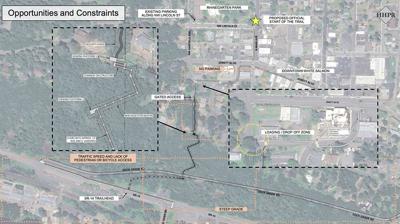
The preliminary pathway of White Salmon’s Bluff Connector Trail, a steep-grade, pedestrian corridor linking Jewett Blvd. with State Route 14 through a series of stairs and walkways. Key features include a security gate to enforce trail hours, a public viewing platform accessible to disabled folks near the bluff’s edge and three water access points for firefighting.
The preliminary pathway of White Salmon’s Bluff Connector Trail, a steep-grade, pedestrian corridor linking Jewett Blvd. with State Route 14 through a series of stairs and walkways. Key features include a security gate to enforce trail hours, a public viewing platform accessible to disabled folks near the bluff’s edge and three water access points for firefighting.
WHITE SALMON — The City of White Salmon held its second stakeholder meeting to further refine the proposed Bluff Connector Trail, a steep-grade, pedestrian corridor linking Jewett Boulevard with State Route 141 on Nov. 14. Consultants Harper Houf Peterson Righellis (HHPR) presented an update and rough design plan, but the 30 or so residents attending expressed mixed support.
Funded by Washington’s Department of Transportation, White Salmon is currently assessing whether the project is structurally and financially possible while incorporating public input. With no projected cost or construction timeline, Thuy Cao, HHPR public involvement specialist, first summarized the feedback they’ve received thus far.
Between a previous stakeholder meeting and open house, residents identified many benefits: recreational opportunities, scenic views for public enjoyment, increased walkability and connectivity, wildfire mitigation and a greater sense of community. The main concerns included loss of privacy, impacts on property values, parking, increased wildfire risk and maintenance.
Starting near Rheingarten Park, the trail would cross Jewett Boulevard and meander toward Edgecliff Drive, with a viewing platform jutting over the bluff behind the Riverwatch Drive cul-de-sac. A series of stairs, walkways and other viewing platforms would then lead users down the bluff. After Cao finished, several property owners commented on how more foot and car traffic in the area would affect them.
“The infrastructure, in my mind, just isn’t there for this type of project. I think it’s a little ironic, too, the stairs that were there previously went up in flames,” said Beatriz Acosta, who lives on Edgecliff. “I have small children who, I’m sure, will turn into beautiful young ladies, and I would like them to have their privacy.”
Acosta’s neighbor, Corey Arnold, emphasized the viewing platform in particular will likely attract a lot of people, tourists along with locals, and hoped a security gate could help turn around nighttime visitors. As for parking, HHPR proposed creating a drop-off area near the start of Edgecliff Drive so disabled folks could access the trail, but doesn’t plan to implement additional parking, opting to use existing spaces around Rheingarten Park instead.
“Parking would be enforced by signage, so then we’re just sort of hoping that people pay attention to signs and abide by it,” said Lauren Egert, who lives on nearby Overlanders Drive. “What’s my recourse if people are still parking?” With sparse sidewalks, a blind corner by the Iconica Hotel and kids who play in the roads, more cars could worsen current safety issues.
City Administrator Troy Rayburn clarified the police department would administer the parking rules. Beyond the police, Alyson Arnold, Corey’s wife, questioned whether White Salmon could manage the trail, should it be built.
“I see a ton of comments on social media and here around town about how our sidewalks aren’t maintained, our roads are in bad shape,” said Arnold. “I don’t think White Salmon necessarily has the trust to maintain things in the long term.”
Even so, many affirmed their support of the trail, including Dale Grinstead-Mayle representing most of the White Salmon Business Association. He saw the trail as an opportunity for commerce, and others similarly thought it could tighten local relationships.
“There’s a component that is important to me, and it’s about community. That’s a hard thing to quantify — it’s really something you need to experience,” said resident Patrick Odell. He met the woman who’s lived atop Hood River’s bluff staircase for decades; she’s had no privacy-related issues and uses the stairs constantly. Odell continued on to describe the trail as a place to exercise and build friendships.
“We live in a house near Gattis Park; we have people going by it all the time. For me, it feels like a gift. It’s actually one of the things I like most about my house,” said Kate Bennett, resident and CityLab board member. “But I recognize that might be a feeling that not everyone shares.”
Throughout the meeting, residents went back and forth on wildfire risk, with some arguing the trail could enhance firefighter access while others believed it would only increase the chances of an accident. Fire Chiefs Bill Hunsaker and Wes Long both reportedly support the project.
HHPR would construct the trail with noncombustible materials, clear all vegetation within at least 20 feet of the trail and provide three water access points for firefighter use. The city and HHPR expect to complete the feasibility study, including a complete design plan, by early 2025. The last stakeholder meeting will be held in January, but the date is not yet determined.



Commented