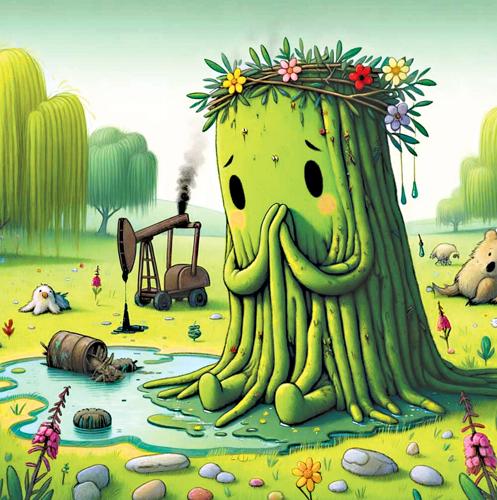
Tragethon is happy with this AI-generated image. He said the well’s plant-like shape expresses her sense of connection with the wild creatures about her.
Tragethon is happy with this AI-generated image. He said the well’s plant-like shape expresses her sense of connection with the wild creatures about her.
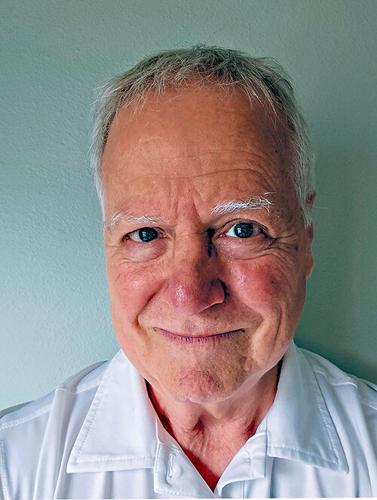
THE GORGE — Dave Tragethon, former Mt Hood Meadows marketer, current climate change activist and storyteller, recently won the Far West Ski Association Environmental Award for his story of an orphan oil well, “Willow’s Second Chance.”
Tragethon worked as vice president of marketing for Mt. Hood Meadows Ski and Summer Resort for some 30 years, part of his long background in storytelling and communication skills. There, he formed a friendship with fellow employee Curtis Shuck, founder of Well Done, a nonprofit dedicated to capping orphan oil wells.
“Orphan” wells are oil or gas wells that have been abandoned by the fossil fuel industry after they were no longer viable, and often their company went bankrupt or abandoned them for other reasons. Often, their location and ownership is unknown. As their infrastructure deteriorates, orphan wells can leak pollutants — including methane, a greenhouse gas. Methane breaks down faster than carbon dioxide, but can trap 80 times more heat during its first 10-20 years in the atmosphere.
Orphan oil wells “benefit no one, they waste natural resources, contaminate water, and pose a threat to the environment,” according to the U.S. Geological survey. Capping or repurposing them can reduce pollution and harmful emissions. The Biden administration has invested $4.7 billion in doing just that, according to a government press release.
“So the most immediate way that we could affect a warming planet is to remove as much methane from the atmosphere as we can,” Tragethon said. “And so that’s really what the story or what this message is about, and humanizing and personifying something that’s very industrial.”
Dave Tragethon
To cap an orphan well, the mechanisms for drilling for oil and gas are removed, and replaced with a solid cap of concrete.
Sorting out who owns and is responsible for an orphan well can be difficult. Decommissioning one can cost thousands — Well Done’s average cost is $65,000.
The Well Done is a 501c3 nonprofit that aims to locate and cap orphan wells, then monitors the capped wells to make sure they remain sealed.
Meadows is fairly forward-thinking about sustainability, Tragethon said. Climate change has been identified as an existential threat to the industry by the National Skiers Association. So when Shuck heard Tragethon had left Meadows, he got in touch about a collaboration.
Wanting to write a Christmas story, Tragethon crafted a tale about “what it might be like to be” an orphan well, and shared it last December.
Response was positive. Curtis asked Tragethon to write a book, now distributed to kids in regions Well Done is working to cap orphan wells.
Tragethon’s protagonist, formerly productive oil well Willow, is abandoned by her owners. She deteriorates, releasing methane and icky pollutants into the meadow she loves. This depresses Willow immensely.
Willow is an agent of pollution. Instead of vilifying her, Tragethon chose to humanize her, presenting Willow as an empathetic, sweet-natured sentient being who “just needs a little help” to become safe, clean and happy.
Well Done workers arrive to cap Willow, and clean up the mess, restoring her sense of purpose and self-respect.
The tale’s art was a “cooperative effort” with Chat GPT. Tragethon said he’d normally go to artist and illustrator friends, but Well Done needed a quick turnaround. AI allowed him to have the finished book in his hand within four weeks. “This doesn’t mean that AI is my future, it means that it’s a tool for storytelling,” he said.
Tragethon “really felt that having that emotional link to something, particularly from a children’s storybook, might make a better connection to the overall issue. And that is, that we have three and a half million orphan wells in this country.
“The wells themselves are in a condition where they may be leaking methane or contaminating groundwater,” he said. “And from a children’s perspective, they really don’t want to be doing that. And they just need a little help in order to have a second chance, in order to be able to stop polluting and actually help protect the environment.”
Shuck himself ran a drilling company and is “oil industry agnostic.” Much of the equipment required for operating a well, and capping a well, is the same. But 3.5 million wells is just too many for one foundation, so Well Done is creating a certification process to train others.
The first documented oil well was sunk in Pennsylvania in 1859. “Back then, almost everybody had a well, they were just planting wells all over the place. ... It was very prominent throughout the Midwest. And over time, you know, the ownership of these wells has been either displaced, or the companies have gone out of business or the product has been sold. But the problem remains, and those wells that have literally been abandoned, so you can blame them if you want, but it’s not going to do any good,” Tragethon said.
Tragethon doesn’t know what’s next for him as a writer, but he’s sure he’ll think of something.
“I really felt like our generation has created this problem. And I’m not anti-oil or anti-industry or anti-technology. But this is not going to be a problem that is resolved within my lifetime,” Tragethon said. “Hopefully it will be resolved within the lifetime of somebody who was in second grade now,” within the lives of his readers.
“I think it would be awesome if my contribution to the ski industry after all these years was a book that kids loved, and became important in their lives. And they felt like there was something that they would be able to do in order to change things and make things better,” he said.
He recalled the story of a high school class from Ohio, which raised funds to cap two abandoned wells on a family farm, which had sickened horses. “It’s a threat,” he said. “But I want it to be presented in a way that a young person, even as young as someone in second grade, can say, ‘It’s a problem. But there’s something that I can do about it.’”
He thinks younger generations are more receptive to this message: “Even someone is small and insignificant as Willow could make a change and help save the planet.”
Tragethon lives in Portland, and emphasized he is happy to travel for readings. He can be reached through tragethonconsulting.com.



Commented