
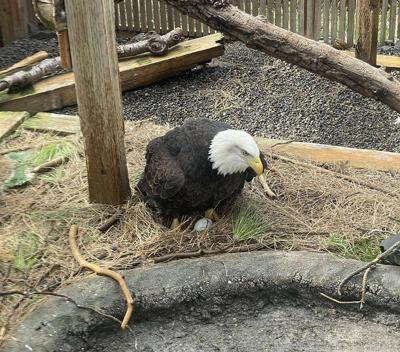
THE DALLES — She’s laid the first egg.
Although she will never hatch a chick, the female bald eagle housed at Columbia Gorge Discovery Center & Museum nests annually with her partner, Ferguson, said Raptor Coordinator Julia Khoury.
And on March 4, Liberty was caught hunching in over the first egg of 2025 in her annually-refurbished nest of ponderosa pine needles. She’s since laid another egg.
Liberty and Ferguson were both injured in the wild, and can never be released.
As a result of their injuries, both experienced the amputation of a wingtip. The bone from which several of the long, strong primary feathers grow at the tip of one wing is gone, meaning that while each can take “pretty big hops,” they’ll never be capable of true flight again.
Neither could survive in the wild.
Their age is uncertain, but Ferguson has been in the Discovery Center’s care since 2007 and is probably about 23-24 years old; Liberty has been at the museum since 2011, and is probably about 16-17, Khoury said.
Each year, Liberty and Ferguson start rebuilding the nest in February — always in the same spot. Liberty will lay 2-3 eggs, usually mid-March.
Soon after, a caretaker will enter the pen draped in a white bedsheet. Nicknamed the “egg ghost,” they’ll approach Liberty’s nest until she leaves it. Moving quickly to minimize the birds’ stress, the staff shines a light through each egg to make sure they’re infertile, then replaces them with a couple of Liberty’s old eggs, saved from a previous year.
So far, though, Liberty has never laid a fertile egg, Khoury said.
“There’s a lot of protections on eagles in general, as part of strategies to protect them, and to help bring them back,” she explained. “... And so to make sure there’s no illegal trade of eagle parts, it’s really regulated ... and we don’t have that breeding permit.”
Since neither Liberty or Ferguson can fly, they could not teach their chicks to fly either and would not make good parents, Khoury said.
But every year, Liberty follows her instincts anyway. “Eagles do mate for life, and they will spend most of the year separate. But they will come back to the same nest every year and keep improving it,” Khoury said.
Tours of the aviary have been halted while Liberty broods to avoid stressing her. But a camera is installed in the aviary and overlooks the nest. Visitors to the museum can watch the camera on a screen in the children’s room.
“Liberty will be spending a lot of time laying on the nest,” Khoury cautioned. “Occasionally, she’ll poke around at the pine needles and rearrange them just the way she likes it.”
Sometimes she’ll switch out with Ferguson for a while. They will take turns incubating the eggs — with Liberty doing most of the work — until the “egg ghost” removes them. That happens after about 35 days, when a wild, fertile egg would hatch. In the past, eggs were experimentally left in longer, and Liberty just kept brooding until they were finally taking away.
Eggs gone, the pair will return to normal behavior and eagle tours will resume — until next March.


Commented