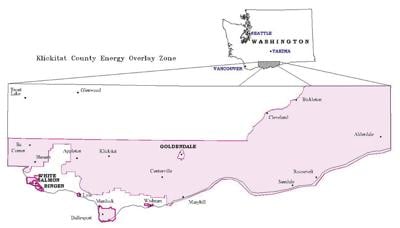
A map of Klickitat County’s current Energy Overlay Zone. The proposed version would significantly decrease the acreage in which industrial-sized solar facilities are allowed, conditional or outright.
Image courtesy Klickitat County Planning Department
A map of Klickitat County’s current Energy Overlay Zone. The proposed version would significantly decrease the acreage in which industrial-sized solar facilities are allowed, conditional or outright.
Image courtesy Klickitat County Planning Department
GOLDENDALE — On July 20, the Klickitat County Planning Commission held a public meeting to discuss first steps for scaling back the Energy Overlay Zone (EOZ), specifically in relation to industrial-sized solar facilities.
Initially created in 2004, the ordinance and environmental impact process focused heavily on wind and did not anticipate the growth of solar in the area. Planning Director Scott Edelman said the planning commission made the suggestion.
The wind boundary would remain unchanged, but as it is currently proposed, solar would be confined to eastern Klickitat — the boundary being Rock Creek Road. Small sections were added to the northeast and central boundaries.
Anywhere outside of the mapped red zone would not allow industrial-scale solar, conditional or outright.
Reducing the overlay might require a State Environmental Policy Act (SEPA) addendum from the Washington Department of Ecology, if that. “We’re not creating more impact, we’re creating less impact,” Edelman said.
However, expanding the overlay into new areas, even a small acreage, might require additional environmental and cultural studies, consultation with the Yakama Nation and poses a higher risk of appeals. The cost could be prohibitive, with $100,000 being a loose estimate.
Discussions about who pays for the new land inclusion in the overlay arose — whether it should be landowners, developers or the county. An idea about including a criteria exception was floated to push the costs away from the county.
Areas like Goldendale, Centerville and High Prairie would no longer be included in the solar EOZ, as currently proposed, and farmers would not be able to lease or sell their properties to industrial-sized solar development. The potential economic impact did not go without input.
“Based on what we’ve heard in community meetings, most of the farmers supplement their income with solar,” said Klickitat County Commissioner Todd Andrews. “We’ve heard that the wheat fields out there are dry weeds and generally, the topsoil is not as deep.”
Centerville rancher Matt Chiles also voiced concern about whether the county’s solar prohibition will hold up at the Energy Facility Site Evaluation Council (EFSEC). In Washington, the governing body can approve energy facility development separate from the county.
“Re-looking at the solar ordinance in light of potentially shrinking the energy overlay zone for solar is probably a wise thing to do,” he added.
As the proposal for the new EOZ is weighed by the planning commission, the Klickitat County Planning Department is also working on finalizing an ordinance that dictates how industrial-sized solar facilities and Battery Energy Storage Systems (BESS) are regulated. The current draft has been under legal review since last December, but Edelman hopes it will be available in time for the next board meeting in September.



Commented