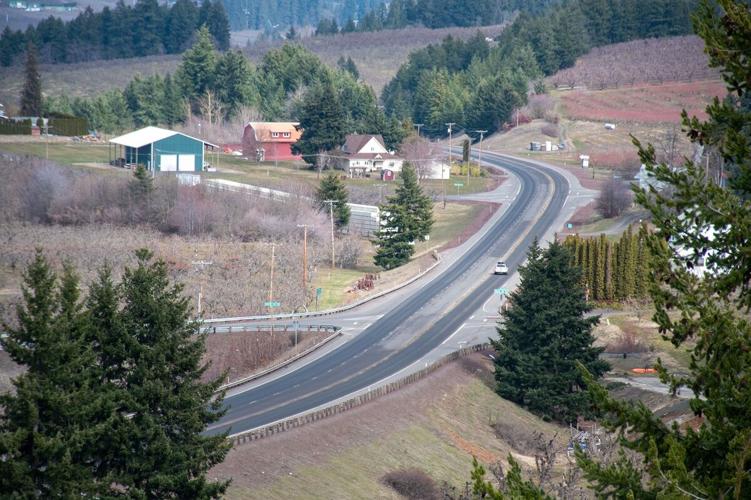
A section of Highway 35 past Odell. The highway serves as a popular expressway to Mount Hood. Legislation could change the name to honor the Japanese American soldiers who served during World War II.
A section of Highway 35 past Odell. The highway serves as a popular expressway to Mount Hood. Legislation could change the name to honor the Japanese American soldiers who served during World War II.
Legislation would rename a Mid-Columbia Valley state highway near Hood River for Nisei WWII veterans
Oregon lawmakers are close to honoring hundreds of the state’s Japanese-American soldiers who fought valiantly for the U.S. Army in World War II by adding a new name to Oregon Route 35 in the Mid-Columbia Valley.
Republican state Sen. Chuck Thomsen of Hood River introduced Senate Bill 1509 early in the short legislative session to designate the 41-mile Route 35 from the Columbia River south to Highway 26 as the Oregon Nisei Veterans World War II Historic Highway.
It would be the first state highway to honor Oregon’s Japanese-American soldiers, who faced discrimination at home because of their heritage. At least eight other highways in Oregon have been renamed during the past two decades to honor U.S. military veterans.
On Feb. 9, senators voted 22-0 to approve the legislation (with one senator absent and seven excused). It heads to a House committee hearing this week, then to a possible House vote. Once approved, SB 1509 would go to Gov. Kate Brown for her signature.
Retired U.S. Army Lt. Col. Dick Tobiason’s nonprofit Bend Heroes Foundation has been the driving force behind most of the highway designations. He has successfully lobbied legislators for more than a dozen years to create the honors, raising thousands of dollars for road signs with the new names.
Tobiason said that besides honoring the sometimes-forgotten Oregon soldiers, Thomsen’s bill would help correct a wrong suffered by the state’s Nisei soldiers at the end of World War II, when they were discouraged from returning to their Northwest homes because of anti-Japanese prejudice.
A resolution by Hood River’s American Legion Post 22 supporting the legislation, drafted with Tobiason’s help, seeks to right an injustice when in November 1944, the names of 16 Nisei veterans were “blacked out” from a place of honor at the Hood River Courthouse. The names were restored 13 weeks later after national condemnation and pressure from the American Legion national commander.
More than 100 Oregon Nisei soldiers — U.S. citizens who were born to Japanese immigrants — served in Europe and parts of the Pacific during the war. About 60 of them came from the Hood River Valley. Many of the Nisei soldiers had been imprisoned in relocation camps with their families under a 1942 presidential order following the Japanese attack on Pearl Harbor.
Most of the young soldiers served in the 100th Battalion/442nd Regimental Combat Team in Europe or as linguists in the Military Intelligence Service in the South Pacific and in post-war Japan. The 442nd Regimental Combat Team is one of the most decorated units in U.S. military history. The regiment also liberated a slave-labor camp at the Dachau concentration camps northwest of Munich.
‘The perfect time’
About four dozen people testified in favor of the proposal during a Feb. 3 hearing before the Senate Committee on Veterans and Emergency Preparedness. Thomsen is vice chairman of the Senate committee. Among those submitting testimony were former Oregon Gov. Ted Kulongoski and his wife, Mary Oberst, submitted testimony supporting the highway honor. “Now is the perfect time for Oregon to create this special honor for these heroic Oregon soldiers,” Kulongoski and Oberst wrote to the committee. “And Highway 35 is the perfect place, significant because the families of many of Oregon’s Nisei veterans owned or worked on orchard fields along the highway until they were forcibly removed during World War II.”
Linda Tamura of Tualatin, a former Willamette University professor whose father and uncle served in the U.S. Army during the war, wrote in her testimony that the honor would remind future generations of the nation’s commitment to its soldiers, no matter who they were.
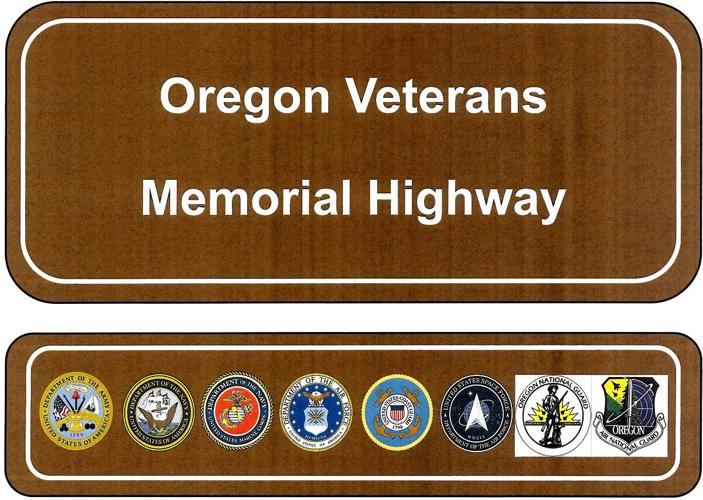
A sample memorial sign.
Contributed graphic
“Honoring these heroes who stood above discrimination can symbolize hope and resilience for our next generations,” Tamura wrote. “They paved the way. Highway 35 can become a highway of gratitude and remembrance.”
Lynn Fuchigami Parks, former executive director of the Japanese American Museum of Oregon in Portland, told the committee that honoring the veterans would add “to their remarkable story.”
“During WWII, the Nisei soldiers fought prejudice and fought for freedom both at home and abroad, and their story is an incomparable example of extraordinary courage, loyalty and selfless service beyond compare,” Parks told the committee. “The fact that they fought and died for a country that had unjustly imprisoned many of them and/or their families and friends, only adds to their remarkable story.
“Elevating their story to help educate future generations and leaders to promote equality and justice could not come at a more critical time. Bringing attention to this history by naming Highway 35 as the Oregon Nisei Veterans WWII Memorial Highway is a powerful and permanent action to help achieve this.”



Commented