HOOD RIVER — Roughly $4 million in budget reductions for the 2025-2026 school year was confirmed at the Hood River County School District’s (HRCSD) April 9 board meeting. Superintendent Bill Newton and Chief Financial Officer Mark DeMoss provided the update.
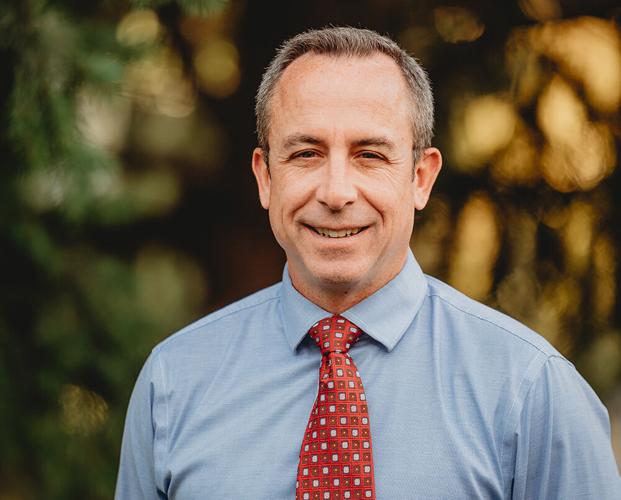
Bill Newton, superintendent, Hood River County School District
Mark DeMoss, CFO, Hood River County School District
The budget has been a reoccurring item on board meeting agendas — it was also discussed Jan. 22 and Feb. 26 — and at community and staff listening sessions. Lower than expected revenues, declining student enrollment, expiration of federal pandemic relief funds, inflation, rising operational costs, and a $2.5 million increase in Public Employees Retirement System (PERS) contributions are all factoring into the shortfall.
“I’ll be honest with you that this meeting tonight is not something I’ve been looking forward to,” Newton said. “While we’re undergoing reductions similar to many school districts throughout the state, it still doesn’t reduce the level of concern that I and others have regarding the underinvestment in education in our state … Despite our efforts to prevent a reduction in force, we will unfortunately need to lay off some licensed staff.”
Personnel make up the largest piece of the district’s general fund at approximately 80%. “Change is always difficult, and it is particularly hard when people’s livelihoods are impacted,” Newton said.
Creating a budget is always a challenge for Oregon districts because of how the state funds education; districts are required by law to file their budgets by June 30 but often don’t know how much money legislators will set aside for education until June or July.
As Oregon School Board Association Communications Specialist Jake Arnold puts it, “School budgeting is one part science and one part educated guesses seasoned with unforeseen circumstances and a pinch of hopeful thinking baked under a constant heat of state and federal requirements. Few of the key numbers are under school leaders’ control."
HRCSD will hold its first budget committee meeting on April 29, with a second slated for May if needed. The budget will be brought forward for board approval in June, “and then in June and July, we’ll have potential budget staffing adjustments, depending on the finalized school funds,” Newton said. “… We may need to come back to the table and take a look at further reductions.”
Before the budget discussion, five parents and one student representing Cascade Locks Elementary (CLE) gave public comments in person, urging the board to consider the needs of the community before making cuts to teaching staff and sharing concern that its students would fall behind if a blended classroom model was adopted.
Cascade Locks Mayor Brenda Wood also provided comment, virtually, saying schools are the hub of a community and cuts would have a devastating impact. She also shared concerns about a lack of representation on the board. (Director Chrissy Reitz, position 1, represents both Westside and Cascade Locks elementary schools.)
Newton addressed CLE specifically during the discussion and explained budget reduction details as it pertains to the school. CLE has the lowest enrollment — 65 students — and the highest cost per student to operate in the district.
“Multi-age classrooms are necessary to normalize your costs,” he said, emphasizing how the district will support the change, such as ongoing professional development training and collaboration time for licensed and classified staff. The school will continue to have a full-time student support specialist, as well as math and reading intervention and early language development (ELD) specialists.
“I would love for our committee to trust every decision that we make is the best decision that we can make with what we have,” said Director Julia Garcia-Ramirez during board member comments. “I really want to put that out there — please trust that the decision that the district and the board makes is the best that we can with what we are.”
Director Jen Kelly echoed the sentiment.
Board members also thanked Newton and DeMoss and expressed appreciation for the district’s transparency. They also encouraged stakeholders to contact elected officials and advocate for education funding.
“I know it feels a little hopeless right now, at least for me, and I’m sure a lot of people feel the same way,” said Board Chair Corinda Hankins Elliot, “but the only way that forward is really working hard as a community, together, to try to recoup some of that funding … I really encourage everyone to use their voice.”
“Advocacy is important,” agreed Reitz. Education Advocacy Day is April 24 in Salem, she added, and encouraged everyone to give testimony, written or in person, with personal stories about how cuts — or more funding — would affect their child.





Commented
Sorry, there are no recent results for popular commented articles.