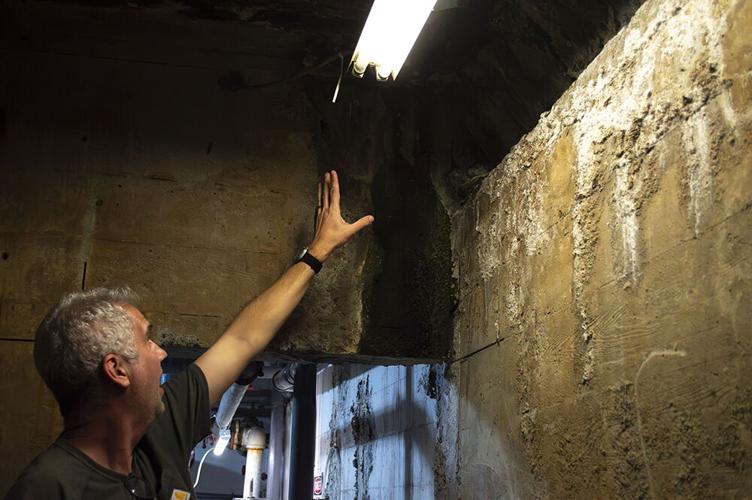
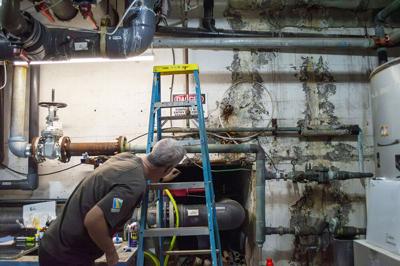
Mark Hickok, director of Hood River Valley’s Parks and Recreation District, looks down the pipe chute underneath the Hood River Aquatic Center on April 8. The right wall of the tunnel, which encases a primary pool drain, has signs of water corrosion and was originally built in 1947.
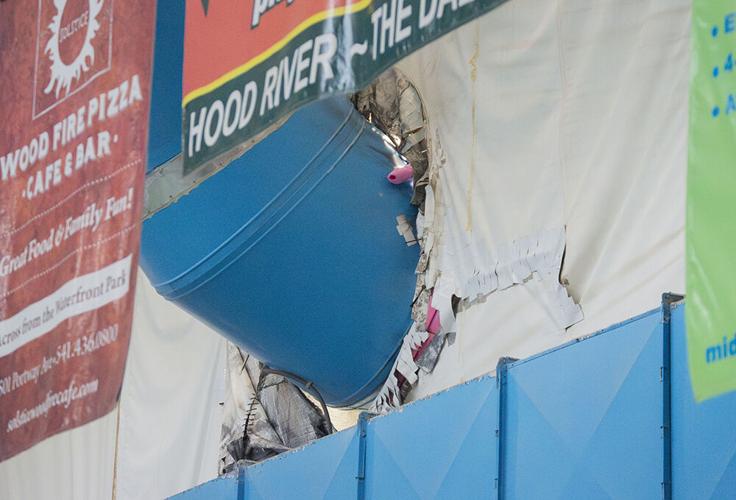
Despite best efforts from district staff, including pool noodles and additional insulation outside, the seal around an HVAC chute routinely rips because of high winds. The original tent panels are two decades past their useful life, and due to a host of defects, Hood River’s Aquatic Center costs about $12,000 per month to heat during the winter.
Mark Hickok, director of Hood River Valley’s Parks and Recreation District, looks down the pipe chute underneath the Hood River Aquatic Center on April 8. The right wall of the tunnel, which encases a primary pool drain, has signs of water corrosion and was originally built in 1947.
HOOD RIVER — A roof held together by zip ties and sealed with pool noodles. Doors that have never been aligned since they were installed. A boiler that requires frantic eBay searches for parts because the American distributor jumped ship. Walls built just after World War II serving as the only separation between critical mechanical systems and millions of gallons of water.
Hood River Valley’s Parks and Recreation District (HRVPRD) is asking the same question as somebody who owns a 1999 Camry with 350,000 miles on it: How much more money should I sink into this, considering everything could fall apart tomorrow?
Not much more, the district hopes. After its 2024 proposal failed, HRVPRD has two measures on the May primary ballot. If attitudes haven’t changed, the closest indoor pool for 20 miles will inevitably close when something severe enough breaks, and more than 40 community education programs — from youth sports to summer camps — will end for more than 3,600 participants come fall.
More than 65,000 people use Hood River’s Aquatic Center every year, according to HRVPRD. That captures older folks doing water aerobics; high school water polo; all the countywide kindergartners, second graders and fourth graders learning to swim; and everyone else in between.
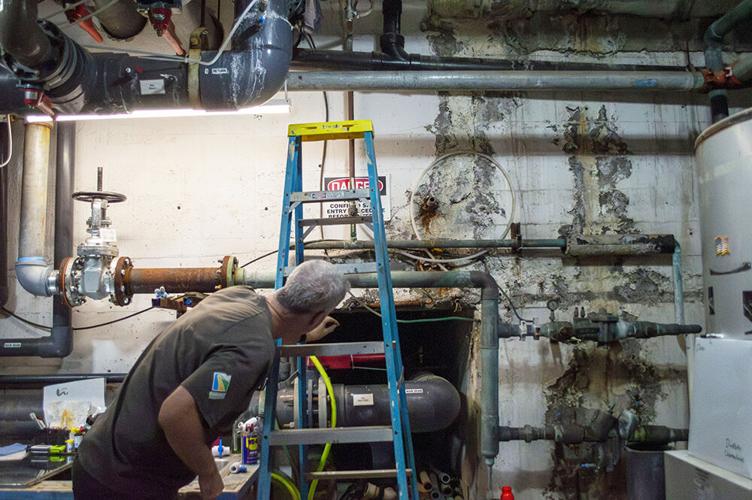
Right below the pool deck, Hickok points to water actively trickling down and infiltrating the aquatic center’s mechanical room.
Nathan Wilson photo
But back in 2017, independent engineers estimated that the pool had a maximum lifespan of five years and gave it a failing grade (44.48 out of 100). Conditions have only deteriorated since then, and after years of saying no, HRVPRD took over community education from the Hood River County School District in 2020 to prevent the permanent loss of those programs.
While the school district initially funded two full-time positions to aid the transition, it doesn’t anymore. And with the pool becoming increasingly expensive to operate, HRVPRD is, quite frankly, at its breaking point.
Lessons learned, and the new proposal
Last election cycle, the district made a big ask of those living within its boundaries. The $72.25 million bond would not only have realized a new aquatic center fit with community spaces, a gym and more amenities, but also funded the purchase of Parkdale Park, development of Westside Park and a connected Indian Creek Trail.
Coupled with a 0.43 cent levy, annual property taxes were going to increase by $373 for the average homeowner. This time around, however, the district’s pursuing a middle ground.
“We landed on a safe, functional pool that’s a similar size to what we have now, but with improvements that make sense, considering this is going to be for the next two generations,” said Christy Christopher, president of HRVPRD’s board of directors.
She emphasized how the current bond is completely pool-focused rather than addressing a suite of needs, and shaped via a robust pool options study led by Integrus. HRVPRD positioned cost as a key metric and required the architecture firm to present community members with at least three options, one being renovation. Following two surveys and three meetings to gather public input, the final concept was revealed last December.
If the bond goes through, Hood River’s Aquatic Center will be completely torn down and rebuilt on the same site with everything on one level. Key improvements include a family changing room, a combined toddler and therapy pool closer to the entrance for better accessibility and, most notably, a permanent roof.
Despite best efforts from district staff, including pool noodles and additional insulation outside, the seal around an HVAC chute routinely rips because of high winds. The original tent panels are two decades past their useful life, and due to a host of defects, Hood River’s Aquatic Center costs about $12,000 per month to heat during the winter.
Nathan Wilson photo
More features may come as well, given that HRVPRD established a foundation to independently fundraise after the election. On the foundation’s list of possibilities are bleachers for the competition area, a rope swing and slide, play features for the combined warm water pool and a garage-door-like wall of windows that can open during the summer. Additionally, the foundation may contribute matching funds for an outdoor splash pad and patio, should the district successfully receive a grant from Oregon State Parks.
Along with the public, a new advisory council comprised of local residents also helped guide the pool options study and develop the following funding measures.
Cost breakdown
So, what does all of that pencil out to?
None of the extra features being pursued by the foundation are factored into HRVPRD’s $40.36 million bond, which would be paid off over 25 years. Accounting for the five-year, 0.33-cent levy, the cumulative impact is 0.97 cents per $1,000 of assessed property value (not market value). Two years ago, that number was $1.70.
That means 75% of residential properties in the district would see their property taxes go up by $26 per month — or less — if both ballot measures pass, based on calculations from HRVPRD. To determine your individual tax impact, visit HRVPRD’s online tool.
Popular misconceptions
Despite the scaled-back proposal, $40.36 million for a new pool is still eye-popping, especially when there’s one in the works for roughly $8.4 million right across the river in White Salmon. Mark Hickok, director of HRVPRD, explained why that comparison isn’t necessarily fair.
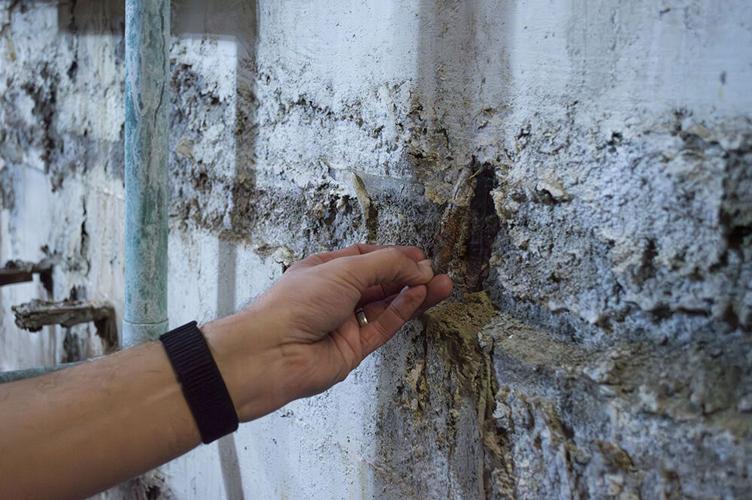
Hickok pulls a small, rusted piece of rebar from a concrete wall inside the aquatic center’s mechanical room that has steadily degraded over time.
Nathan Wilson photo
“It’s an outdoor pool that’s much smaller, and it’s not just about scalability,” he said. “There’s dehumidification systems, there’s really big, industrial air handling systems that help with the off-gassing of chemicals, which you need once you make an indoor building that has a pool.”
As the roof must stand without support beams protruding into the pools below, that’s another major expense. Larger pools mean bigger pumps, boilers, treatment systems and filters, too, and more concrete. Hickok has also heard community members point to the Lake Oswego Recreation & Aquatic Center, which cost just over $46 million for two pools, a gym and several other spaces for fitness activities. Again, he pushed back.
“A gymnasium is way less per square foot than a pool,” said Hickok. “It was also bid in 2022, whereas this project, if it passes, will be bid in 2027. That may not seem like a big difference, but a five-year difference in commercial construction inflation is quite a bit.”
More responsibilities, same money
In more ways than one, it’s abundantly clear that the aquatic center needs help. But as Kate McBride, former mayor of Hood River who chairs HRVPRD’s Advisory Council, explained, the levy is just as important.
“That’s the money to function, to pay lifeguards, to pay people to run community education,” she said. “Those dollars run the district, not the capital bond.”
HRVPRD was established in 1988 with the sole mandate to build and manage a new pool, and four years later, voters expanded the district’s authority to include parks and recreation. HRVPRD now has 73 acres of park space and six miles of trail; however, its operating levy hasn’t increased since 1997 because of state law.
And while the district was provided system development charges (one-time fees paid to offset the burden of new building on public infrastructure), those can only be used to purchase more park space, not cover wages, maintenance or other daily expenses. Without a levy bump, not only will all community education programs end, but local parks will continue to see reduced work and the aquatic center will be closed one to two days a week, indefinitely.
On the upcoming vote, McBride considers it a choice about legacy.
“My parents and grandparents helped with public infrastructure like the swimming pool originally, and took us to swimming lessons. They thought it was important,” she said. “I’m doing this for my grandkids and my great grandkids … I don’t think it’s outlandish or extravagant.”
“I want to live in a community where there are enrichment opportunities for kids and adults and seniors, and also basic essential services,” said Christopher, HRVPRD’s board president. “A public pool falls into that category, especially if you’re in a town that’s near a lot of water.”
One study found that children aged 1-4 are 88% less likely to drown after participating in formal swimming lessons, and based on numbers from the Centers for Disease Control and Prevention, drowning deaths, both in terms of medical expenses and the value of a life lost, cost the United States nearly $50 billion in 2023.
The county will start mailing ballots in late April, and they must be dropped off by 8 p.m. on election day, May 19.




Commented