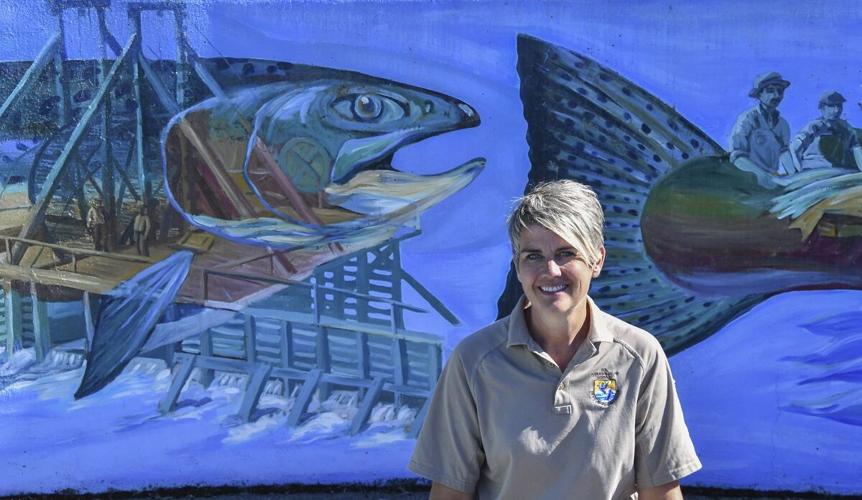
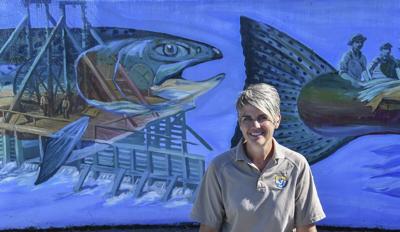
Cheri Anderson works for the Columbia River Gorge National Fish Hatchery as the information and education specialist. She sits in front of the educational mural at The Spring Creek hatchery painted by Northwest artist Janet Essley in 2001.
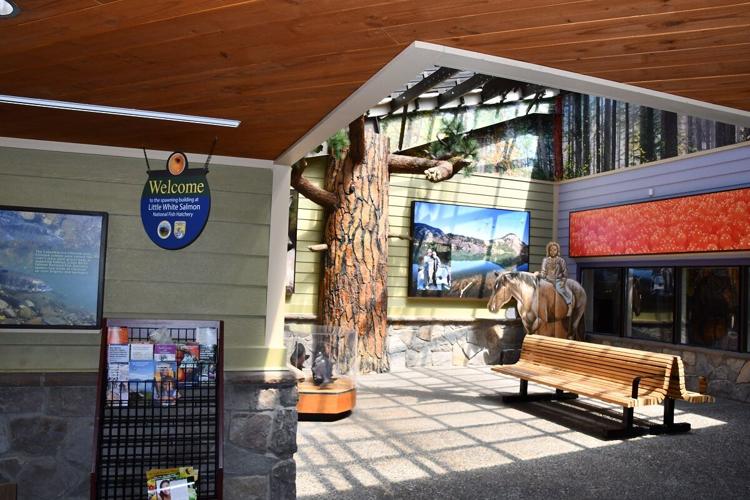
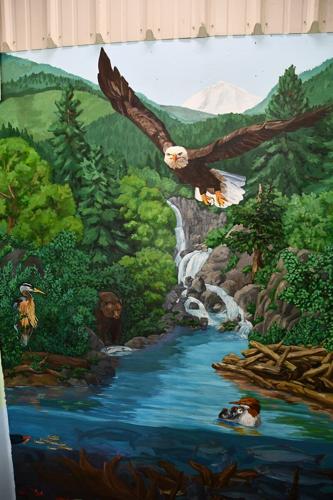
The Little White Salmon hatchery entrance, above. includes art, educational displays and literature to greet visitors. Once visitors head downstairs to the salmon viewing room, they see new murals by artist Janet Essley, completed in July.
Cheri Anderson works for the Columbia River Gorge National Fish Hatchery as the information and education specialist. She sits in front of the educational mural at The Spring Creek hatchery painted by Northwest artist Janet Essley in 2001.
Fish hatcheries have a long history in the Columbia River Gorge, said Cheri Anderson, information and education specialist for the six stations that make up the Columbia River Gorge National Fish Hatchery complex. And the work they were designed to do continues to be relevant.
Anderson works out of the Spring Creek hatchery location off State Road 14 in Washington — one of four stations in Southwest Washington, with another two in Oregon. With 24 years of experience, she works to educate both visitors and locals on the role these hatcheries play.
“The primary role of the National Hatcheries in our area is salmon preservation,” she said.
The Spring Creek Hatchery was created specifically for mitigating the loss of salmon habitat due to hydroelectric projects on the Columbia River, with funding coming from the U.S. Army Corps of Engineers.
But the first facility in the Gorge was the Little White Salmon Hatchery, founded in 1898, she said, with the Spring Creek Hatchery created as a substation starting in 1901. Salmon return to their natal waters, and Gorge hatcheries were placed to help with declining fish population. The first salmon packing plant was built in Astoria in 1823, and by the mid-1800s, people were harvesting salmon and hoping to harvest larger amounts.
The Little White Salmon hatchery entrance, above. includes art, educational displays and literature to greet visitors. Once visitors head downstairs to the salmon viewing room, they see new murals by artist Janet Essley, completed in July.
Chelsea Marr photo
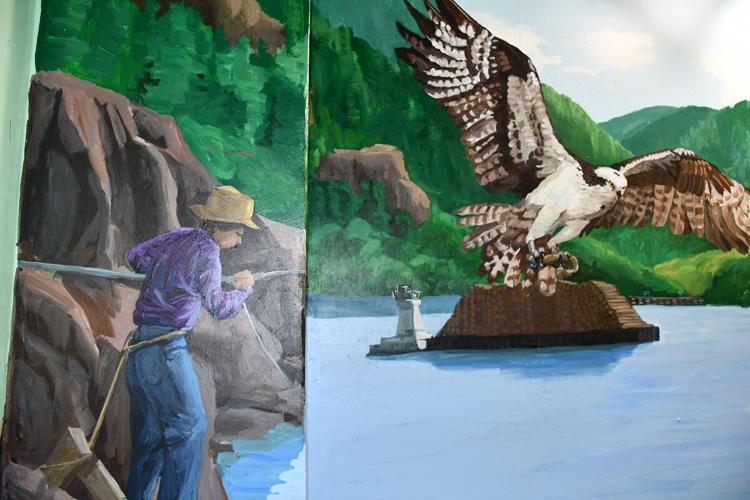
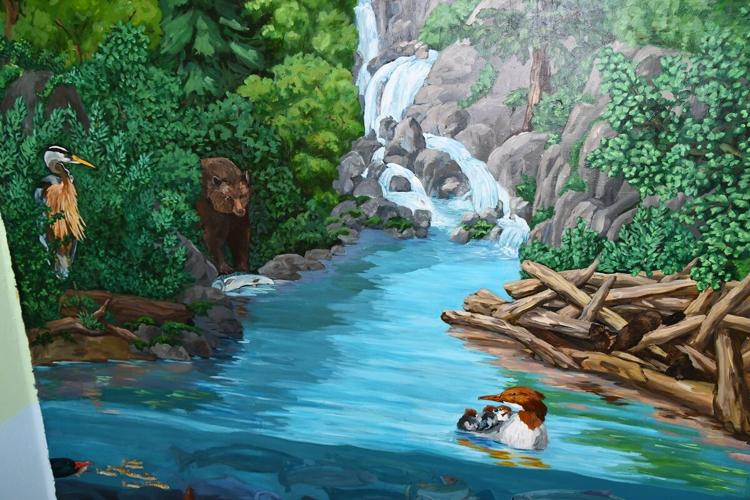
The new mural at the Little White Fish Hatchery visitor center in Cook, Wash., created by White Salmon artist Janet Essley, as well as Essley’s mural at Spring Creek, which she created in 2001, illustrates the role hatcheries play in diminishing salmon losses.
“If you refer to the mural at Spring Creek Fish Hatchery Janet Essley did in 2001, it shows the use of the fish net and people catching salmon,” Anderson said. “They progress to using horses to pull in more salmon and eventually they bring in the fish wheels. In the mid-1800s, there was already a really noticeable decrease in salmon populations in the Columbia River. The first hatchery was started in 1877 in Clackamas, Ore., by cannery workers.”
A decrease in the “big food fish,” the Chinook salmon, was the start of the preservation movement, since the smaller pink salmon was not a favorite compared to the big salmon and the numbers were continuing to drop, she said.
Scene from the new murals at The Little White Salmon hatchery by artist Janet Essley, completed in July.
Chelsea Marr photo
“The cannery workers started the idea of artificial production to help the system,” she said. “This cannery facility lasted for a couple of years. And then it was taken over by what was then the U.S Fish Commission, which would later become the U.S. Fish and Wildlife Service in 1887.”
Once the U.S. Fish and Wildlife Service took over, they began to seek out new places for facilities, mainly because the water quality on the Clackamas was not ideal for the fish, Anderson explained. That’s when they found the Little White Salmon River and the Little White Salmon National Fish Hatchery began in 1898.
“So, we’re as close as you can get to the native river — it’s right here,” Anderson said.
The 10.5 million fall Chinook salmon the hatchery “makes” fulfill Tribal Trust responsibilities, as well as for commercial catch and sportfishing.
The hatcheries have a good working relationship with the tribes, with the primary responsibilities at all of the facilities being Tribal Trust, fulfilment, and fulfilling treaty rights, she said. When there is surplus fish, those go to the tribes, where they are used for their ceremonial and subsistence programs.
Scene from the new murals at The Little White Salmon hatchery by artist Janet Essley, completed in July.
Chelsea Marr photo
“Of course, we’re producing these fish to get caught, so they’re also catching the fish,” Anderson added. “So not only are we giving them our surplus fish, we’re providing a good amount of the fish that are swimming up the river and they’re catching them, whether it’s with a hoop net or the gill net fishery. That’s one of our huge missions.”
The Wind River Hatchery sees approximately 5,000 visitors a year, mainly due to its proximity to Drano Lake, one of the largest fisheries in the Gorge. All of the locations are fitted to tourists, with windsurfing and the park drawing in visitors to Spring Creek and Carson on the way to Gifford Pinchot for hiking trails and Mount St. Helens, she said.
“Of course, timing the visit to the fish is also important,” she said. “Little White Salmon has that great salmon viewing room and now a colorful mural that tells a story to visitors.”
Another is educating area schoolchildren on salmon and the role of hatcheries in preserving the fish — an annual lesson in fourth and fifth grade classrooms.
“The in-person program in classrooms has been taught for years and has been what many kids remember from the school year,” she said, adding that, during COVID, the program was taught online.
Scene from the new murals at The Little White Salmon hatchery by artist Janet Essley, completed in July.
Chelsea Marr photo
In normal years, “we placed tanks out in classrooms,” she said. “The schools come and visit to learn the process and why we’re here, and the importance of (our work) and then come October, we set up tanks.”
First comes a water delivery, then the eggs — which the students watch hatch and then grow. Just before Christmas break, if the school can afford a field trip (“A lot of schools can’t anymore,” Anderson said), students come to the hatchery so the fish can be placed in proper drainage.
If a school can’t afford a field trip, staff comes to retrieve the fish. “And then we quickly reset the tanks up in a second batch of schools and we do the whole thing again, January to March,” she said. “So there’s a good half of the year where we’re really involved with the schools and we go out and do lessons with each of the classrooms. It’s pretty intense; I’m in the classroom for that year.”
The National Hatcheries are free to the public and are a family-friendly place to visit. Exhibits and literature are available, along with parks and walking trails.
“Seldom do you have a line to wait in or trouble parking at our locations, come visit us.” Anderson adds, “We’re hidden gems.”
The National Fish Hatchery system celebrates its 150th anniversary this year, marking the signing of legislation by Congress in 1872.
Chinook salmon spawning at The Little White Salmon will begin Aug. 16 and continue every Tuesday; the public is invited to visit the hatchery and view the new mural created by White Salmon artist, Janet Essley.
Spring Creek Hatchery will have an open house Sept. 17, with adult fish viewing.



Commented