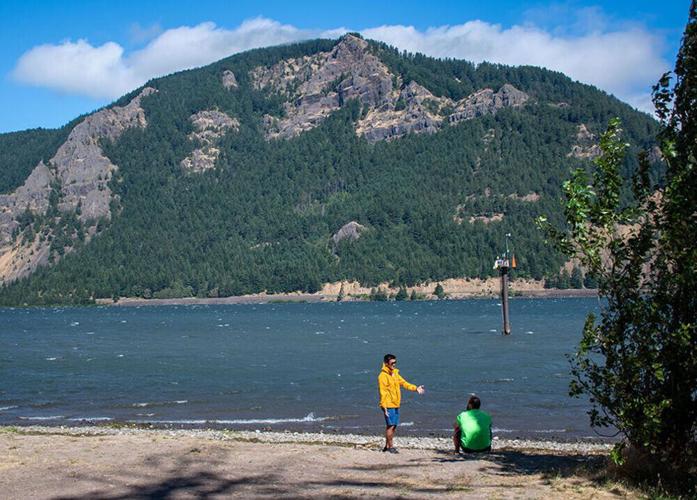
The Columbia River Gorge Commission, which oversees land and resource protections for the Columbia River Gorge National Scenic Area, recently announced a 25% decrease in funding.
The Columbia River Gorge Commission, which oversees land and resource protections for the Columbia River Gorge National Scenic Area, recently announced a 25% decrease in funding.
KLICKITAT CO. — We may never know which legislator asked Rep. Travis Couture, ranking Republican on the House Appropriations Committee, to introduce an amendment into the budget defunding the Columbia River Gorge Commission.
Hannah Scott, Public Information Officer for the Republican Caucus in the House said, in Washington, only members of the Appropriations Committee are allowed to introduce budget amendments. As a result, those committee members introduce amendments for House members who are not on the committee. According to her, Couture said he had introduced hundreds of amendments on behalf of other members, and did not recall which member made the Gorge Commission request.
At a time when the state was facing a major funding shortfall, other members of the committee didn’t question the request, though it was the only agency funded by the state to face complete defunding.
And though the House passed a budget excluding the Gorge Commission, the Senate’s budget included full funding. A conference committee settled on cutting the budget by 25%.
Here’s where some history is needed. When Congress passed the National Scenic Area Act in 1986, it authorized a bi-state compact between Oregon and Washington. That compact, which created the Gorge Commission, required the two states to fund the Commission on an equal basis. The ideal was that no state should have a dominant role by paying more. In practice, this meant that whichever state faced financial difficulties and had to reduce its funding, the other state had to match that reduction.
Following the recession of 2008, staff at the Commission was cut back, and that hurt Klickitat County residents. That’s because the compact says that each of the six counties in the Gorge — Klickitat, Skamania and Clark in Washington, and Wasco, Hood River and Multnomah in Oregon — should enact legislation for their county mirroring the Gorge Commission’s regulations and Management Plan. That would allow the county planning departments to deal with applications in the Scenic Area.
Five of the six counties did so. Klickitat was the lone exception. In that case, the compact says, land use applications in Klickitat County’s portion of the National Scenic Area have to go directly to the Columbia River Gorge Commission.
When the funding cutbacks for the Gorge Commission came in that recession, there wasn’t enough staff left to handle Klickitat County applications on a timely basis. Waiting periods stretched out to a year and beyond.
That’s when Gorge Commission Executive Director Krystyna Wolniakowski approached the Washington legislature and suggested that instead of increasing their contribution to the Gorge Commission, which Oregon might not choose to match, that they give money directly to Klickitat County to fund a position just to work on Klickitat County applications.
That strategy that has worked well for the last few years, until now. Because along with reducing the contribution to the Gorge Commission, the legislature completely eliminated the funds they had been giving to the county to fund that position.
Klickitat County Planning Director Scott Edelman said that Commissioners discussed the matter at their Thursday, May 22 workshop.
He said they discussed alternatives, including joining the other five counties in enacting ordinances that copied Scenic Area ordinances, which would give the county more control and make businesses in the county eligible to borrow from the Washington Investment Board.
Other options included funding the position by the county, finding grant money to fund it, or simply go back to letting the Gorge Commission do the work.
All of the options, commissioners noted, have disadvantages. Grantors are reluctant to fund wages. Returning to sending applicants to the Gorge Commission at a time when their budget is cut is likely to return to the problem of lengthy waits for approval. Hiring a planner just to deal with Scenic Area applications when the county’s budget is being cut is difficult, and enacting local Scenic Area ordinances faces political opposition.
And the county is facing a short deadline. The fiscal year ends June 30, and with it goes state funding for the position.



Commented
Sorry, there are no recent results for popular commented articles.