
By Emma Renly
For Columbia Gorge News
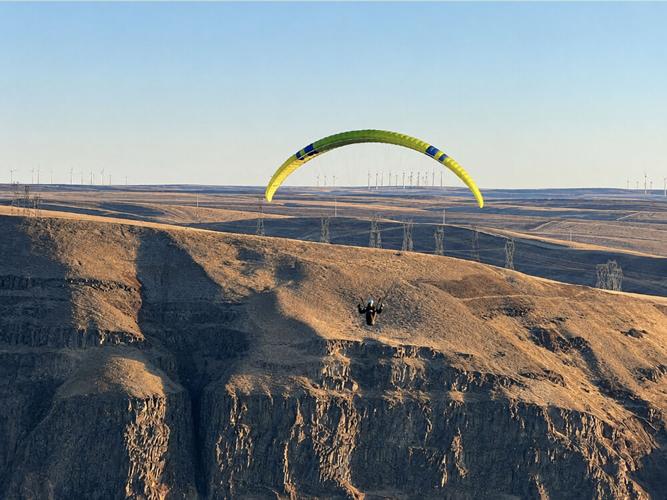
THE GORGE — On calmer days in the Gorge, there’s one sport in particular that benefits from the lack of strong wind: paragliding.
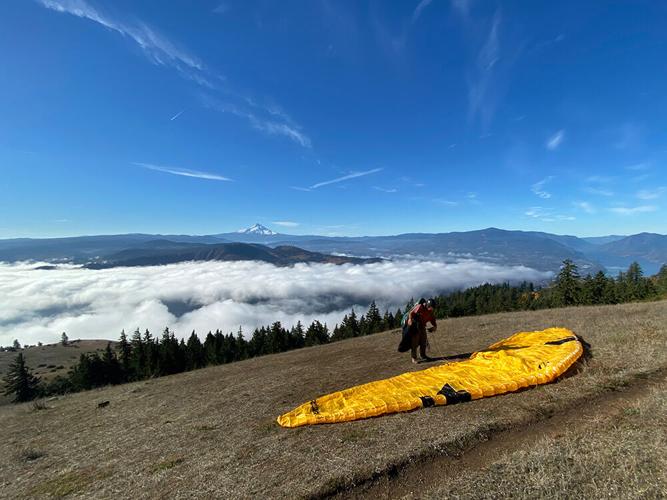
Using the area’s natural landscape and thermals, a few running steps off a hillside can lift the wing and send the user high above the ground for a bird’s-eye view of the river and surrounding towns.
“The take-off is a pretty magical part of it,” said Weaver Froelicher, a paraglider based in Lyle. “It’s a really cool way to physically be in the air and feel what the atmosphere is doing, and then harness the power of that.”
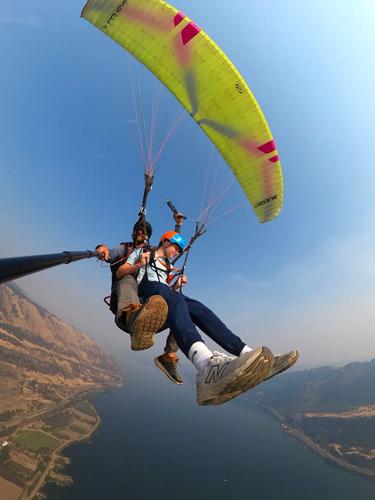
Froelicher runs Hood River Paragliding, where he offers piloting lessons as well as tandem flights for all skill levels. He’s flown people from youth to their 80s, or those who are paralyzed and have limited physical mobility.
“Most people can try it, and it really is like the dream of flying,” Froelicher said. His favorite people to tandem with are those who are a little bit nervous. “It’s really cool to watch people overcome that fear, and it can be really transforming for someone.”
Originally from Colorado, Froelicher first came to the Gorge as a teenager to whitewater kayak. “My parents were cool enough to see my passion for kayaking and let me just disappear as soon as I had a driver’s license,” he said. “I pretty much knew immediately after my first trip that this was a home to me.”
After discovering paragliding in Salt Lake City, he was immediately hooked by the sensation of weightlessness and gliding. It just so happens that the Gorge is a dual location for paragliding and whitewater.
“So many cool people live here,” he added. “We have an epic community of paragliders, and everybody is stoked on the sport and supportive ... which doesn’t exist everywhere.”
While beginners start with a quick flight from Hospital Hill to the landing zone at Bingen’s waterfront, the Gorge is also the ideal place to start cross-country flying, which means staying in the air for long distances, following thermals. One popular launch site starts at Rufus and runs all the way down to Bingen — around 40-50 miles.
Froelicher explained that thermals happen when the ground heats up; columns of hot air form and rise through the cooler air.
“Maybe they only go up 1,000 feet, but some days they’ll go up 8,000 feet, and you can start turning circles in them,” he said. “You see hawks doing circles and going up. We’re basically doing that.”
A lot of the time, pilots will watch the birds to find thermals.
“I think of the atmosphere as an ocean that’s moving with all these currents, and we’re little crustaceans on the ground running around,” Froelicher said. “But there’s this entire world of birds, which are like fish moving in these currents.”
As for now, Hood River Paragliding continues to grow year-by-year primarily through word of mouth in the community. “There’s no other experience quite like paragliding,” Froelicher noted.
For more information, visit www.hoodriverparagliding.com.
•••
Our journalism needs your support. Subscribe and read more at columbiagorgenews.com.


Commented