
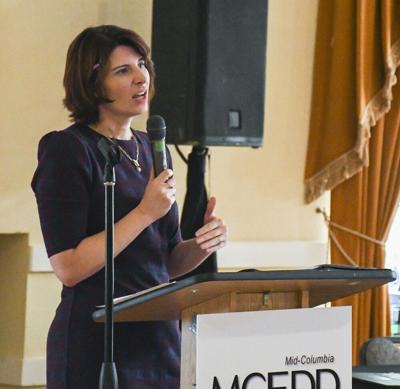
At the 2022 MCEDD Symposium, held Nov. 4 at The Dalles Civic Auditorium, keynote speaker Margaret Salazar, administrator for Region 10 of the U.S. Department of Housing and Urban Development, spoke about how housing and local economic development go hand in hand, and gave updates on what the agency is doing in the northwest.
Salazar, who grew up in Odell, was appointed to the position by President Joe Biden in January to oversee HUD operations in Oregon, Washington, Idaho, and Alaska. She previously served in Oregon Gov. Kate Brown’s cabinet as the executive director of Oregon Housing and Community Services.
At the symposium, Salazar highlighted the barriers for first-time home buyers to become homeowners, and for people to find stable rental opportunities, noting that region-wide, the homeownership rate is as high as 70%.
The average home price was $244,000 in January 2015, and in August 2022, it was $520,000, she said. About 34% of renter households spend more than 30% of their income on rent, classifying those households as “rent-burdened.” When families spend more than 50% of their income on rent, she said they are more at risk of experiencing homelessness.
“In order to grow, we know that families and workers need a place to call home, and that is absolutely what we hear time and time again from employers as we travel across the Northwest,” she said. “They want to expand their businesses and there’s just no place for folks to live.”
One of HUD Secretary Marcia Fudge’s key priorities centers around homeownership. HUD has been making small policy changes in the FHA program, “which taken together is a whole new bundle of approaches to try and get folks into a position of homeownership,” including updating the student loan monthly payment calculator and changing how the program views credit worthiness, “which we think will also be really critical to our efforts to address the homeownership gap for people of color because we know that there’s a disproportionate amount of student loan debt for people of color as well.”
She said credit checks will be expanded to reflect positive credit history, including on-time payments, as opposed to solely reflecting negative credit, such as any history of evictions.
Secretary Fudge also took steps to make clear that HUD is enforcing fair housing laws, she said. Understanding the difficult environment for homebuying currently with rising interest rates, Salazar noted that there are many programs to assist first-time homebuyers, including downpayment assistance and mortgage tools that are offered by FHA, other federal agencies or state and local governments.
“We are leaning in with all the tools we have even in this difficult interest rate environment to get folks in that position of homeownership, because not only does it build generational wealth, and help us address racial divides, but it also helps folks with just that stable mortgage payment, which is what folks need especially in this volatile rental market.”
Addressing the housing supply issue, Salazar said that a recently initiated program through HUD called “Our Way Home” seeks to connect cities, counties, tribal communities, states and territories with the resources available to boost housing construction. This, in conjunction with a set of financial acts through congress and regulatory changes at HUD will help “to streamline some of our programs, making them easier to use and connect folks with those resources,” she said. This would look like expanding the use of the FHA program for manufactured housing, to looking for ways to finance development through community land trusts.
In response to investors buying up single-family housing, which is a concern in many different markets, HUD is setting some mortgages aside so that non-profits and local governments can instead purchase those homes and allow them to remain available to low-income homebuyers.
“I think this is going to be a really promising practice that we’re going to move into to get more homes into the affordable supply,” she said.
One program is seeking to tackle the issue of homelessness in our communities. It’s called the HOME Investment Partnerships program, and it works by using funds provided through the American Rescue Plan Act to purchase multi-residential properties, including hotels, to provide transitional and supportive housing, the funds of which are being given to the states to reallocate across different communities.
HUD also offers emergency housing vouchers, and Salazar said Oregon and Washington are the two leading states in the nation for people using these vouchers which provide emergency assistance to get rehoused. She said she is proud to see that this region is using this program the most, considering the shortage of housing in the two states.
Another program recently offered 322 million throughout the U.S., with an amount set aside for rural communities, to address the problem of unsheltered homelessness.
“We’re hearing from our communities around the nation that unsheltered homelessness is one of their biggest challenges. And we know that rural homelessness looks different,” she said. “It looks like overcrowding, it looks like living in vehicles, it’s just not the same kind of manifestation that you might see in bigger cities.”
In closing, Salazar said Oregon recently met its goal to house 4,300 people through the House America program, which calls on communities to access the federal resources offered through HUD by adding housing supply, issuing vouchers, and leveraging federal dollars. She added that rural communities can be an afterthought in an agency with “urban” in its name, but that the Region 10 team understands the unique issues presented in rural communities. HUD recently created an internal committee dedicated to analyzing housing issues that crop up in rural communities and how programs currently offered by HUD are addressing those specific issues.


Commented