HOOD RIVER — When construction begins for Hood River Bridge replacement — anticipated as early as October 2027 — a key technical challenge will be to ensure this $1.12 billion project doesn’t damage the existing structure.
The new bridge will be built immediately downstream of the current bridge, largely parallel except on the Oregon shore, where traffic streams will merge where the toll booth now stands. The old bridge will be demolished once the new bridge is completed.
As described in the Hood River–White Salmon Bridge Authority’s June 8 meeting, engineers aren’t taking anything for granted. On at least two occasions elsewhere (Iowa on the Mississippi River and British Columbia, Canada), bridge construction destabilized the older, adjoining bridges, leading to costly delays and interim repairs.
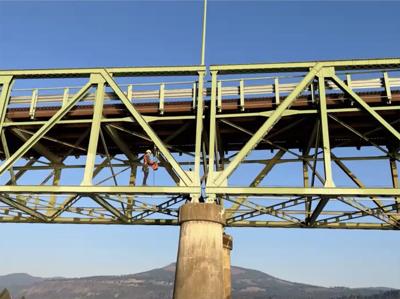
To help avoid that, engineers have installed monitoring technology to gather “baseline” data of how the current bridge moves and shifts under the weight of traffic, wind loads, seasonal temperature changes and the Columbia River’s current. The monitors capture data on bridge vibration — no stranger to motorists stalled during bridge maintenance — and other, more subtle movements.
Then, once fisheries restrictions allow “in-water” work to occur this winter, crews will install test piles in the Columbia River channel: four piles at each of four locations where permanent piers will later be placed. As explained by James Scheer of Kiewit Construction, the engineering firm designing the new bridge, pile placement will reveal any complications that might be encountered when major construction begins in October 2027. (Construction is contingent on federal funding, but that’s another story).
“We want to see what checks and balances we have to make sure we don’t do any damage to the existing bridge,” Scheer explained.
When the test piles are driven, incoming monitoring data will be compared with baseline data. Should the data reveal any alterations in the current bridge’s physical behavior, engineers would look for mitigation measures to avoid delays when major construction begins during the next in-water work period.
Bridge replacement has already had its share of surprises. The total projected cost is about double earlier estimates, when initial surveys determined that most of the old bridge’s 20 piers failed to reach bedrock when the bridge was built in the early 1920s. As a result, the new piers must go much deeper than originally anticipated.
Details on the replacement project, including recently-updated designs of the new bridge, are available on the bridge authority’s website, www.hoodriverbridge.org.



Commented