
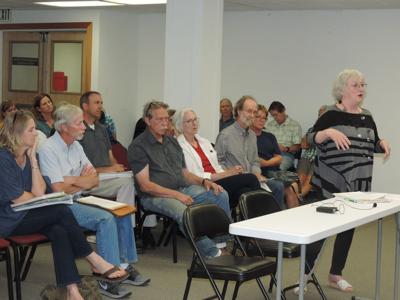
Public meetings typically draw a crowd for one item on the agenda, but Monday’s Hood River County Board of Commissioners meeting saw large groups speak to a pair of items that dominated the three-and-half hour session.
Short-term rentals and the County Identification Card resolution — two of a record nine public hearings — on the agenda collectively drew about 20 people giving testimony. One speaker pointed to an intersection of the two topics.
The long-awaited ID ordinance received unanimous commission approval, while the hearing on the controversial STR measure was continued until Aug. 20. Signs and other demonstrations are formally prohibited, but close to 30 people held up “Thanks” signs after the ID card vote.
The board’s decision makes the county the first jurisdiction in the Pacific Northwest to formally adopt a local government identification card, under a three-year pilot program funded by private grants and card fees that will involve “virtually no taxpayer funds or county staff time.”
Supporters praised the board action.
“Without ID, people cannot access many vital services for which they are eligible, and feelings of belonging in their community are diminished,” said Deb Chenoweth of Gorge Ecumenical Ministries, which will serve as fiscal agent. “Changes in federal law make getting state-issued ID more difficult or impossible for some. Seniors, immigrants unable to gain legal status, survivors of domestic violence and homeless people to anyone recently in jail face additional barriers,” she said.
“This is not a liberal thing or a conservative thing. It’s a community thing,” said Mark Thomas of Providence Hood River Memorial Hospital. “We see better health and safety outcomes for everyone in places that support a culture of inclusion and belonging.”
“Anyone who calls Hood River home, and can demonstrate their identity and residence here, can apply for the card,” said Chenoweth. Following an initial request last winter, GEM and other groups worked with county staff to craft a revised version of the ID ordinance that would ensure a third party, in this case GEM, would administer the program at no cost to the approving agency, Hood River County.
“Every resident of Hood River County should be enabled and supported to connect with public safety, civic, educational and community services,” said Supt. Dan Goldman of Hood River County School District.
*
On STRs, Community Development Director John Roberts gave a short history of what led to the proposed legislative amendments to the county’s regulations, including four proposed alternatives for the board to choose, but asked that the board delay action by continuing the hearing to Aug. 20, which the board agreed to.
The commissioners heard plenty of testimony on the issue, but no one spokein support of it and several speakers called on the board to make a fundamental change in its STR policy: Specifically, to require STR dwelling owners to be full-time residents of the property, and to do away with the staff-recommended requirement that the property owner live annually for 30 or more days in a dwelling used as an STR.
“It’s a common-sense solution,” said Mary Ellen Barriloti of Hood River, who has attended all board and Planning Commission discussions on STR. “You need to be able to tell people, ‘you cannot operate a dwelling if you’re living in Georgia.’
“To just allow it based on 30-day residency — I’d say 30-day visit to the county— would not be sufficient justification,” Barrilotti said.
Roberts said his department received a letter making “a litigious claim regarding the county’s inability to repeal (STR) regulations.”
Roberts told the board, “this correspondence needs to be taken seriously and these claims, whether true or not, causes staff to recommend a different course of action tonight. That recommendation is that staff needs additional time to research these claims so the board can be appropriately advised.” Among the alternatives was to “stay the course and do nothing, and let potential appeals play out.”
Roberts added, “existing regulations actually do work, just not to the satisfaction of one special interest group.
The Hood River County Residents Committee spoke in volumes against the 30-day residency requirement, including its executive director, Heather Staten, its vice president, John Mills, and new president, Dale Hill.
“This is a decision on priorities, and a vote for primary residence is a vote to put your residents, your voters, first,” Staten said.
Barriloti invoked the ID card decision as she pointed to the public process on STRs in 2016-17.
“The community understood residency met full-time residency,” she said. “For example, you just did something for community IDs. You (won’t give) IDs to determine residency based on the fact that these people might be here for 30 days. Nowhere in the country is residency defied as a 30-day visit to the county.”
Staten said the county’s proposal to cap STRs at 100 “will limit the overall impact” but that number has already been surpassed by the 140 or so in operation.
“We have not heard why opening those spots to out of town investors is the best policy for Hood River. If you are in favor of the 30-day definition, I encourage you to explain to the public why you think this is the best decision for our community,” she said.
Staten also called on Roberts to explain why the Community Development Department has not forwarded written comments or Planning Commission transcripts after April 6 to the Board of Commissioners, and said Roberts has ignored emails asking for an explanation. Roberts did not comment on the assertion during the meeting and was unavailable for comment before press time.


Commented