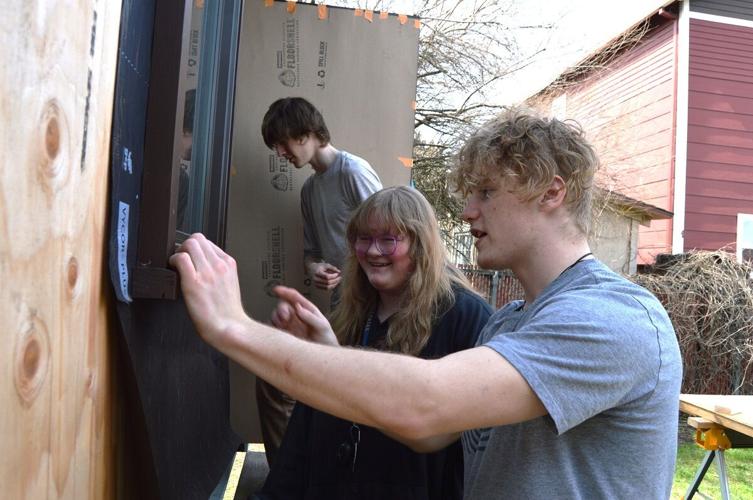
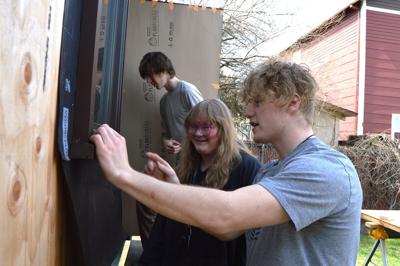
Leif Mortenson (junior), Belle Silva (senior) and Seth Mamuska (senior) at work on the tiny home students in the Community Works program are building with help from community member Jack Miller; the home will be raffled off this spring, with proceeds to be used to start constructing another tiny home.
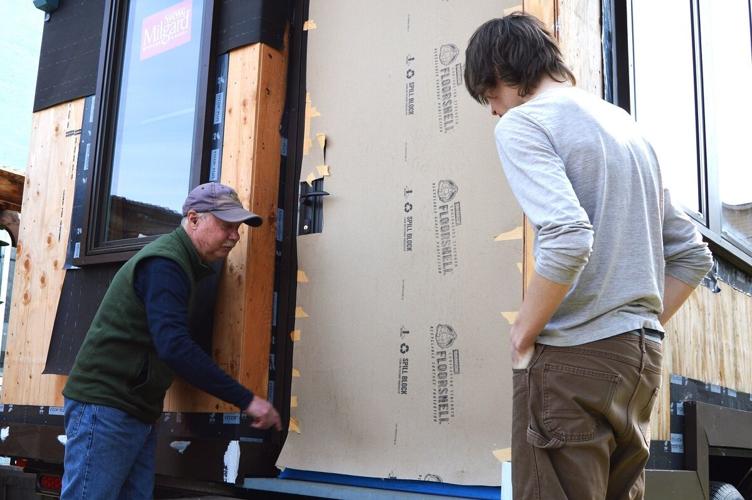
HRVHS Teacher Pete Lawson credits Jack Miller with the creation of the Community Works program. Above, Miller and student Seth Mamuska discuss the tiny home project the class is constructing with Miller’s help.
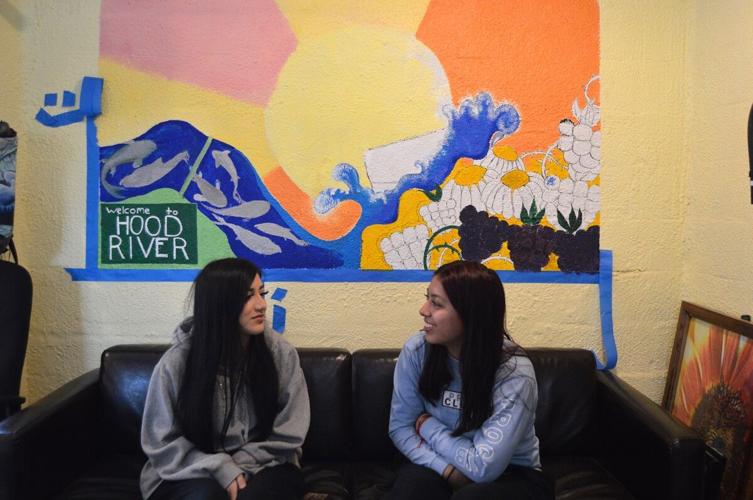
Daisy Alverez (sophomore) and sister Bryanna Alverez (junior) in the Community Works classroom area, where students can catch up on credits needed to graduate. “Lawson helps a lot,” Bryanna said. “He makes sure we get stuff turned in, and checks on how we’re doing. Not a lot of teachers ask that.”
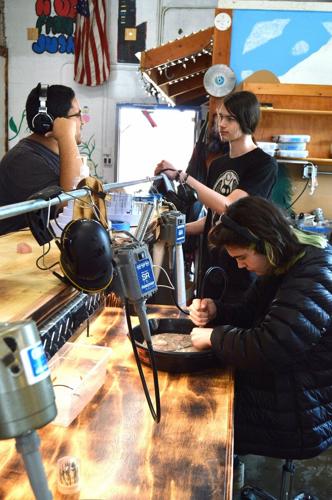
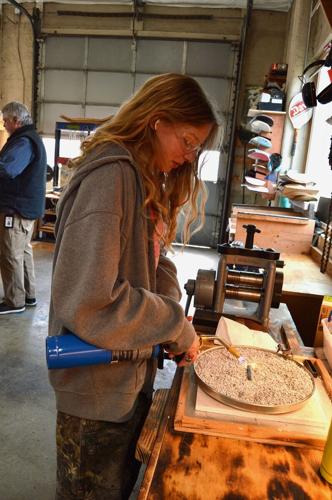
HRVHS students, clockwise, Felix Nuñez (senior), Sheamus Perkey (junior) and Aidan LaParre (senior) at the lapidary station. The program also features a skateboard press, jewelry making station and stained-glass station, among others.
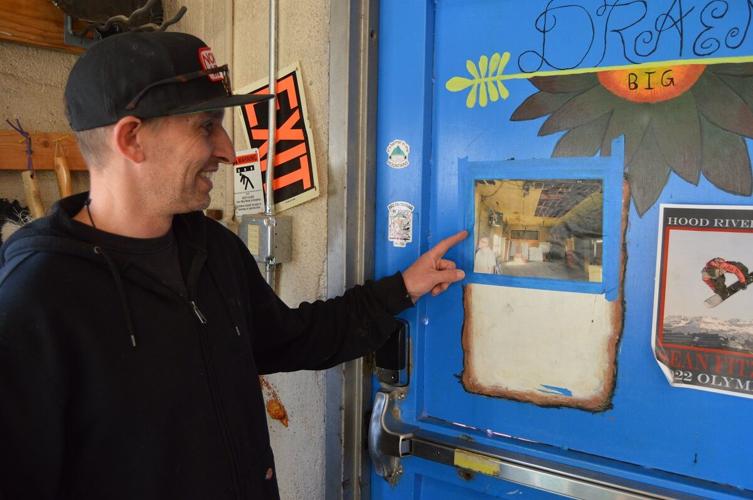
HRVHS Teacher Pete Lawson points to a photo of the firehouse before his Community Works Career and Technical Education (CTE) program moved in and cleaned up.
Leif Mortenson (junior), Belle Silva (senior) and Seth Mamuska (senior) at work on the tiny home students in the Community Works program are building with help from community member Jack Miller; the home will be raffled off this spring, with proceeds to be used to start constructing another tiny home.
HOOD RIVER — Hood River Valley High School’s Community Works program didn’t exist five years ago.
Today, approximately 84 students are bussed daily to and from the offsite classroom, located in the old Hood River Fire Department firehouse on Wilson Street, to work on projects ranging from building skateboards and a tiny home to making mosaics and jewelry, catch up on homework and get help with college applications.
And as its name suggests, students also participate in a variety of community projects, such as the recent construction of four picnic tables installed earlier this year at the Children’s Park in partnership with Hood River Rotary.
“All of the work we do here matters,” said Community Works Adviser and Teacher Pete Lawson. “It’s real work.”
Students enroll in the program to learn real world skills, which lead to good jobs. While the program focuses on carpentry, Lawson has also expanded what he calls manufacturing workstations, “taking a raw material and making a finished product.”
And it all started with a chance encounter.
HRVHS Teacher Pete Lawson credits Jack Miller with the creation of the Community Works program. Above, Miller and student Seth Mamuska discuss the tiny home project the class is constructing with Miller’s help.
Trisha Walker photo
“If I would have sat in a room with the smartest minds in our school five years ago and tried to envision this, there’s no way,” he said. “It’s just kind of evolved on its own.”
Five years ago, Lawson was teaching six students who qualified for Oregon Special Education’s emotionally disturbed category. They would go on walks along the Indian Creek Trailhead, and with his background in construction, Lawson would stop and talk about the construction techniques used at one of the home sites in a nearby neighborhood.
About two weeks later, the owner and builder, Jack Miller, noticed Lawson and his students and introduced himself — and invited them inside for a tour.
A week later, Lawson was bringing the students to help build Miller’s home, which they did for the rest of that school year: Six months, two periods a day.
Lawson found that, the farther away they were from campus, the more work his students were doing and the less school they missed.
“All of a sudden, all the (negative) behaviors were gone,” Lawson said. “And now we were teaching kids skills. The kids were so focused, so into learning what we were teaching them. They wanted to be there.”
Wanting to continue the program after Miller’s house was finished, Lawson began reaching out to the community. Scott Baker, then with Hood River Valley Parks and Rec, said that while his department didn’t have a suitable space, he’d noticed an old firehouse that appeared to be unused.
Daisy Alverez (sophomore) and sister Bryanna Alverez (junior) in the Community Works classroom area, where students can catch up on credits needed to graduate. “Lawson helps a lot,” Bryanna said. “He makes sure we get stuff turned in, and checks on how we’re doing. Not a lot of teachers ask that.”
Trisha Walker photo
That led Lawson to contact Devon Wells, then chief of the Hood River Fire Department. The two met at the building on Wilson Street, and Lawson asked if he could bring students in to clean it up as their next project. When Wells saw the benefit to students, he agreed, and an interagency agreement came into place between the school district (represented by then Superintendent Dan Goldman), the city (City Manager Abigail Elder) and the fire department.
And then the students got to work.
Miller continued to volunteer with the program and brought others with him. After clearing the building of trash, they began constructing a classroom and bathroom.
Once the interior was completed, Lawson began adding worktables: A skateboard station was the first, with jewelry, mosaics, stained glass, and stonework added as the years went by. Lawson has more planned — such as a silkscreen station so students can have program t-shirts.
Outside in back are more workstations: A garden area, a tiny home under construction, and a shed built by students to hold supplies. Building the high-end tiny home, which Miller oversees, teaches the same skills students learned while working on the firehouse and Miller’s home, and will be auctioned off upon completion, the funds from which will be used to build another.
Lawson recently contracted with artist Toma Villa, who will facilitate a mural project on the firehouse’s exterior with students beginning in May.
“Everything we do here is about a process, not a product, so we’re never trying to push to get something done,” he said. “It’s more about making connections with a kid. So with volunteers, we always make sure they understand it’s about finding a connection, or way to connect, and build on that relationship. So if we’re having a conversation with a kid, we’ll just stop — if they’re telling a story, it’s always okay.”
Another way he’s connected with kids: By bringing service organizations in to meet students where they’re most comfortable, whether that’s Next Door Inc. or FISH Food Bank. And he stocks a variety of snacks for the kids as well, to eat onsite or to take home over the weekend.
“Our community has surprised me, how many students are struggling,” Lawson said. “Their parents are one paycheck away from homelessness.”
HRVHS students, clockwise, Felix Nuñez (senior), Sheamus Perkey (junior) and Aidan LaParre (senior) at the lapidary station. The program also features a skateboard press, jewelry making station and stained-glass station, among others.
Trisha Walker photo
The COVID pandemic didn’t help. “COVID was hard on kids,” he said. “Six or seven of the kids I work with feel like that’s why they’re so far behind in credits, because they never flipped open their laptop or iPad” when the district switched to virtual learning — students had to watch siblings, work to support their families, and/or didn’t want peers see the inside their home, he said.
“Lots of kids are trying to make up credits from classes they failed in years past, and we’re trying to help get their diploma,” Lawson said.
Though everyone is welcome to sign up for the program, he protects spaces for students who are most at risk of dropping out. The class is capped at 17, but he admitted to having a hard time saying no, so sometimes class sizes hit 23. Students are identified through Early Warning System meetings, counselors, case managers or the special education department.
“So through all the different stakeholders, we’ll try to figure out who the right kids are and put them in first,” he said. “I try to spread them out through the periods because if I have 17 kids who are really struggling, that can sometimes be too much. So I want to weave in some kids who will follow directions as pro-social examples of their behavior.”
“The community works program housed at the firehouse is absolutely the reason some students come to school,” said HRVHS Principal Columba Jones. “Learning experiences there are primarily project based and the vision for them comes from students’ feedback. The relevancy and owner-ship created via these projects peak students’ interest, and that can point them in the direction of a future career field. It’s definitely an opportunity for students to hone in on their strengths and find success.”
Lawson has helped countless students get internships or better jobs — even after graduation — and now has contacts throughout the community, some of whom are former students.
“When you do that, I feel like you get buy in,” he said. “Because they talk. And they come here with the idea that this is a positive environment that can lead to a better job.”
Piper Lawson (sophomore) makes a bracelet at the jewelry making station.
Trisha Walker photo
The class is now one of several Career and Technical Education (CTE) programs at HRVHS. Lawson feels that the district has created a model program that other districts can benefit from, and is appreciative of having the opportunity and support of his colleagues.
“A lot of my colleagues have been really patient with the kids coming in late because the bus was a little late, or coming in just covered in sawdust,” he said. “And almost anybody I’ve talked to in our community, like Tum A Lum four years ago when I told them what I was trying to do, and they were like, ‘Whatever you need.’ We live in a very special place — I’ve really come to see that, just as a result of being part of this. Not every community would be behind kids like this.”
When the program started, Rich Polkinghorn, now the district’s superintendent, was the HRVHS principal, and he’s seen firsthand how the program has evolved over the years.
“Pete’s vision for the program has always been great,” Polkinghorn said. “I trusted him and supported his vision, and he’s done the hard work to create a place that is teaching students hands on, job ready skills while fostering a sense of community and family — all while literally keeping students from dropping out of school.
“When I visited the firehouse a while back, I was talking to a student who was building a fence that would eventually cordon off a portion of the back area — I asked what the firehouse meant to him. His response was, ‘It’s like a home; we’re like a family here, and it’s the only thing that is keeping me in school.”
HRVHS Teacher Pete Lawson points to a photo of the firehouse before his Community Works Career and Technical Education (CTE) program moved in and cleaned up.
Trisha Walker photo
Lawson adds that Elder’s and the City of Hood River’s support has been invaluable as well as the district doesn’t pay utilities or rent. “One of the things that makes this unique is, this is city owned. The fire department had a stake in it, and the school district is using it, but all three agencies worked together for our kids,” he said. “That relationship with the city has been just incredible. And the support that I get from public works has been amazing.
“Wherever a person sits on the political spectrum, or economically, I feel like people who live here want to see a better community,” he added. “And the kids are that future. That’s a common ground for everyone. It’s pretty cool.”
Grant leads to program expansion
In 2021, Lawson and former HRVHS Vice Principal Josh Robins wrote and received a grant for $250,000, which has allowed the Community Works program to expand its reach.
“The program was always run on a shoestring budget, scraping to get lumber,” Lawson said. “But getting grant money has been huge — it’s allowed us to accommodate more students, individual projects, and also expand the experiences offered to the kids.”
Money has helped fund firehouse building improvements and purchase tools and materials for the tiny home. He’s also renovating a 14-passenger minibus to provide transportation to various recreational activities the Gorge has to offer.
“We have busses but not drivers,” Lawson said. “Transportation is a barrier — we want to focus on job skills, but also learn about the cool recreational activities in our area. That’s what gets us out of bed, to think of that weekend. A lot of students go to school, and they work full time or watch their siblings and they don’t have time for themselves or to explore leisure activities. With this van, we can take the kids on fieldtrips — go to the mountain or go paddleboarding.”
He’s also working to make sure the program continues well into the future. “We’ll reapply (for the grant) and use the money to add staffing,” Lawson said. “I want to get other adults trained so they can run it, too.”
‘We could never afford Jack’
Lawson is adamant that the Community Works program owes much of its success to Miller. “He’s donated four hours a day, three times a week for the last five years. He has literally built this program,” Lawson said. “I could not have done this without him. And he’s one of the best teachers I’ve ever seen work with kids. He’s a natural. The kids listen to him, love him and they get a lot more from him than just having a square and a framing gun.”
Lawson said that with Miller’s skills, he’d cost the district around $175,000 a year. “We’re extremely fortunate that we have these members of our community who are willing to come and share their expertise with the students — and with some of the most at risk kids,” he said, adding it’s not uncommon to have three or four professionals working with students, from architects to doctors.
Miller is also involved in Rotary, Helping Hands Against Violence, FISH Food Bank and is building a school in Mexico, Lawson added.
“He’s really an amazing human being. I mean it — without Jack, this never would have happened,” he said. “We’ve been a great team together. I’ve learned a ton from him.”



Commented
Sorry, there are no recent results for popular commented articles.