

THE DALLES — After hearing testimony in April from a group of fruit growers in the Gorge region, the Wasco County Commissioners sent a letter to the state OSHA (Occupational Safety and Health Administration) office opposing some of the proposed changes to OSHA rules for on-farm agricultural labor housing.
Since 2018 the growers have been in talks with OSHA over on-farm housing standards for migrant workers, saying some of these rules are impossible for them to afford without going out of business.
“The draft rules include numerous provisions that are neither financially feasible nor grounded in science and jeopardize workforce housing and the viability of multigenerational family farms in our county,” said a letter from the Wasco County Commissioners to OSHA Administrator Renee Stapleton.
Two thirds of registered agricultural labor housing across Oregon is located in the Columbia Gorge to provide essential hand labor for fruit commodities, like cherries, for which automation is not an option.

Lesley Tamura
“We require the most labor of all the ag commodities in the state,” said Lesley Tamura, chair of the Columbia Fruit Growers Association, in Wasco County Commissioners meeting April 17. The group’s executive director, Mike Doke, said that out of 9,000 migrant workers in the state 5,200 stay in OSHA certified housing in Wasco and Hood River counties.
“We feel that the goalposts are constantly being moved and they simply cannot keep up,” she said. “Many growers really feel we’re at a tipping point of being able to continue surviving.”
But while growers have listed financial concerns, farm worker advocates in the region say the proposed upgrades are just a starting point for providing safer, more dignified accommodations for workers.
“I couldn’t imagine living with my wife and my 2-year-old daughter in these living quarters,” said Sam Murillo, an advocate who was born in farm worker housing and has lived his whole life in Hood River County.
A 2023 study by Oregon Housing and Community Services farmworkers interviewed across the state reported:
- 83% (66 out of 80) not having enough privacy,
- 65% (52 out of 80) not having enough heat,
- 64% (51 out of 80) cracked, peeling or chipped paint and
- 59% (47 out of 90) mold.
With the passage of Oregon HB2001 in February 2023, $5 million has been budgeted for agricultural workforce housing grants, but relatively few farmers benefit yearly from state or federal dollars set aside for farm worker housing.
According to the Oregon Housing and Community Services, 11 farms — all in Wasco and Hood River counties — have been awarded this year from the $1.67 million available to on-farm housing projects through the Agricultural Worker Labor Housing Tax Credit program. This segment of the fund provides a tax credit to growers, amounting to 50% of the cost of farm worker housing upgrades.
“Most of the on-farm applicants are located in Hood River and Wasco counties,” Program Analyst Martin Jarvis told Columbia Gorge News in an email, noting most projects are between $100,000 to $200,000.
Columbia Gorge News reached out to the Oregon Department of Agriculture to find out how the HB2001 money is expected to reach growers.
“ODA has been in discussion with partner agencies but because the program hinges to a certain extent on the OR-OSHA rules we haven’t been able to move forward,” ODA Communications Director Andrea Cantu-Shomus said in an email. “We will be putting out more information in the next month or so.”
On-farm housing secures timely harvests
Farmworker housing is free for migrant workers and their families, who might otherwise be unable to find or afford housing opportunities for their short-term work in the area.
According to Oregon Housing and Community Services, the average farmworker income in Oregon is $20,000 to $24,000 per year, which is between 25-37% of the state’s median family income. Thirty-one percent of farmworkers live under the poverty line, more than twice the general population at 14%.
Free housing is hardly just a courtesy, Tamura explained. Providing housing allows growers to tap into a cheaper, plentiful workforce to match their tight harvesting time frame.

Ubaldo Hernández
“They need the workers,” said Ubaldo Hernández, executive director and senior organizer for Comunidades, a Latino social and environmental action organization in Hood River. “They even call them essential when the worker is working in heat conditions, in smoke, or through the pandemic.”
The need goes both ways, Tamura said, adding that farms without housing see workers sleeping in cars, tents, and even 15-20 people in a hotel room.
“Frankly, I do not understand how those scenarios could be any safer or healthier than what we currently offer to them,” she said. “However, if we are unable to comply with the posted rules, then we will have to either reduce our capacity by a large amount or close it completely.”
One such farmer is Dave Meyer, whose cherry farm is located in The Dalles. Meyer’s current building will drop by 75% capacity in order to accommodate the proposed 100-square-foot per person rule.
“If I have a room for four individuals, two bunk beds, it becomes a room for one person,” he told the commissioners. “That’s the reality of what they want to push through.”
Meyer said if he can’t house the same number of workers as previous years, his farm will go out of business.
Hernández said the prescribed upgrades aren’t extraneous amenities; providing comfortable accommodations is about a spirit of reciprocity. Many agricultural workers and their families have returned to farms in the Gorge for 40-50 years, with multiple generations tending the orchards alongside their parents.
“They’re helping [farm owners] to maintain their wealth, but they don’t want to spend anything to give comfort to these workers. To make them feel welcome, to make them feel appreciated,” Hernández said.
Contested upgrades include room size, washing and cooking accommodations
The Columbia Fruit Growers Association has spent years participating heavily in OSHA’s rulemaking process in both farmworker housing and safety standards: Attending meetings, providing verbal and written comments, and pushing to create a fiscal impact advisory committee.
“Where the proposed rules are clearly related to health and safety, we have agreements,” Tamura said. “Unfortunately, a lot of the proposed rule changes have nothing to do with health and safety, they’re more focused on comfort and convenience.”
One major focus of proposed rule changes the growers contest are those that would require additional plumbing, including hot and cold water for hand washing, six shower heads per person with locking doors, and separate washing machines: Some for regular clothes and others for clothes contaminated by pesticides.
“Portable handwashing stations that provide hot water are incredibly expensive, not readily available, and not at all necessary for hygiene,” the document says, adding that growers have previously been unable to obtain additional septic permits from the county.
“While we would love to provide housing that meets all the comfort and convenience that anyone would want, it is simply not feasible. Nor do we believe it is OSHA’s purview to mandate that comfort and convenience,” Tamura said.
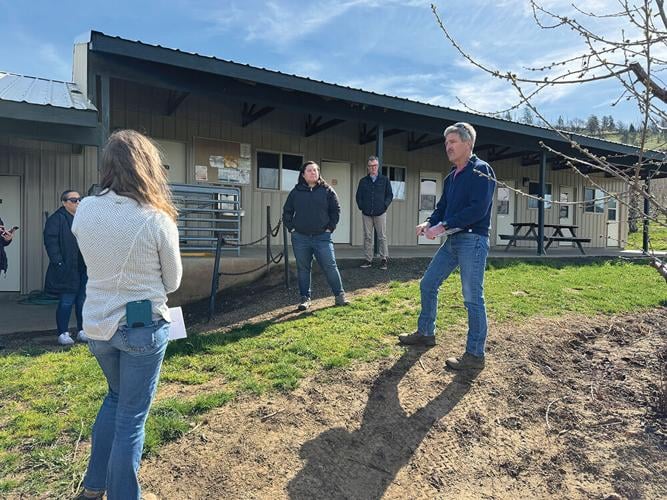
As part of the rulemaking advisory committee between OSHA and stakeholders, several members of the Columbia Fruit Growers Association offered tours of their on-farm housing facilities.
Murillo said he found these conditions concerning. On a tour of Rolling Hills Farm, which can hold up to 60 people at its peak, he noted only one washer and dryer. After pointing this out to the group, the tour guide explained adding plumbing for additional electric washing units would be too expensive.
Most distressing to Murillo was a mixed-gender bathroom at a farm in The Dalles.
“All they have is a plastic screen door,” he said. “I believe all people to be good until they’re not and but I wouldn’t want to [have] my wife and my daughter take a shower and not have the decency of having something to close the door.”
Columbia Gorge News asked Hernández which of the rules contested by the growers association might be negotiable for farm workers, such as having two kitchen burners for every five people.
He said, “If we ask the farmworker community, they would say they don’t need those burners. They would prefer to have their job because they need the work. But what would happen if we got into another situation like the pandemic where you can’t go and buy food outside?”
Hernández explained farmworkers who travel to fruit farms from Mexico using their H2A visas arrive without transportation. To shop, these workers ride together in buses to local grocery stores, then return to the farm. In crowded facilities, they may have to wait hours to cook their meal.
“I think it’s a fundamental human right to have a dignified place to live where they work, to have the essentials, so they don’t have to struggle through the time they’re working and producing on these farms for these farm owners,” Hernandez said.
Doke took a different stance on the kitchen burner question, saying, “Why should we have five different ovens in a kitchen so everybody can cook whenever they want to instead of waiting 15 minutes? Now if it’s a health and safety [reason], that’s a different thing, but adding an extra stovetop sounds like convenience to me.”
The growers argue OSHA’s stricter rules won’t eliminate substandard housing across the state.
“Increasing the regulations doesn’t affect these housing operators because they’re already not following the rules, so having stricter rules is not going to magically motivate them to do better and invest the time and the money and the energy to improve,” Tamura said. “Instead, the increased regulations are going to punish those that are already following the rules.”
Murillo takes issue with this argument.
“It’s the rule of law,” he said, illustrating by saying the existence of major infractions of the law doesn’t excuse minor ones.
Commissioners asked for revise draft rules
The commissioners’ letter to OSHA asked the agency to “revise the proposed draft to ensure that housing is not eliminated due to overly stringent and costly ALH (Agricultural Labor Housing) rules.”
At the board meeting Commissioner Phil Brady, who also attended an on-farm housing tour, compared the current farm worker housing to his college dorm. He agreed with the growers’ position, saying the industry needs to grow before standards can improve.
“Dorm rooms on average have a 200-square-foot minimum for two folks,” countered Murillo, noting that this matches the proposed OSHA requirement for 100-square-feet per person.
The American Correctional Association requires prison cells to be a minimum of 70 square feet for a single occupant, with 35 square feet unencumbered. This is almost twice as large as the current farm worker housing standard of 40 square feet per person, established in 1989 (OAR 333-040-0015).
Commissioner Scott Hege said, “It’s hard for me to understand why there isn’t movement on the other side.
“You’re doing all you can do to try to provide the best housing for these people within the means that you have,” Hege said to Tamura, “and I think if this is pushed through, the result is going to be not good for our communities and not good for these workers.”
Murillo objects to the way the commissioners moved forward with promoting the growers’ stance without hearing from the farmworker community. He also noted the commissioners didn’t make a motion to approve the action items they promised on behalf of the growers.
“It just didn’t seem like a proper methodology,” he said.
Funding for on-farm housing improvements and alternative strategies
In a 2023 study of farm worker housing across the state, Oregon’s Housing and Community Services described improvements to on-farm housing as just one element of addressing housing insecurity for farm workers as they provide essential services to the local agriculture industry. The study recommends solutions such as cooperatively built on-farm housing between multiple operations, or off-farm affordable housing through federal and state funding.
A housing development in Jackson County known as Lilac Meadows Apartments offers an example, as “the first project of its kind in Oregon to blend farm-labor housing funded by the U.S. Department of Agriculture’s Rural Development program (RD) with a low-income housing tax credit (LIHTC) project.” The apartment complex offers graduated assistance levels based on farm worker income.
Partnerships with the Farmworker Housing Development Corporation, Community and Shelter Assistance (CASA) of Oregon and Bienestar have also resulted in successful housing initiatives. For example, a collaboration between the city of Lebanon and FHDC to build 24 affordable homes in proximity to agricultural employment and community services.
Doke pointed out that off-farm housing is a difficult proposition in Hood River and Wasco counties, where real estate is more expensive.
“I’m not saying we’re not going to look at it,” he said, “but we already have on-farm housing in place, built over decades and generations and upgraded.” He added that community-based housing costs more in bureaucracy and overhead. “You don’t see that in on-farm housing.”
While growers wait for the state to release more information about the $5 million in HB2001 money, federal funds for farm worker housing have become easier to access this spring, according to USDA’s Rural Development.
“Our On-Farm Farm Labor Housing Loan is an excellent tool to access low interest capital to provide safe, healthy housing for our farm labor workers and their families,” said Rural Development’s Oregon State Director Margaret Hoffman. “We’re really excited that a lot of agricultural producers in Oregon are interested, we would like to see a lot of new housing constructed using this program.”
Hoffman noted that in prior years, this loan program was more complicated in Oregon but has been made more accessible this year. “There’s a clear legal pathway established to unlock the potential of this program in Oregon,” she said.
“We’re really grateful that we now have $5 million to utilize as part of this program. And we hope with that money we’re able to address some of the housing issues that we’ve seen with our farm labor population,” Hoffman said.


Commented