
Facing budget shortfalls, how are three local institutions faring now?
THE GORGE — Last year, Columbia Gorge News covered several stories that didn’t necessarily have a neat ending. So, we’re following up.
For a variety of reasons, some of our most important institutions faced budget shortfalls in 2025, creating uncertainty about what services or projects would continue, and which ones would fall by the wayside. And there are at least three cases where we now have more concrete answers: the Stevenson-Carson School District, Oregon’s interlibrary loan program and Mosier Community School.
Stevenson-Carson School District
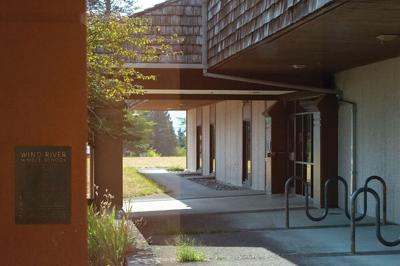
Back in August, Skamania County’s largest district shuttered Wind River Middle School, the second closure in just as many years. Beyond slashing $75,000 from the athletics budget and 21 staff positions, 40 sixth graders had to remain at Carson Elementary while 117 seventh and eighth graders graduated early, stepping into Stevenson High School on their first day.
The catalyst was a lapse in Secure Rural Schools payments, a program designed to offset lost revenue from the federal government harvesting timber on public lands within county borders. With an $830,000 hole, Superintendent Ingrid Colvard and her colleagues had to choose between cutting programs or consolidation; however, Congress reupped Secure Rural Schools in December — with backpay.
“I know people would like to see something more obvious, like the middle school reopened or people hired,” said Colvard. “But we need a more sustainable model. We need to not be going back every three years, hoping and then waiting almost two years to finally get it. It’s just unreasonable.”
To manage the deficit, Colvard had to pull from the district’s capital fund, and that’s exactly where those federal dollars will go after arriving in April. With two buildings more than 70 years old, leaks and other issues are inevitable, so it’s crucial to have a healthy backstop. Bringing staff back with funding that’s short-term and subject to national politics isn’t ethical, either.
“What we just went through could happen again, and it could happen even with it being reauthorized,” Colvard said. “We’ve seen the government hold back monies after they’ve authorized, so you really can’t spend it until you have it.”
Plus, Wind River was always expected to close, just not this soon. District-wide enrollment dropped from about 800 students in 2020 to fewer than 650 in 2025, primarily because of lower birth rates, housing costs and migration to urban areas. With those trends projected to continue, the number of eligible students simply wouldn’t justify a standalone middle school.
If anything, the whole ordeal brought the importance of state support to the forefront, and Colvard said the district needs legislative fixes on that side, too. Despite a revision to the formula last year, as previously reported by Columbia Gorge News, Olympia still isn’t fully covering materials, supplies and operating costs that keep rising because of inflation.
Further, the School Construction Assistance Program, which helps build and modernize facilities, is inherently more difficult for small, rural districts to utilize, according to a state report. That’s because the program requires adequate local dollars to match, typically through a voter-approved bond, and the tax burden is far higher in property-poor districts, or those with low assessed values.
As residents know very well, only 1.8% of the land in Skamania County is taxable at full market value.
There are some solutions under consideration. On Jan. 26, Rep. Kevin Waters of Washington’s 17th District introduced House Bill 2653, which would enable counties doing mandated wildfire mitigation work to sell the timber harvested from completing roadway setbacks, instead of just letting it rot. That’s a start for Colvard, who firmly believes the district’s — and county’s — financial woes if they could more actively manage their existing resources.
In the meantime, students are adapting, and, logistically speaking, Colvard said the transition went well. The main challenge is navigating differences in behavior and maturity, and what experiences to still keep separate.
“The challenge is always figuring out how to get seventh through twelfth grade to coexist,” she said. “Take homecoming week, for example. You want them included so they’re not just left out, but it’s also sort of a high school thing.”
In the end, staff brought together student body leadership and advisors to let them craft a plan, and they held two dances.
Oregon’s interlibrary loan program
On March 14 of last year, President Donald Trump signed an executive order to dismantle seven agencies “to the full extent of the law,” including the Institute of Museum and Library Services (IMLS).
“The impact of funding cuts would be significant for rural communities like Hood River County that rely heavily on resource sharing and statewide support systems,” said Hood River Library Director Rachael Fox.
Wasco County also looked at cuts, including the need to fund Oregon’s interlibrary loan program, otherwise known at the Sage Library Consortium. The courier system allows patrons to request materials from 77 libraries across 15 counties in primarily eastern Oregon, and without it, they would be limited to whatever is on local shelves.
Especially affected would have been the talking book and braille libraries (to which Hood River refers a few people every year), prison and hospital libraries, and small rural libraries. But after a coalition of 20 states sued the federal government, IMLS was funded in the 2026 federal budget.
Hood River Library saw no break in services, Fox said. Money is secure through July 2027 and Hood River even got a teen internship grant for the summer.
“Currently, we feel secure through 2027, but our Sage Consortium is still discussing that we want a contingency plan,” Fox said. So far, they’ve considered fundraising and looking at how libraries can absorb the cost, should somebody yank IMLS dollars again in future years. “People just aren’t sure how the funding will be impacted in future years.”
Mosier Community School
Mosier Community School spent 2025 fighting to retain a grant already awarded to replace its outdated and ailing boiler with an HVAC system. Access to the Renew America’s Schools grant from the Department of Energy vanished for a period during federal layoffs early in the year, but came back online weeks later.
The school completed its new HVAC and received over $400,000 towards the cost, before stalling again. This time, they were waiting for a grant extension from the federal government, which they received the morning of Jan. 16.
“This means that we are able to move forward with new windows and insulation. We are also working on installing solar panels to help offset the cost of the new HVAC system,” said Michelle Dawkins, the school’s executive director. “We are very optimistic about the grant and the money we are receiving.”
•••
If there are any other stories from 2025 that you think are unfinished and deserve renewed attention, reach out to natew@gorgenews.com, and we’ll do our best to accommodate.


Commented
Sorry, there are no recent results for popular commented articles.