
By Dan Spatz
For Columbia Gorge News
HOOD RIVER — Four years of preparation, Congressional advocacy and fundraising reach a milestone this year as the Hood River Watershed Group, Port of Hood River, Confederated Tribes of the Warm Springs, US Army Corps of Engineers and other partners embark upon a three-year initiative to improve local cold-water fisheries habitat.
The confluence of the Hood and Columbia rivers is considered one of 12 “primary cold water refuges” for Columbia River salmon and steelhead, despite nearly a century of intensive development and long-past logging practices. Although fisheries stocks are a small fraction of their historic levels, the Hood River watershed has one of the most diverse varieties in Oregon, with spring and fall Chinook salmon, summer and winter steelhead, coho, Pacific lamprey, bull trout, sea-run and resident cutthroat and rainbow trout. These are nurtured by the river’s cold, glacier-fed waters.
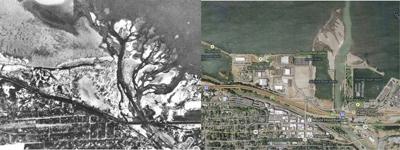
As described during a Hood River port commission meeting Feb. 17, the Hood River–Columbia confluence has been utterly transformed since the early years of the 20th century, when the Hood River branched out across a wide delta as it reached the Columbia. Much of this was inundated with completion of Bonneville Dam in 1938, then covered with river dredgings by the US Army Corps of Engineers to create today’s port riverfront properties, marina and Nichols boat basin.
Other, drastic changes took place along the Hood River watershed, where early logging practices used the river itself as a flume to float harvested timber downstream. This involved construction and abrupt demolition of log dams; as the logs were released, they eradicated fisheries habitat along the way — damage still evident today, even as Hood River Watershed Group, the Forest Service’s Hood River Ranger District and Confederated Tribes of the Warm Springs work to restore upstream habitat.
The “Hood River Confluence Aquatic Ecosystem Restoration Study” will bring restoration forward to the mouth of the Hood River. “Although it isn’t possible to fully restore the river’s delta as it once existed, there is great potential to improve the quality and amount of cold-water habitat for salmon, steelhead, and other native fish species,” said Cindy Thieman, executive director of the Hood River Watershed Group. She also noted that the feasibility study will carefully consider how improved fish habitat can complement recreational uses, with the goal of finding win-win solutions.
“By 2040, watershed conditions will support viable populations of salmon, steelhead, bull trout, Pacific lamprey and other native fish,” according to project partners.
The port was an early project advocate, recognizing growing recreational use of the Hood River sandbar “and the importance of the lower Hood River for fish habitat,” explained Thieman in a Jan. 16 briefing letter to port commissioners.
Congress authorized the ecosystem restoration project study in 2020 as part of the Water Resources Development Act through the leadership of Sen. Jeff Merkley.
But there was no money attached. That’s changed now, as watershed partners secured match funding from the Oregon Watershed Enhancement Board, and the Confederated Tribes of the Warm Springs enabled a $677,000 cost share waiver. The final contribution came in January, when Congress appropriated $500,000 for the US Army Corps of Engineers to fund the first year of the three-year, $3 million study; this will include alternatives development, technical analyses, public comment and design development . (Later appropriations are anticipated.)
The study will build upon a Hood River watershed strategic action plan completed in 2021 that analyzed in-stream habitat restoration, fisheries distribution and other factors. Ultimately, the feasibility study will identify specific measures that could be taken around the Hood River–Columbia confluence to improve habitat, with future costs to be shared be-tween project partners and the Corps of Engineers.
In other business at February’s port commission meeting:
• Commissioners issued a “Request For Developer Interest” (RFDI) to encourage re-development ideas for the port’s Marina East and Marina West parcels just west of the port’s administrative offices. Comprising 2.6 acres in the Marina Basin, the parcels include two aging structures, one leased to Oregon Department of Motor Vehicles and the other to an acupuncture clinic. The RFDI will garner development concepts, guage market interest and identify potential partnerships. The invitation is non-binding and does not seek financial offers. Responses are due April 23.
• Commissioners approved final closing on port purchase of property at 200 N. Was-co Court from Burck Properties, LLC, in the amount of $1.2 million. The site will diversify the Port’s commercial holdings and could serve as the port’s new administrative office when bridge replacement starts as early as October 2027.
• The board offered consensus support to pFriem Family Brewers to expand its physical footprint at the Halyard Building. The local brewer — now the second-largest in-dependent beer producer in Oregon and among the top 40 in the nation — hopes to construct a 5,280 square foot packaging building.
“We need a co-location to be able to grow,” pFriem CEO and co-founder Rudy Kellner told commissioners. “We’re not going anywhere,” he added. “Hood River is our home.” The company employs 120 people, most of them in Hood River. The estimated $2.1 million expansion is contingent upon additional financial analysis, formal commission approval, and city planning approval.
• Commissioners also watched a video commemorating the port and structural bridge engineer HDR’s rapid response to a June 27, 2024, emergency bridge closure when construction equipment damaged several bridge support beams. The work began with a first-ever Sunday morning public port meeting three days later, attracting almost 2,000 people virtually. Assisted by Kiewit Infrastructure West, the effort led to bridge re-opening within weeks and garnered a “State Project of the Year” award by the American Council of Engineering Companies of Oregon, as announced in January.


Commented