A Columbia High School student recently placed third in the SkillsUSA regional welding tournament. And he did it with a broken hand.
Josiah Nelson, a senior at Columbia High School in White Salmon, is waiting to hear whether he will be heading to state tournaments after receiving solid marks on five different welds completed during the virtual tournament.
The competition, held over four days in January, involved students from Southwest Washington, who were provided blueprints and told to fabricate five designs to the prints’ specifications in a given timeframe. Nelson, who according to teacher Chris Hipskind spent between 200-300 hours training in the weeks leading up to the competition, said the broken hand was not much of a deterrent, but the most major obstacle he had push through was learning to consistently perform the techniques required of a welder.
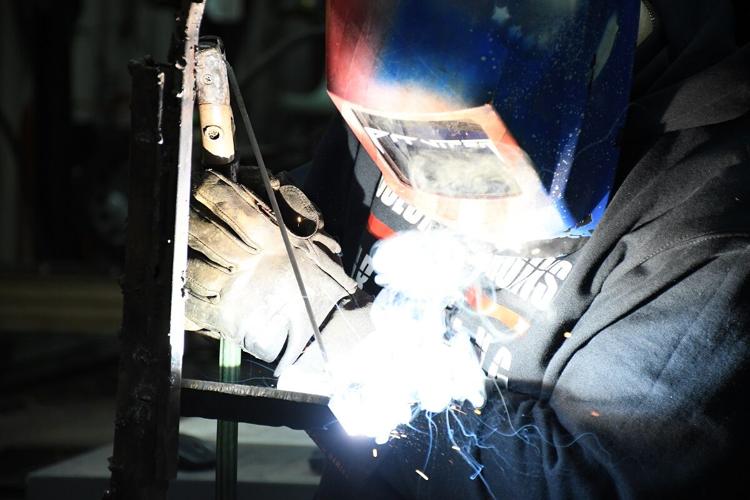
Josiah Nelson demonstrates a shielded metal arc weld.
Jacob Bertram photo
“I stayed up very late, up at the school, learning how to do these things,” Nelson said.
Nelson has been involved with the Columbia High School’s agricultural mechanics program since he was a freshman, taking to the welding area immediately.
According to Hipskind, the metal shop teacher at Columbia High School, the agricultural mechanics program combines fundamental areas of learning. It not only teaches students metal fabrication and welding, but also teaches them skills in interpreting and creating blueprints.
Students who learn to weld, which is the practice of fusing two or more parts together using heat, are introduced to the five most common welding techniques, each unique for their usage and process: Shielded metal arc welding (SMAW), Flux Cored Arc Welding (FCAW), oxygen acetylene welding, metal inert gas welding (MIG), and tungsten inert gas welding (TIG).
Hipskind said metal fabrication is a highly desired skill for employers in the Gorge, which is something the school’s advisory committee looks out for when making recommendations on Career and Technical Education curricula.
A well-rounded curriculum, such as the one seen in the metal fabrication classes overseen by Hipskind, creates well-rounded individuals who can compete in the job market and gives them a jump start to their careers, he said.
“The research that we kind of lean on is that, students who find some kind of success in first five years after high school, that kind of sets up a momentum or pattern,” Hipskind said. “Our goal is to help them be successful in whatever they do.”
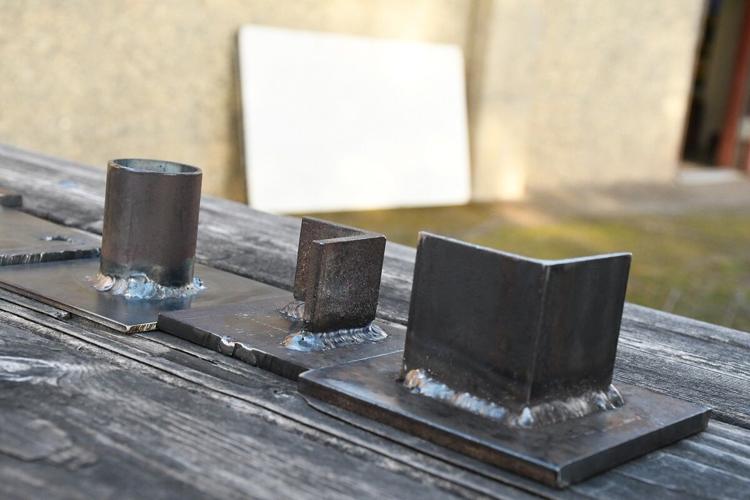
A closer look at Josiah Nelson’s welds made during January’s tournament.
Jacob Bertram photo
The program also uses the help of volunteers, who attend class typically once or twice each week to help students practice.
During the tournament, Nelson was not allowed to have a teacher help perform the welds. After years of learning the craft, Nelson was confident.
“I had faith in myself that I knew how to do all this stuff. I just had to do it,” he said.
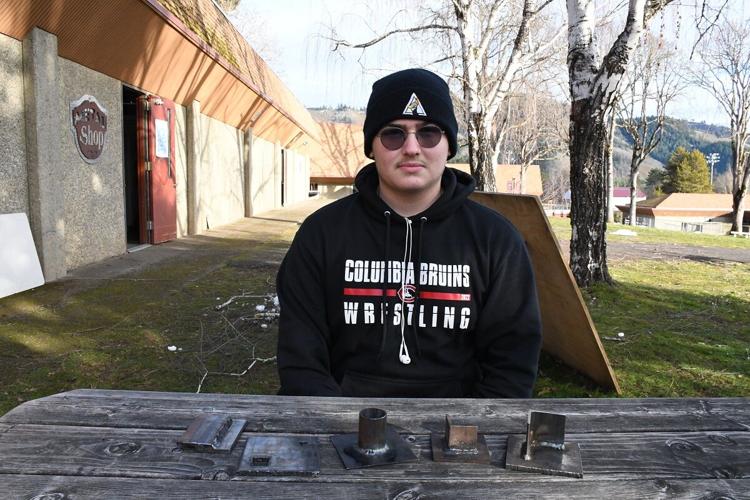
Nelson displayed the five finished products during an interview outside the metal shop at Columbia High School. Each design was made using a different process, with different specifications. He had critiques for a few of them, but one in particular he was most proud of: A hollow cylinder fused to a square base.
“I never ran 6013 before this, and … I mean, that’s pretty good,” Nelson said, describing the type of electrode rod used during the process.
Nelson is waiting to hear whether Skills USA will select Nelson for the state tournament in April, where he would have the opportunity to compete for a spot in the national tournament.
Regardless how the competition concludes for Nelson, he sees a future in this line of work, and since Nelson’s father introduced him to the world of electronics, he now sees an opportunity to apply those interests to his career.
Influenced by a number of family members who served in the military, Nelson is seriously considering a career in the U.S. Navy, where he wants to work as either an electronics technician or fire controlman. He is in his fourth year as a Navy Sea Cadet, a federally chartered organization that prepares young people for a career in the military.
“I feel like as an American, I have an obligation to serve my country and do a minimum of four years,” Nelson said.
It’s a program that has taught Nelson indispensable knowledge of leadership, something that he displays in the metal shop at Columbia High. As one of the more experienced welders of the students within the program, Nelson spends time in the classroom helping out the beginner students. By this point, Nelson can walk into the classroom and begin experimenting with different designs.
“The first time I welded, I was making single little welds… and now I’m doing multi process welding, like aluminum TIG, compared to just taking a MIG welder and pulling the trigger,” Nelson said.
Nelson said Hipskind’s teaching style allowed him to grow into an experienced welder that can explore more challenging welds.
“As a beginner, it’s a lot of like, hands on from the teacher, he teaches you the basics. And then as an advanced student, he really puts a lot of trust in you to like, do your own work, figure out how to do it yourself. And then if you need help, ask him,” Nelson said.
As to how his broken hand impacted his performance during the competition (Nelson simply responded “wrestling” as to how the injury occurred), he said that it was “kinda annoying to have a cast on to do small things.”
The agricultural mechanics program is seeking additional volunteers. Professionals interested in helping students with their technical coursework, reach out to Hipskind at Chris.Hipskind@whitesalmonschools.org.



Commented