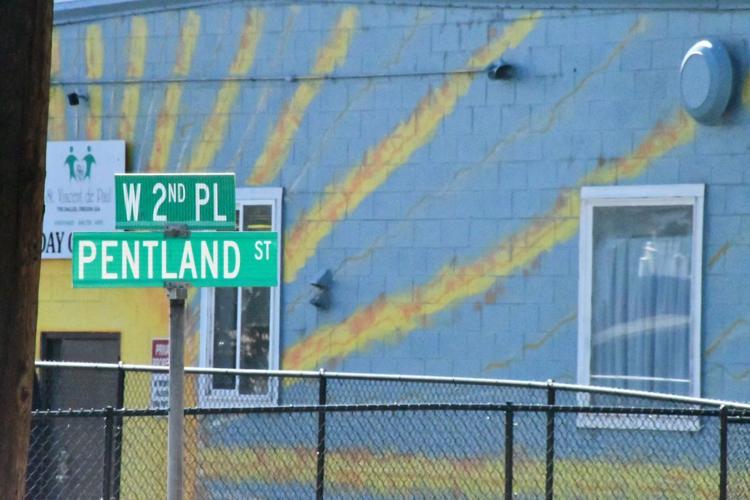
Neighbors near St. Vincent de Paul's Day Center, located on Pentland and W. Second Place, have expressed concerns about the non-profit's operation affecting the neighborhood. Pentland Street in particular has been brought up, as many people experiencing homelessness have been sleeping and storing their things there.
Neighbors near St. Vincent de Paul's Day Center, located on Pentland and W. Second Place, have expressed concerns about the non-profit's operation affecting the neighborhood. Pentland Street in particular has been brought up, as many people experiencing homelessness have been sleeping and storing their things there.
Neighbors near St. Vincent de Paul's Day Center, located on Pentland and W. Second Place, have expressed concerns about the non-profit's operation affecting the neighborhood. Pentland Street in particular has been brought up, as many people experiencing homelessness have been sleeping and storing their things there.
The Dalles City Council authorized City Attorney Jonathan Kara to file a public nuisance action against the St. Vincent de Paul Society of The Dalles following an executive session on Sept. 11.
The emergency shelter and meal hub, which is located at 315 W. Third St. in The Dalles, partners with local non-profit organizations Community Meals and Bread and Blessings to offer meals to those experiencing homelessness. However, members of the community have expressed concerns about the way surrounding neighborhoods have been affected by the behavior of some of those who utilize St. Vincent’s services.
During the regular meeting on Sept. 11, which took place directly before the executive session, community members, including several who live in the vicinity of St. Vincent, shared anecdotes about their experiences living near the organization and implored the council to take action.
Several people cited being victims of property damage or theft, seeing people urinate or defecate near the facility and witnessing people dealing or using narcotics. There was also concern related to a recent fire that broke out near Mill Creek, marking the second year in a row this has happened.
According to multiple neighbors, their houses were threatened when people camping by Mill Creek were trying to cook and started fires. Kelsey Alsheimer, who lives on W. Third Street, recounted being out of town during last summer’s fire.
“We were so lucky to have community support and people there that were on top of it,” she said, noting the quick response from the fire department and action from neighbors. “An isolated incident is one thing, but a second year in a row is just not acceptable.”
Megan Wells-Clark, who lives on W. Third Street with her husband Robert, said that this summer they were out of town during the fire and had to watch on their doorbell cameras while their neighbors tried to protect their property. She expressed the fear and helplessness she felt, saying she “was certain [she’d] be coming back to nothing.” She implored the city to work to create safe places for those experiencing homelessness to meet their needs and cook, as they may otherwise be facing a third fire in the next year.
Litter, specifically biohazardous waste such as defecation or dirty needles, was also brought up as a concern. Robert Wells-Clark noted that though his daughter enjoys playing in Mill Creek, which is adjacent to his property, he now has to go and check for needles before he can let her.
Many of those living in the area noted that they had tried to communicate with St. Vincent’s regarding the problems but had been ignored or written off.
“The leadership of St. Vincent’s has never had any regard for the neighborhood’s wellbeing,” said Rian Beach, who lives with his family on W. Second Street, not far from the non-profit. “Their position is that we chose to move into the neighborhood and knew what we were getting into.”
Robert Wells-Clark shared his experience bringing up concerns with St. Vincent, noting that they told him it was “not [their] problem.”
Beach also pointed out that, within the last year, St. Vincent has also added a fence surrounding their property, causing more people to have to move to the sidewalks.
“The fence serves only to protect St. Vincent and their property from their own clientele,” he said. “[It] serves as a stark example of the fact that St. Vincent does not care about its neighbors or the broader community.”
Additionally, Beach cited Mid-Columbia Community Action Council as an example of an organization that helps those experiencing homelessness while also being respectful of the community. He pointed to their strictly enforced rules, security on the premises and open involvement with their neighbors.
Similarly, Wells-Clark noted that the implementation of the pallet shelters a few years ago seemed to help the problem, though it had since gotten worse as the shelters were unable to support the growing population, and he looked forward to seeing the effect MCCAC’s upcoming projects would have.
A few people expressed frustration with what they perceived to be inaction by the city on the matter, but it was clarified at the meeting that the city had been consistently meeting with St. Vincent de Paul and that, on Aug. 1, The Dalles Police Chief Tom Worthy sent the organization a notice of public nuisance.
In the notice, Worthy noted that under The Dalles Municipal Code (TDMC) 5.12, one of the things that constitutes a public nuisance is a pattern of behavior in which there are three or more specific offenses in a 12-month period revolving around a specific property. Worthy said he analyzed the calls for police service at or within 300 feet from the property, particularly those resulting in actual arrests or citations, in the 12-month period between July 1, 2022, and July 1, 2023.
Neighbors near St. Vincent de Paul's Day Center, located on Pentland and W. Second Place, have expressed concerns about the non-profit's operation affecting the neighborhood. Pentland Street in particular has been brought up, as many people experiencing homelessness have been sleeping and storing their things there.
Chelsea Marr photo
According to Worthy, there were arrests and citations for many acts not allowed under TDMC or Oregon law, including drinking in public places, unreasonable noise, assault, sexual abuse, public indecency, criminal trespass, criminal mischief, disorderly conduct, harassment, minor in possession of alcohol, unlawful delivery or possession of a controlled substance and theft by receiving. He noted there were at least 34 total charges that took place during that year-long period.
Worthy finished the letter by requesting that St. Vincent respond to the notice within 14 days with a course of action, which they did with a letter dated Aug. 14. In their proposal for addressing violations, they listed many possible actions to address various problems.
For behavioral issues among those served, they proposed training staff and volunteers in de-escalation practices, coordinating with police to provide the names of those causing issues, and considering reducing their hours. They also mentioned tracking those served, requiring those served to register for services, which would include giving a photo ID, and requiring those served to sign a form acknowledging their understanding of facility expectations.
The proposal also addressed waste and garbage issues, suggesting encouraging those who serve meals to do so within the facility, rather than using take-out containers, and engaging volunteers and patrons to help maintain facility grounds. They also made suggestions to help the external appearance of the facility, which included informing those served that sidewalks must be kept clear, posting “no camping” and “no loitering” signs, withholding service from those who do not comply and opening the fence prior to meals so those waiting have a place to do so.
For safety and security, St. Vincent proposed increasing their number of cameras, giving police access to the cameras and considering hiring a security guard to monitor cameras. They also expressed an interest in boosting their communication with facility partners and city leaders.
On Aug. 17, Worthy responded to the proposal, going through it step by step and explaining where it would be inadequate. In particular, he pointed out that many plans were alluding to actions that “could” be taken or would be “considered,” and asked that St. Vincent commit to creating a concrete plan, rather than just identifying potential remedies. He also asked for specifics as to how several parts of the plan would be executed. At the end of his response, he asked for an updated plan by Sept. 7. According to the city, they never received a second response from St. Vincent de Paul, which was why they would be meeting in executive session to discuss next steps.
Following their executive session, City Councilor Tim McGlothlin made a motion to authorize the city attorney to file a public nuisance action against St. Vincent in Wasco County Circuit Court. This was seconded by Councilor Dan Richardson, who said he was doing so with the intention “to remedy ongoing quality of life impacts and public disorder.”
The vote passed 4-0, with Councilor Darcy Long unable to vote as she had to leave before the executive session.
It is not yet known what action the city will be asking the Wasco County Circuit Court for in their complaint, whether that will be a fine or a short- or long-term closure of St. Vincent de Paul.
The next city council meeting is set for 5:30 p.m. on Monday, Sept. 25. It will be held at The Dalles City Hall, located at 313 Court St., and will also be available via Zoom and streaming live on YouTube.





Commented