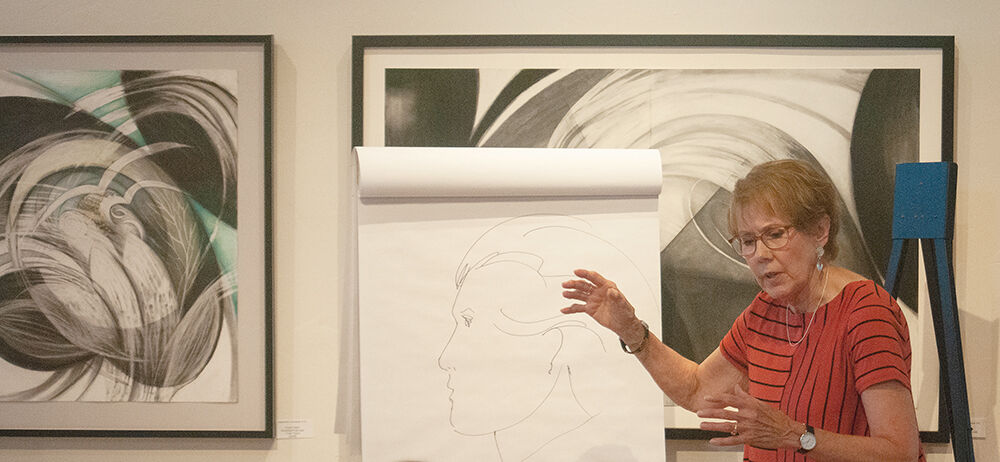
Artist Cheryl Hahn presented recently at The Dalles Art Center. A recap of one of Hahn’s early exhibits, “Drawing Conclusions: Part Two” is exhibited at The Dalles Art Center (TDAC) until Aug. 15.
Artist Cheryl Hahn presented recently at The Dalles Art Center. A recap of one of Hahn’s early exhibits, “Drawing Conclusions: Part Two” is exhibited at The Dalles Art Center (TDAC) until Aug. 15.
THE DALLES — From the colorful, layered sound of a foghorn to the dots and dashes of her own breath and heartbeat, Cheryl Hahn works to portray emotions and personality in her bright, abstract mixed-media paintings. Over five decades — from struggling for recognition as a female art student, to painting in her kitchen in the ‘70s, to success in several galleries across the country — her paintings have slowly transformed, reflecting her experience.
A recap of one of Hahn’s early exhibits, “Drawing Conclusions: Part Two” is exhibited at The Dalles Art Center (TDAC) until Aug. 15.
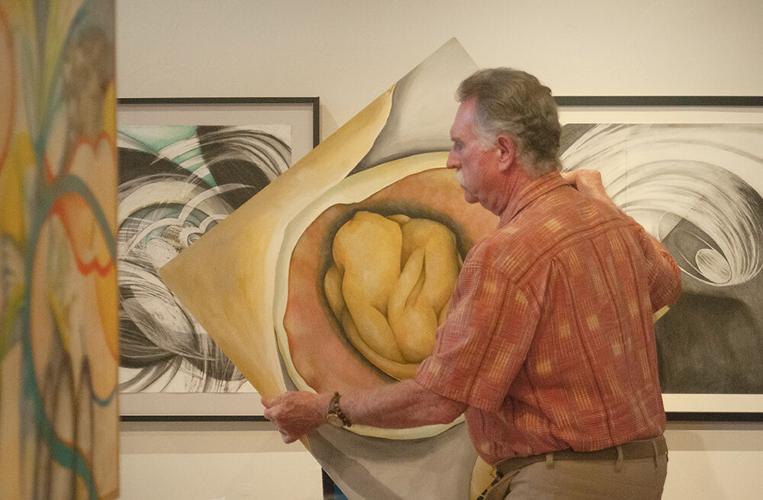
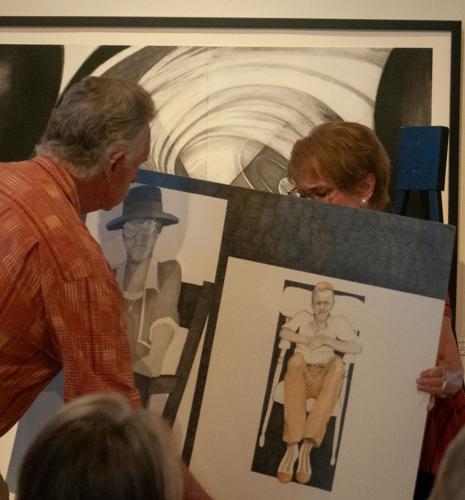
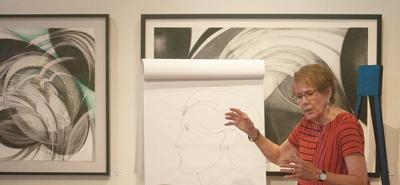
Cheryl Hahn and her partner ferry paintings back and forth, making a slideshow of Hahn's artistic transformations over decades.
Flora Gibson photo
Hahn’s grandfather, born around 1886 in Chicago, visited museums and filled sketchbooks with careful copies of Rembrandts and other classical artists in the late 90s. When 5-year-old Hahn’s mother showed her the sketchbooks, she was inspired.
“It’s a kind of wackiness, really, because I have to spend money to do it. Luckily, I have the finances that I can do it. Not always was that the case,” she said in an interview.
Hahn’s father was a musician, playing wind instruments in orchestras in the late 1920s; her mother acted in high school shows and received an offer to continue that career. But Hahn’s grandparents where “quite strict back in the day.” Instead, her mother married and raised seven children.
“It was still a very oppressive atmosphere for women. They were the muse. They were not taken seriously,” Hahn said of her time in undergraduate school in Indiana. At least one professor laughed and made fun of Hahn’s appearance in a sculpture class. She was not taken seriously, and not given help — at one point, she lost three months of work on a sculpture after misjudging the amount of aluminum needed, without help from her teachers.
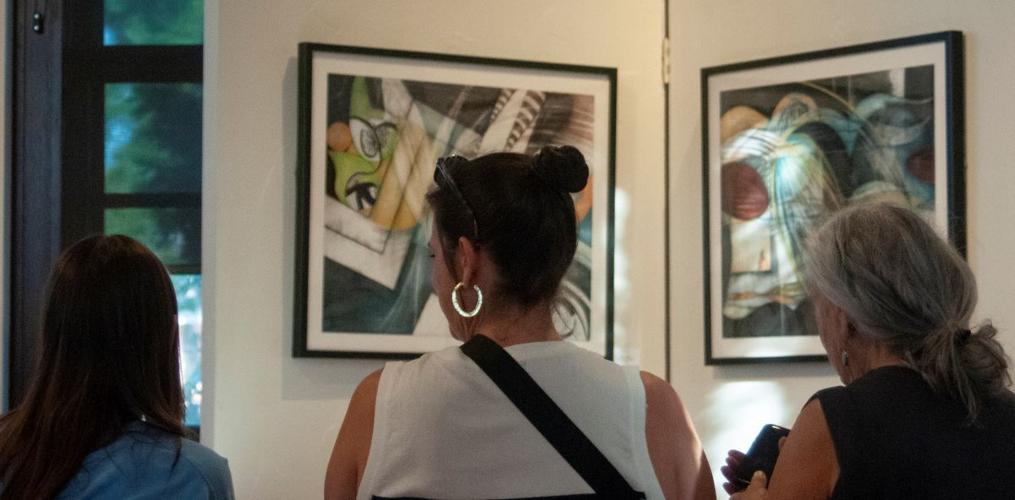
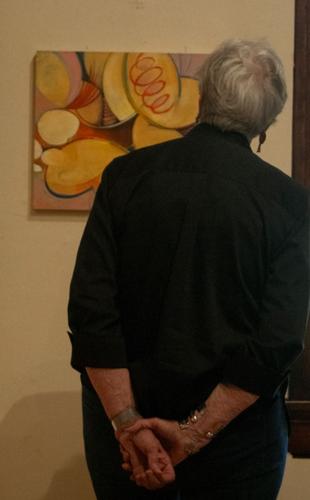
Spectators explore Cheryl Hahn's paintings at TDAC on opening night, July 11.
Flora Gibson photo
At graduate school in 1980, at Carbondale in Illinois, Hahn was given mocking nicknames. “You took it and you laughed with them. Because if you didn’t, then it showed you were weak, you see,” she recalled. “...But what it does to you, as a women artist, is you take it in. You take it in, and you second-guess yourself.”
Hahn read voraciously and found her own role models, among them Georgia O’Keefe, Rilke, Mary Oliver, May Sarton, Hilma af Clint and Anais Nin. In them she found the strength to value her own work, she said.
But graduate school hadn’t prepared Hahn for the real world, and she walked into a gallery for the first time with no idea how to price her own paintings. “I was working in my kitchen. You know, I was always backing into the oven or something,” Hahn said. She didn’t get a proper studio until the late ‘70s.
Male gallery owners could be blatantly sexist, even propositioning female artists. “A whole lot was going on before the #MeToo movement ever woke up. Because you just could not speak up,” Hahn said. “You would get fired, if it was a job situation.” When #Me Too took flight, Hahn was thrilled; she had lived through it.
Hahn chronicled the discrimination she faced and the inspiration she found in journals since 1960. Recently, she reread her journals and ephemera and gave them to her alma mater, Indiana State University. Now, the institution where her younger self struggled for serious recognition as an art student curates the Cheryl H. Hahn archives.
Over the years, her work slowly transformed. Many early works are traditional drawings and portraits. Later, Hahn’s human subjects meld with other forms. By the late ‘70s, human faces had become open spaces or outlines of mountainous natural shapes.
Cheryl Hahn and her partner ferry paintings back and forth, making a slideshow of Hahn's artistic transformations over decades.
Flora Gibson photo
Then a “strange thing” happened in the ‘80s. Hahn heard a foghorn blow, overwhelmingly loud and close to Hahn’s position on the shore of a northwestern lake, transforming her art forever. “It made my whole body feel like a violin, you know?” she said at a TDAC presentation. Hahn became driven by the idea of capturing, on paper, that overwhelming moment of sound.
“One can maybe call it a drawing with paint,” she said. She uses arcs and dashes, dots, and the convergence of lines. Each mark holds meaning. For instance, the dash marks in many of her images “represent for me pulse, and breath. So I may be sitting here silently in my chair, but there is movement within me ... So those sort of rhythmic vibrations, I express in the images.”
She starts with an idea of the finished painting, then starts adding collage elements and mixed-media and graphic marks. Using graphite, charcoal, acrylic, watercolor, marker, collage, ink and oil paint, even indentations pricked in her canvas, she marks rhythmic patterns, dots, dashes and curling arcs.
“I’m not interested in making a picture of the landscape. I’m interested in making a painting that visualizes my experience in the landscape,” Hahn said.
Physical letters began disappearing in the late ‘90s, Hahn said. An avid letter writer, she became fascinated with the alphabet after discovering a box of letters her mother left behind — every note and postcard her parents exchanged. For almost ten years, Hahn researched and painted alphabets, before returning to the abstract, organic illusions on show at TDAC.
Spectators explore Cheryl Hahn's paintings at TDAC on opening night, July 11.
Flora Gibson photo
But last year, Hahn read the Toni Morrison quote, “We need more good speech in the world,” and returned to words. Paintings for her next show hide words like “heal” and “hope” in their shapes. “It’s all I think about, and I keep getting ideas,” she said at TDAC.
Her advice to young artists like her is “never give up, never give in. I have a saying on my wall: ‘I may become disappointed, but I will not be deterred’ ... And you also have to work really hard.” Hahn herself chose not to become a mother, focusing on art instead.
“If you measured it in financial success, I guess I would have stopped 50 years ago. But that’s not why I make my work,” she noted. “I make my work because I get turned on by ideas that I think are worth talking about or visualizing.”



Commented