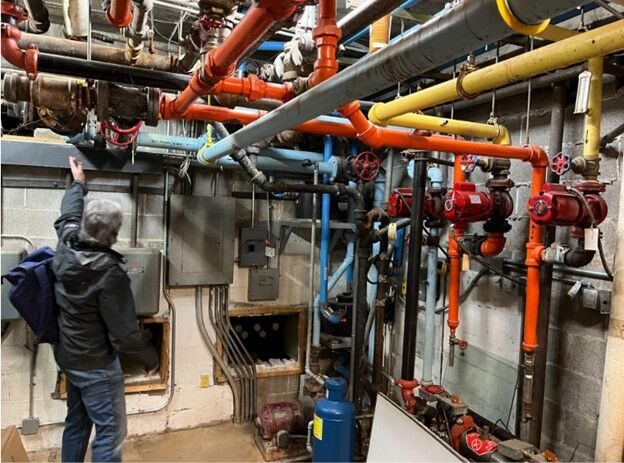
A contractor looks at the various water supply lines in the boiler room, some from the old boiler. Cascade Locks Elementary School has been using a temporary HVAC system since September, after its 75-year-old boiler was deemed unusable by the state and the district's insurance provider.
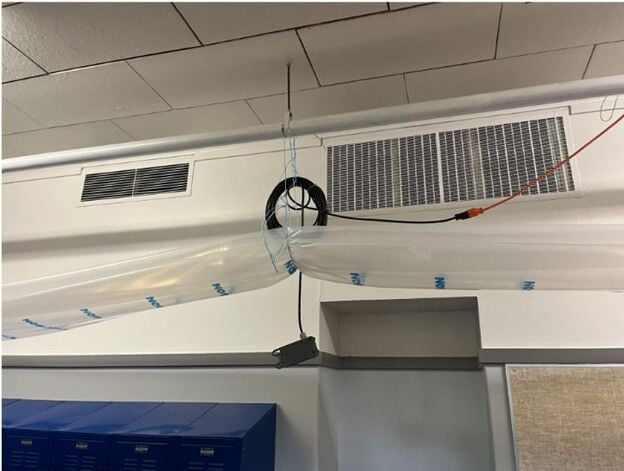
Cascade Locks Elementary School has been using a temporary HVAC system since September, after its 75-year-old boiler was deemed unusable by the state and the district's insurance provider.
A contractor looks at the various water supply lines in the boiler room, some from the old boiler. Cascade Locks Elementary School has been using a temporary HVAC system since September, after its 75-year-old boiler was deemed unusable by the state and the district's insurance provider.
HOOD RIVER — School district board members voted unanimously to declare an emergency situation in order to replace the HVAC (heating, ventilation and air conditioning) system at Cascade Locks Elementary as quickly as possible.
The emergency declaration was needed to get the project moving forward so the new system will be ready for the 2024-2025 school year. It will improve not only heating, but air quality and flow. Total anticipated cost is $551,100, which covers owner contingency, the architect and engineer, mechanical contractor, commissioning, project management and a hazardous materials allowance.
Since September, the school has been using a temporary system to heat the hallways, gym and cafeteria spaces after its boiler was deemed unusable by both the State of Oregon and the district’s insurer.
“It comes at a cost — it’s an expensive cost just for the rental of the equipment, somewhere around $67,000,” Superintendent Bill Newton told the board during its Jan. 23 meeting — about $7,000 a month.
Luke Harkness of Wenaha Group, the district’s project management team, joined Newton via video call to explain the scope of the problem. The boiler, Harkness said, was built in 1948, and the school opened in 1949.
“That boiler’s been serving for 75 years, which is pretty remarkable when you think about it,” Harkness said. “As far as getting your money’s worth, I think you got it out of that original boiler.”
The new system, recommended by Interface Engineers, is zone-based and runs entirely on electricity.
Cascade Locks Elementary School has been using a temporary HVAC system since September, after its 75-year-old boiler was deemed unusable by the state and the district's insurance provider.
Contributed photo
Director Corinda Hankins Elliott (position 3) asked if there were funds to cover the project in Capital Improvements; Newton said that fund is a little more than $200,000, so the district will either need to move funds from the general fund or take out a loan, as a full faith and credit obligation.
“We can take a look at it a couple of different ways … [but] when you’re moving money to take on capital projects, it comes from someplace else. It’s going to have an impact,” Newton said.
Board Chair Chrissy Reitz (position 1) asked about grant opportunities; both Harkness and Newton said that because of the unique way Cascade Locks receives its power — from an electric co-op — it is not eligible for state energy grants.
Reitz said a Washington State legislator is looking to establish a capital improvement fund for districts to access. “I would encourage everyone, when you’re talking to legislators, if you can take time to write a letter, to bring up problems like this and how they are really bad for school districts,” she said. “They make school districts make choices that people who run schools don’t want to have to make … That’s not something that’s available to us right now, but it would be nice for the state to know it’s something that should be available to districts.”
Harkness said the goal is to have all work done by the end of August.



Commented