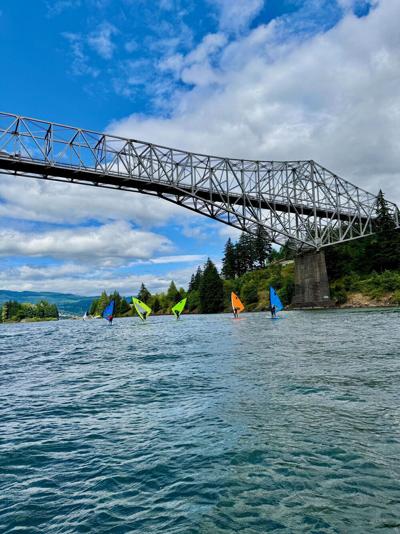
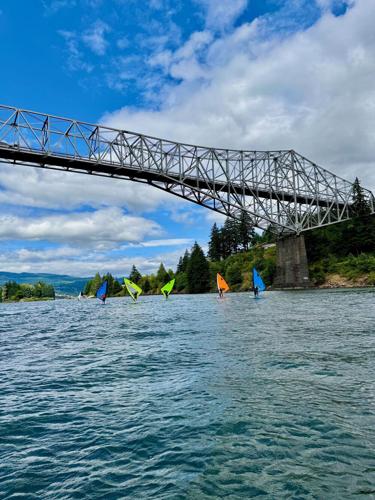
CASCADE LOCKS — Port commissioners heard an update from David McCurry of Parsons Engineering about safety, seismic and preservation studies on the Bridge of the Gods at its Aug. 19 meeting. Parsons is collecting data on how to keep the bridge from falling apart in earthquakes, and keep it in good condition.
McCurry had good and bad results to share. With data collection and analysis done, Parsons will be reporting the results from borings, geotechnical analysis, soil testing and other information.
One problem: They never found the original construction drawings. They have found new information and new archives, but not the old drawings, which had to be reconstructed using LiDAR surveys. Structural work relies on these new drawings.
And while current funding is secure, future funding is not. “On the national level, lots of weird stuff [is] happening,” McCurry said. National funding streams are changing and lists of possibilities shrinking.
Commissioners watched a seismic model, a detailed 3D bridge, breaking under earthquake stress on McCurry’s screen. Parsons mapped the bridge’s natural frequencies of vibration and can throw different earthquake forces at the digital bridge, seeing what makes it break and what makes it undulate and vibrate like a violin string.
The bearings, transferring a lot of energy between pier and trusses, are a weakness.
In better news, underneath the Bonneville landside deposits, earth that might liquefy under the bridge’s supports in an earthquake, lies “good, solid” rock formations. “The soil conditions are actually great, which is not what we expected,” McCurry said.
Biennial bridge inspections by Oregon’s Department of Transportation are complete, too, and Parsons will write reports and draw up plans for retrofitting the bridge against an earthquake next.
Fieldwork also went well. A geologist and archaeologist collected data to check for archaeological sites, and found none. They put equipment into the holes and gathered data and samples. They also closed the bridge at night and ran a special loaded truck up and down the bridge, collecting data to calibrate new sensor systems. The sensors monitor the movement, strain, acceleration, and displacement of the bridge.
Underwater imagery and diving, and hands-on inspections of certain spots on the bridge where cameras didn’t reach, is ongoing.
All this work means they can determine “exactly what’s happening on this bridge in terms of the trucks and the traffic,” matching it to mathematical modeling.
The sensors will collect data for a few months. The bridge moves a lot, McCurry said, because metal absorbs heat, expanding and contracting. The bridge expands at sunrise, straining a little, and contracts at night.
When a heavy weight goes over, like a big truck, the bridge strains sharply.
Soon, they’ll know exactly when each overweight vehicle crossed, and can match timestamps with video cameras to view any vehicle. Commissioners noted it’ll be interesting to see how many overweight vehicles cross. The numbers show the bridge isn’t under alarmingly high stress.
In other news, Cascade Locks is working on a shelter for emergencies, like heat waves, cold snaps and wildfire. Before it can open, they need five trained door openers. The Red Cross will train volunteers to get things running before Red Cross personnel arrive to an emergency. One commissioner and the deputy executive director volunteered.
Albert Nance noted the importance of finding door-openers from every part of the community, especially folks who can speak different languages so “everyone ... feels welcome.”
Commissioners noted Take a Kid Mountain Biking returns to Cascade Locks on Oct. 4. The last version drew 300 kids. Commissioners are also seeking to build a new RV park and will hear from a consultant on the most feasible way to develop or use the land they own. Designing for new campgrounds will start in October, with commissioner input.
Commissioners unanimously approved guidelines for the next round of grant funding, to open in early September.
Local grant programs are continuing, said Deputy Director Genevieve Scholl, “in stark contrast to the federal programs.”



Commented