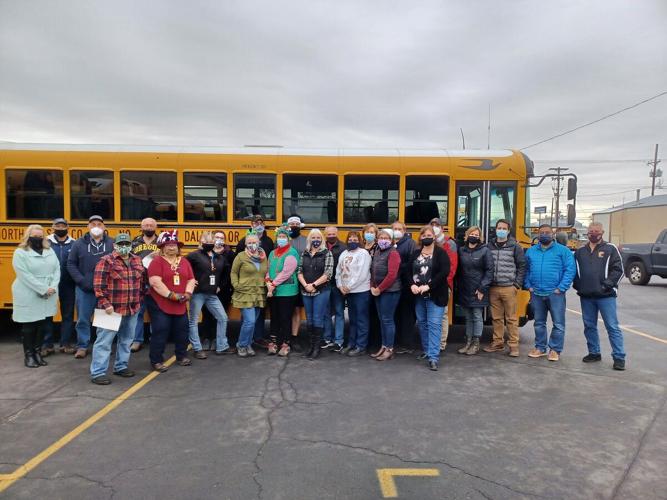
The North Wasco County School District 21 Transportation Department poses for a photo with school board members Jose Aparicio and David Jones, and Jared and Cora Sawyer, who presented the drivers with gift certificates to Grinder’s coffee in The Dalles.
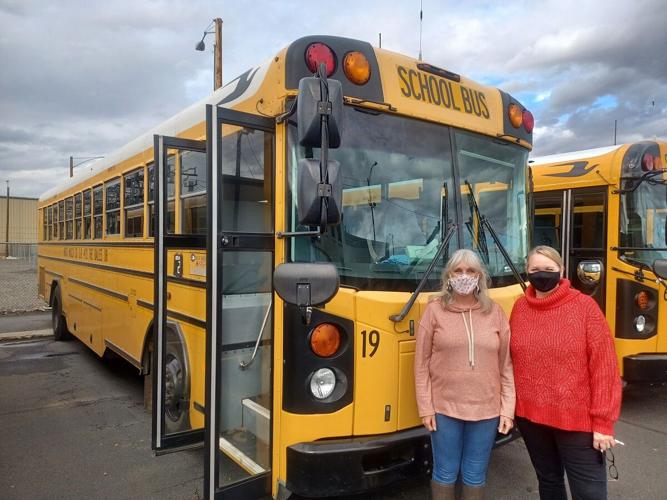
NWCSD bus driver Cindy Ross, left, stands with Superintendent Carolyn Bernal in front of one of the district’s buses.
Contributed photo
Have you ever thought about who is the first — or last — face your student sees on a typical school day? For some, that may be a teacher, or a coach, or even a club adviser, but for many students, that face would be of a school bus driver.
Be it an early weekday morning, a busy post-school afternoon, or the evening after a big game, your local school bus drivers work hard to get your students where they need to be.
“These are the first faces that these kids see from our schools in the morning, sometimes they’re the first face (of an) adult that they see at all and the last one that they are going to see going home — and in education we think about teachers often as the primary educators, but really, bus drivers are every much an educator as a teacher is,” said North Wasco County School District (NWCSD) Communications Director Stephanie Bowen. “They are just as essential a piece of the education system.”
A typical day of a home-to-school NWCSD bus driver is broken down by bus driver Audrey Stephens, who recently celebrated 33 years of serving NWCSD. Getting in around 6 a.m., Stephens shared that drivers perform “pre-trips” of the buses, which consist of a 20 minute walk around, checking things such as the oil and tires, and making sure the basic functions like the lights are all in working order before the drivers go out on their routes. “Most of the runs are both elementary, middle school and high school,” said Stephens. “And then after we get done, we come back and we clean our bus, we sweep it and clean the windows and do the wipe downs.”
When it comes to daily busing in NWCSD, driving does not simply consist of home and school destinations. “Depending on the route, some of the drivers do the shuttle from the high school to the college,” said Stephens. “Then we also have some drivers that do Preschool Promise, which is the preschool program. And we have drivers that are doing the special needs buses, and they kind of come and go more during the day. And so then the regular route driver usually comes back in at 2 p.m. and goes and picks up the kids and takes them home.”
Over in White Salmon Valley School District (WSVSD), White Salmon native Mike Yarnell has worn many hats since starting working with the White Salmon Valley school district in the early 1990s.
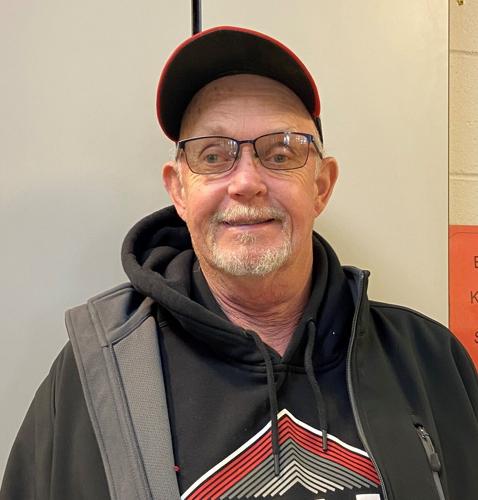
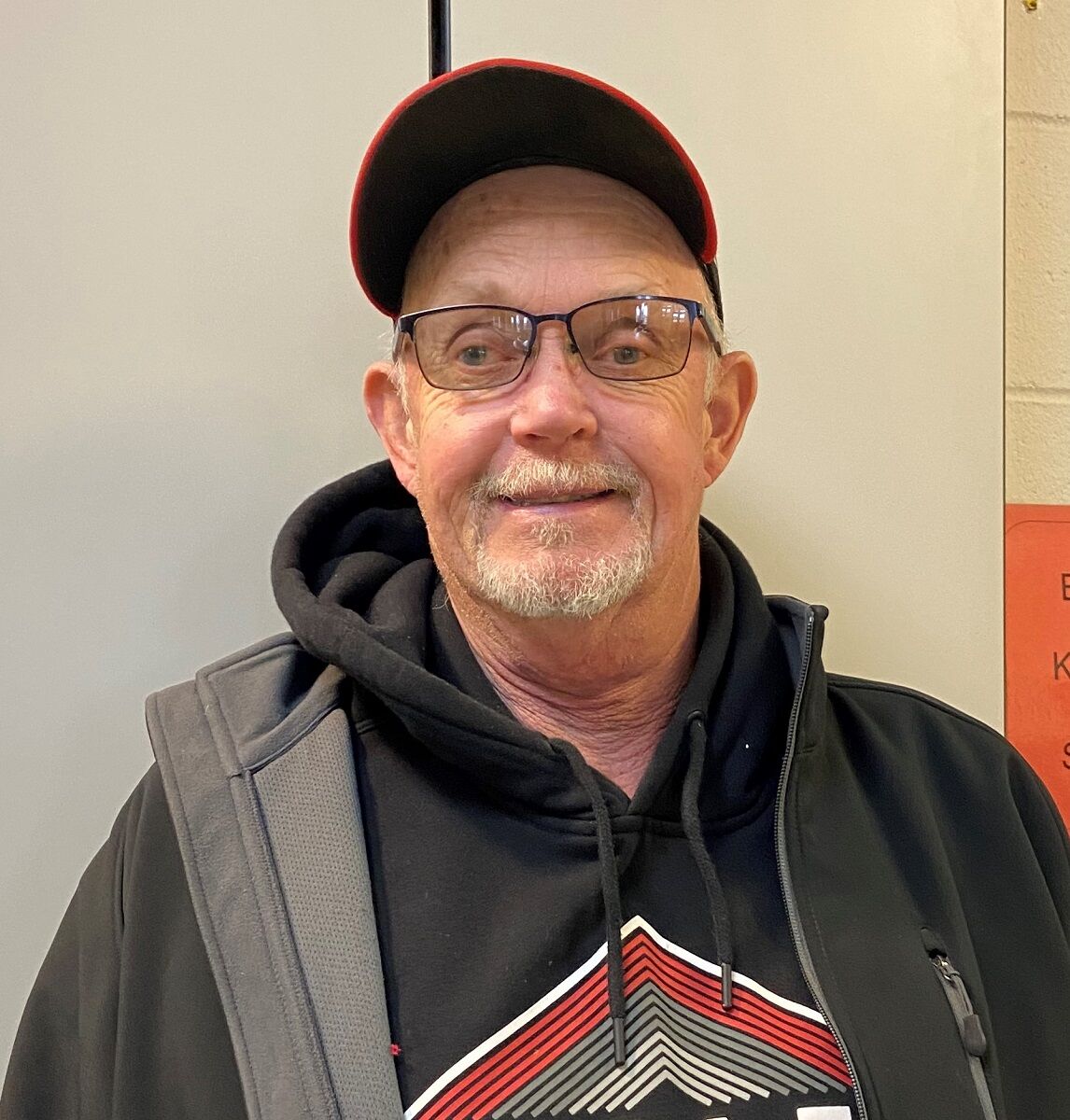
Mike Yarnell has been driving bus for the White Salmon Valley School District for the past 12 years.
When logging work opportunities dried up 30 years ago, Yarnell, an experienced groundskeeper from a nursery job and from experience through his own entrepreneurship, found work with the school district doing grounds maintenance. But later on, he immersed himself in the district, subbing for teachers, coaching basketball, and later driving bus.
“I’ve been involved with kids for a very long time, and our number one concern is safety,” Yarnell said.
Each morning, Yarnell arrives at the transportation center’s bus barn and, similar to Stephens, ensures the entirety of his pre-check routine has been completed. Once he checks the lights and the lugnuts, Yarnell and his aide, Margie Grant, roll out at 7:20 a.m. Yarnell is responsible for three bus-loads of 50 kids each day, making sure the kids are dropped off at the correct location, and for the younger ones, that their parents or guardians are around to pick the kids up.
“I got little kids that, you know, they’ll come up and they’ll give you a high five or, if you’re gone for a couple of days, want to know where you’re at, and you make you make a connection with these kids,” Yarnell said. “That’s pretty cool stuff.”
While Salmon Valley Transportation Director Susan Tibke said that shortages in bus drivers have been frequent since before the COVID-19 pandemic started in March 2020.
“There’s places that they have to cancel bus runs, because they just don’t have the drivers for this day or that day,” Tibke said. “We’ve been extremely fortunate that we’ve been able to work it well enough to cover our routes.”
Not only is it difficult to find available bus drivers during the school day, but many school districts are finding it hard to get transportation for their sports teams. Sports faced shortened seasons — or in some cases, were canceled entirely. The arrival of a vaccine helped some schools reconvene in-person, and athletics followed.
Hood River Valley High School (HRVHS), a member of the Intermountain Conference, made up of schools from Redmond and Eastern Oregon, has struggled to find available — and capable — bus drivers to transport players and coaches, and much of the responsibility has fallen onto one driver.
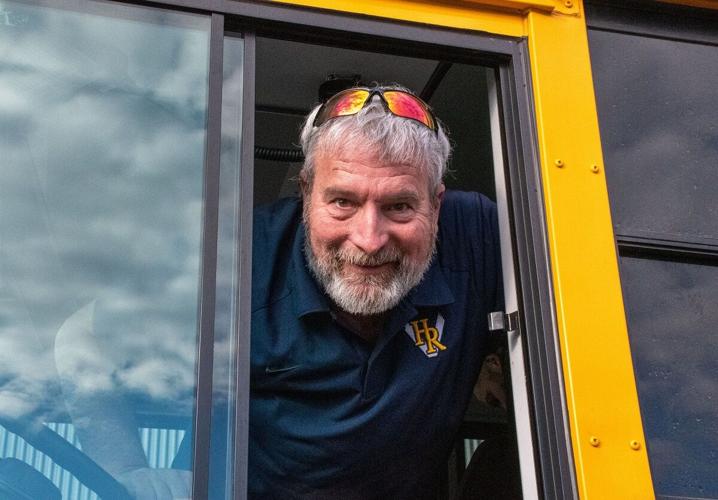
Paul Askins dons his HRV gear that coaches have given him for driving them to and from games.
Noah Noteboom photo
Paul Askins, a Hood River native, and has worked as an electrician and construction worker in Hollywood. Since he returned to Hood River, he has worked in the Hood River County School District (HRCSD) for almost 10 years as a bus driver. He spends most of his time transporting students and athletes to and from away games. Also a part-time mechanic, he gives a lot of time to fixing the buses, yard maintenance and helping out around at the district’s “bus barn” in Odell.
“If you asked me 10 years ago, I would have said there are better chances I win the lottery than become a bus driver,” said Askins.
As one of a few drivers who is capable and willing to drive in Portland, many times he is the one tasked with driving athletic teams to away competitions. Askins said COVID has also made his schedule unpredictable. Although he is not responsible for a usual morning route, he often doesn’t know what his schedule is until he gets a call at 5:30 a.m. that morning.
This year, a central part of a driver’s typical day has consisted of maintaining COVID-19 protocols. In NWCSD, along with cleaning — which consists of drivers cleaning high-touch points such as railings and windowsills after morning routes and the facilities department cleaning the buses in the evenings with an electrostatic sprayer — drivers, according to Kaseberg, perform visual screening of all students, provide masks to all who need one, and keep a seating chart.
“Having to screen students and be the one that says, ‘You’ve got a cough, please remain at home,’ that’s been a tough duty,” said Kaseberg, “I would say that puts pressure on a driver, that we never had to do things like that before.”
Like NWCSD, White Salmon Valley transportation center has also added new policies for sanitation and safety. They have worked hard to disinfect the equipment and enforce mask rule, Tibke said.
“The whole mask thing, the kids have been really good,” Yarnell said. “You always got one or two kids you got to talk to about keeping their mask up, but as a whole they’ve been great.”
According to a Jan. 14 Oregon Health Authority (OHA) press release, bus drivers are no longer required to perform contact tracing as everyone on the bus is masked, though Kaseberg shared that NWCSD will continue to keep attendance sheets for the valuable insight they provide, “It gave us a ton of information” said Kaseberg, “who was riding what route, where we can make improvements, where I can combine a route … it’s just structure, which is always imperative on the bus.”
In the wake of shutting down due to the COVID-19 pandemic, and then the overall staffing shortages NWCSD has experienced since reopening, Kaseberg shared that her drivers, like many different employees within the district, have stepped to into other roles to meet needs and gain extra hours, “During COVID … when we initially shut down, we were packaging lunches to doing custodial work to planting flower beds … just a little bit of everything,” said Kaseberg, “Even right now … we have staff that are going to be stepping in and helping at recess duty and lunch room duty and picking up extra hours for them.”
As sport seasons transition from one to the next, Atkins from HRVHS said he will have a difficult time getting enough hours. Askins said he and other drivers don’t get many hours in the months of November and March. He estimates his mileage per calendar year tops 50,000 miles, but COVID has severely impacted the consistency he had previously.
Yarnell also helped out in the early days of the pandemic, driving lunches around to WSVSD children stuck at home during the quarantine. “They really appreciated it. You had families that were very consistent, so you knew for sure they were going to be there.”
Tibke said the pandemic has brought the White Salmon Valley staff closer together and reinforced the idea that “we’re all on the same team. And that team is to be for the kids. That everything we do on every side is to just help the kids out and support the kids, the parents, and the community.
“For most kids who ride a school bus, if there was no school bus, they wouldn’t get to school,” Tibke added.
Along with the work that they do for the NWCSD district itself, according to a presentation made by Kaseberg in a December school board meeting, NWCSD Transportation department has sub-contracted their services in order to assist neighboring school districts, supplying drivers for field trips, driver training, and mechanical needs. “It’s been really important to myself and (NWCSD Superintendent) Dr. Bernal … working with our neighbors,” said Kaseberg in the December meeting, “We have a lot of neighboring school districts that they’re struggling with finding staff … we all have reached out to each other, but they have reach out to us … we are happy to look into helping neighbors out.”
Since Yarnell started working with the White Salmon Valley School District 30 years ago, Yarnell has seen generations grow up and multiply. He can recall coaching students of parents he coached years earlier, a fact he reflected fondly on. Despite growing in age and pondering retired life, Yarnell knows he’ll “always be around.”
“When you have been around a group of people like this year for all these years ... it’s kind of like home,” Yarnell said. He added that driving bus does pay very well, but “if it was just for money I wouldn’t do it … You gotta have a heart for kids.”
When asked if there was anything she would like to say to the community, Stephens from NWCSD extended her gratitude for people being so understanding through the harsh weather the Gorge faced this winter. “I want to thank the community for being so gracious to us during the snow,” said Stephens. “There was many times that people would pull over if the road wasn’t quite wide enough, or they would hang back so we could make a turn.”
“The community was great,” said Kaseberg.
The North Wasco County School District 21 Transportation Department poses for a photo with school board members Jose Aparicio and David Jones, and Jared and Cora Sawyer, who presented the drivers with gift certificates to Grinder’s coffee in The Dalles.
Contributed photo
“It’s (bus driving) a wonderful job,” said Stephens. “I love meeting up with adults now that rode my bus 20 years ago, and they’re like, ‘Hi Audrey, how are you, do you remember me?’”
Despite knowing communities will need school buses and drivers, Tibke recognizes the weight of the responsibility that lies with transportation centers. “They don’t know you, but they put their kids on the bus with you. That’s a pretty big deal, you know?”
At the Dec. 16 NWCSD board meeting, the school board recognized the transportation staff for their dedication and hard work, with the department having been presented with gift certificates to Grinders Coffee in The Dalles. “We are so pleased, and we so much appreciated the recognition that the bus drivers got ... During the school board meeting, that was just great,” said Kaseberg.
Hood River County School District also recognized its drivers during its Jan. 12 board meeting. Catherine Dalbey, human resource director, said there are 22 bus drivers covering the 533 square miles in the county — together, they drive 2,365 miles each day, picking up and dropping off children (which works out to around 100 miles per driver per day).
“They’re the first people the kids see in the morning, and the last people they see at night,” Dalbey said. “It sets the tone for the day.”
If you live in the Columbia River Gorge area and are interested in becoming a school bus driver, you can visit the following for more information and to apply:




Commented