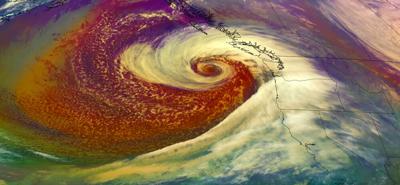
The National Oceanic and Atmospheric Administration (NOAA) defines a bomb cyclone — also known as a bombgenesis — as a cold air mass that collides with a warm air mass, like air over warm ocean waters. Another criteria is a rapid drop in atmospheric pressure. It must drop at least 24 millibars in 24 hours. A millibar is a unit of atmospheric pressure, and the atmosphere can typically be measured at 1,013 millibars.
National Oceanic and Atmospheric Administration graphic
The National Oceanic and Atmospheric Administration (NOAA) defines a bomb cyclone — also known as a bombgenesis — as a cold air mass that collides with a warm air mass, like air over warm ocean waters. Another criteria is a rapid drop in atmospheric pressure. It must drop at least 24 millibars in 24 hours. A millibar is a unit of atmospheric pressure, and the atmosphere can typically be measured at 1,013 millibars.
National Oceanic and Atmospheric Administration graphic
THE GORGE — The Pacific Northwest and the Columbia River Gorge have experienced two significant weather episodes over the past week. Starting last Tuesday, a phenomenon known as a “bomb cyclone” made landfall along the northern Oregon Coast, bringing gale-force winds and heavy rainfall. Two days later, a long plume of moisture called an atmospheric river brought threats of flooding, landslides and snow in higher elevations to Northern California and southwest Oregon. Atmospheric rivers originate from the tropics and can stretch for thousands of miles.
Jon Liu, meteorologist at the National Weather Service (NWS) in Portland, said these two different weather phenomena are more common than people might think.
“They’re not particularly rare. Typically, you’ll see them maybe once or twice per season; maybe not always impacting our area, but I would say they’re not actually incredibly rare,” Liu told Columbia Gorge News.
The National Oceanic and Atmospheric Administration (NOAA) defines a bomb cyclone — also known as a bombgenesis — as a cold air mass that collides with a warm air mass, like air over warm ocean waters. Another criteria is a rapid drop in atmospheric pressure. It must drop at least 24 millibars in 24 hours. A millibar is a unit of atmospheric pressure, and the atmosphere can typically be measured at 1,013 millibars.
“An atmospheric river is essentially a weather system that’s backed up by a lot of moisture coming from warmer latitudes,” Liu said. “What that essentially means is its sort of like transport system for moisture from the more tropical latitudes up to a higher latitude like ours.”
On Tuesday night, 35 mile-an-hour winds battered the Gorge, and rain fell for an extended period of time. Liu said there was no threat of flooding in the Mid-Columbia region, but electric cooperatives in Hood River County reported higher than usual power outages. A Hood River Electric Cooperative spokesperson said there were 549 reports of flickering lights and power outages in homes across the Hood River Valley. Most of the outages on Tuesday were a result of crews shutting down power to repair tangled power lines. Another outage occurred in Hood River County on Thursday afternoon, with another 544 customers without power — the most in the state at that time.
Is there a bright side?
Atmospheric rivers can benefit certain areas, according to Liu. The weather can bring much needed water to vegetation, it can replenish streams and rivers and build snow pack in higher elevations.
“It does produce a lot of rain, so I could see a scenario where, let’s say it’s been pretty dry for some time … that could maybe have some benefits,” Liu said.
The low-pressure systems tend to produce cooler temperatures and snow at higher altitudes.
Skiers and snowboarders can rejoice, because resorts on Mount Hood have opened early thanks to the wet weather. Timberline Lodge reported enough snow to open on Nov. 9 and Mt. Hood Meadows held their Preview Weekend on Nov. 15-17, the earliest in 15 years. Last week, the NWS issued winter storm warnings for the Cascade Mountain Range above 2,000 feet. Liu said that some areas received a foot of snow due to the storm systems.
“That’s probably the reason that a lot of these ski lodges are opening up earlier,” Liu said.
Rain continued through Friday, but the weather calmed over the weekend. For the most updated weather forecasts visit www.weather.gov.



Commented