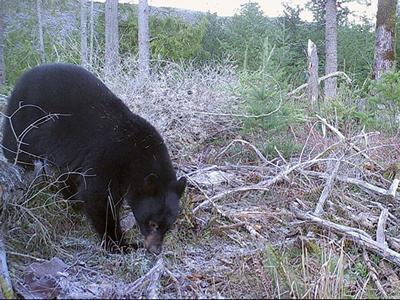
THE GORGE — White Salmon police officers responded to a small bear standing on Jewett Boulevard May 30, apparently unafraid of the passing vehicles. “Seems to be the same bear that has been seen several times recently in the same area,” said Officer Sauter in a media log. As usual, Washington Department of Fish and Wildlife (WDFW) was notified.
WDFW Wildlife Conflict Specialist Todd Jacobsen was not surprised. “I will get, usually, multiple reports of two to three to four bears a year in White Salmon,” he said.
This happens in every population center in good bear habitat like White Salmon, surrounded by forests, orchards, and water, according to Jacobsen. It’s pretty easy for a bear to “wander one property over and find itself in town.”
“In the wild, bears work hard to find natural foods,” reports BearWise.org. “When bears use their amazing sense of smell, great memories and impressive strength to forage in communities, they can become destructive, aggressive and potentially dangerous.”
How dangerous? Not very much, Jacobsen said.
A bear injuring a human is “extremely rare, but that doesn’t mean that people should approach bears,” he said. Usually, city visitors are younger bears, “more inquisitive or naive and less adept at finding food,” he said. In other words, small “walking stomachs” mostly focused on munching the maximum number of calories before November hibernation. Humans, apparently, rarely present as attractive calories.
“If you go out and yell and bang pots and pans and make a lot of noise, a bear might take off,” Jacobsen said. He requested people contact WDFW’s wildlife dispatch upon spotting an urban bear. Then, just give the animal space; if there aren’t any easy garbage snacks available, they will usually leave town under their own power.
Nonetheless, if a bear decides to settle in town and cause a nuisance or property damage, Jacobsen will catch it and take it back to the woods.
“I think two years ago, I had to catch two bears in White Salmon. I think it was a pair of siblings, and it took me a month or so to catch both bears,” he sighed. “But they had decided that they likedliving in town, and needed help getting out of town.”
Garbage, bird seed, livestock and chicken feed, and fruit trees are the biggest attractions for these omnivores. They’ll also eat beehives.
Intentionally feeding bears is illegal in Washington and Oregon.
Jacobsen hopes to organize an official BearWise Community designation for White Salmon, which would take coordination with landowners, the municipality and the garbage service. BearWise is a program run and funded by a nationwide association of local fish and wildlife agencies.
He said the main challenge is reaching the thousands of people in who live in Klickitat and Skamania counties, including through mailing info to specific zip codes, giving presentations, and talking to local residents.
“I field roughly between 75-150 bear calls a year in the Gorge, so it’s all there. Bear issues are everywhere,” Jacobsen said. “People think that it always happens to somebody else, and eventually they become somebody else.”



Commented