THE GORGE — Two little owls fell out of a tree; one got re-nested, but the other encountered a bb gun and some motor oil, and faces rehabilitation in captivity.
In late April, wildlife conflict specialist Todd Jacobsen responded to a “little downy owl” on the ground in Dallesport.
Jacobsen, who works for Washington’s Department of Fish and Wildlife (WDFW), sent photos to wildlife rehabilitator Ash Harris, who runs Mountain Top Wildlife clinic near White Salmon.
While hopping on the ground is normal for fledgling Great Horned Owls, this one was far too young for that — probably about 4 weeks old, Harris said.
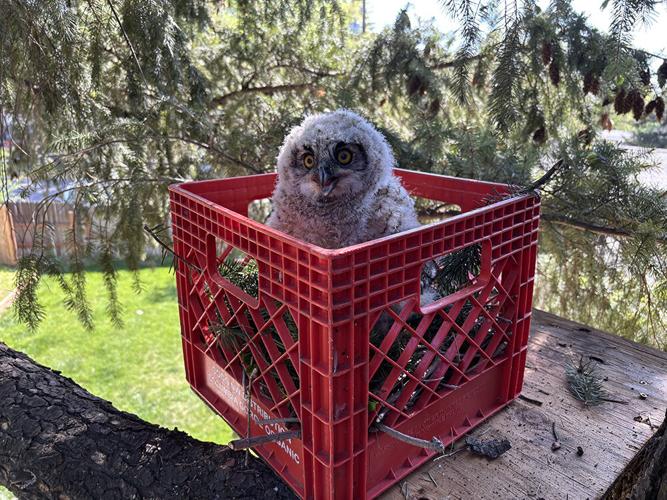
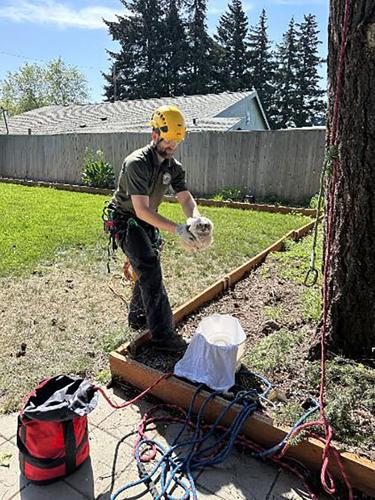
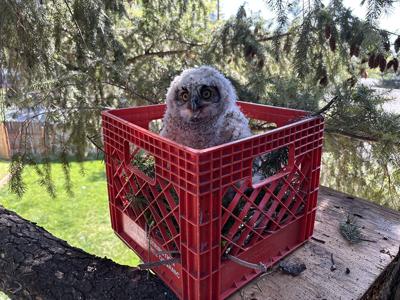
It was a hot day, flies buzzing around the nestling. So the landowner and Jacobsen screwed together a makeshift nest from an old milk crate and plywood and stuffed it with twigs. Jacobsen put on his climbing gear and hoisted nest, then bucketful of owl, 20 feet into a Douglas fir tree.
The owl parents watched, exchanging communicative beak-clicks with the nestling, and later visited the milk crate with food. Landowner Christian Coe said the baby stayed there into May, fledging normally. Then the family vanished from sight — but Coe still hears hooting, and owl pellets still fall on his car.
A couple weeks later, Jacobsen responded to another call on the same Dallesport street: Another grounded owlet, flight feathers nearly grown, was having an altercation with a dog.
“Great Horned Owls protect a territory that’s over a square mile, so there would not be another great horned owl nest in the area,” Harris said. The first owlet was still safe at Coe’s house, so this had to be a sibling.
Lifting the roughly 6-week-old fledgling into a tree (with a ladder this time), Jacobsen found his hands soaked in motor oil. Checking the owl again, he found it soaked in oil too, with two small wounds he thought were dog bites. He tried a soapy bath, but couldn’t get the bird clean.
WDFW Wildlife conflict specialist Todd Jacobsen, absent a ladder, prepares to climb up and hoist the first owlet back into its probably nest tree.
Photo courtesy Christian Coe
So he took it to Harris.
Mountain Top is allowed to accept oiled animals for stabilization, which includes cleaning the eyes and nose and giving fluids. Harris must also report incidents to WDFW and to an oil spill hotline.
For further care, the owlet needed transferring to the PAWS clinic, four hours away in Washington. Volunteer Carol Breem dropped everything to take it there.
PAWS is supervised by an oil spill response organization, and has a special washroom that handles hazardous waste. There, X-rays found the owlet had been shot twice with a bb gun, once in the chest and once in the neck. One wing-bone was fractured. Only one of the bb’s could safely be removed.
To shoot an owl is a federal crime — they are protected under the Migratory Bird Treaty Act of 1918. But unless someone reports who fired the shot, not much can be done, Jacobsen said.
“Since fledglings live on the ground for a while, they hop around, walk, perform short flights. So it must have walked through motor oil that was spilled or wasn’t cleaned up properly, and then, couldn’t move as well. Its legs, its stomach, its flight feathers on its wings were all covered in motor oil,” Harris said.
Oil had filled the hollow shafts of growing feathers. It might damage them. If the feathers can’t grow properly, the owlet can never be released.
It’s just “one thing after another” for this owl family, Jacobsen remarked. “These are the only owls I’ve dealt with this year. Bad luck. Or just mischievous owls.”
Disposing of hazardous waste keeps wildlife safe, Harris said. That includes rodent poisons and pesticides. “A good rule of thumb to follow is, if you wouldn’t want a family member to touch or taste it, it’s not safe to use in areas where wild animals can come across it,” Harris said.
She added, “I knew oiled wildlife were harmed from being covered in oil, but I wasn’t aware of the extent of the external and internal effects oil can have on wildlife. Some of the external effects, like feather and fur damage, skin burning, damage to vision; and then the internal effects can be so dire — respiratory damage, gi damage, liver and kidney damage, especially if they consume the oil or just get very dehydrated from the process. And then even blood cell damage, which leads to anemia. So it’s important to get them treatment right away.”
Harris hopes to work toward an endorsement that would allow Mountain Top to treat oiled animals in the clinic’s hospital, which will be constructed in the next few years.
She encouraged anyone who finds any sort of damaged wildlife to call Mountain Top at 541-615-1565 or mountaintopwildlife.org. She added staff will not judge people for causing accidental injury to wildlife: “We educate the public when we can, but we do not preach or judge.”
Currently, Mountain Top accepts small mammals, fawns, all songbirds and small and medium raptors. “We’re about two weeks away from finishing our 21-square-foot raptor flight, and once that’s finished, will submit our permitting paperwork to accept large raptors,” said Harris. With that, she’ll be able to treat big birds like pelicans, hawks, osprey, eagles, and waterfowl.



Commented